BiblePlaces Newsletter

Vol 24, #2 - November 3, 2025

Twenty-five years is, by some standards, a long time to be doing one thing, and when I think about various Bible resources and related ministries that have come and gone, I am thankful that the Lord continues to sustain our work of creating photo collections.

Our initial photo collection, released in January 2000, provided 1,600 photos in 4 volumes, covering all of Israel, Jordan, and Egypt. Twenty-five years later we are releasing a single volume with the same number of photos, all to illustrate a single book of the Bible, the book of Job.

Job is not the first book many people would expect to illustrate visually, and it’s not where we started. (Our first volumes were Gospels, Acts, and the historical books in the Old Testament.) But Job is filled with imagery, just like the other poetic books of Scripture, and photos go a long way in closing the distance of time and space.

You can get a taste of what I mean in the description and photos below, as well as in the free Job 6 PowerPoint. We are reducing our launch price in gratitude to you, the readers of this newsletter and our long-time supporters.

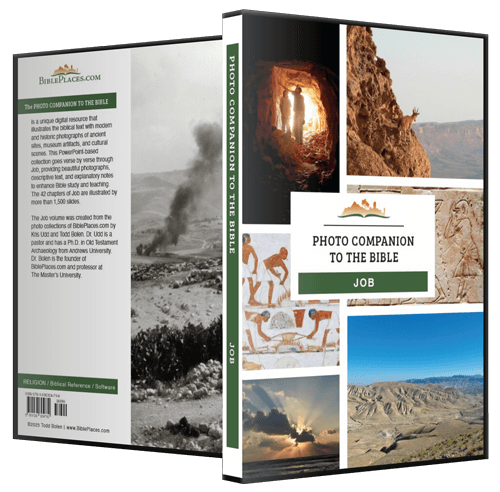
The sale price of $29 provides you with 42 PowerPoint files—one for each chapter of Job—with more than 1,600 images. You can purchase this volume as a DVD+download or as download-only.

Finally, I’ll note that this volume was prepared in conjunction with my teaching through the book at church over the course of a year. If you would like my teaching handouts, send me an email (or reply to this newsletter), and I’ll be happy to send you the 260-page pdf. May the Lord continue to bless your study and ministry of his glorious Word.

Todd Bolen
Photographer, BiblePlaces.com
Professor of Biblical Studies, The Master’s University

Job

When the wisest men of Job’s day gather to explain Job’s inexplicable suffering, they are quick to draw on imagery from their world. These men are students of science, history, and philosophy, and they have a knack for using metaphors to crush their friend. Job returns fire, disgusted with his friends whom he deems to be “waterless wadis.” When Elihu and the Lord speak, they too draw on the world of nature to correct Job and his friends. Our new Job volume provides more than 1,600 slides, including: 

  • Photos and discussion of possible locations for the land of Uz

  • Ancient depictions of sheep, camels, oxen, donkeys, and servants

  • Imagery of feasting, sacrifices, and offerings

  • Examples of mines for iron, silver, gold, and other commodities

  • Photos of precious materials, including amethyst, lapis lazuli, and pearls

  • Historic photos of ancient building techniques and examples of tools for construction

  • Archaeological reconstructions and artistic depictions of storehouses

  • Imagery of lightning, dew, frost, stars, and other phenomena referenced in the Lord’s speech

  • Photos of lions, ravens, ibex, ostriches, and eagles

  • Proposals for the identification of Behemoth and Leviathan

  • Free download: Job 6 (40 slides)

Everything is organized by chapter and book, so you can find what you’re looking for in seconds. The PowerPoint format makes it easy to view on your computer, to copy to your own presentations, and to teach others.

Purchase Job today for $29: DVD+download or download-only.

What Others Say...

“The Photo Companion to Job opens new windows into an old and often daunting book. With its rich collection of images—from animals and minerals to storms and stars—it gives readers visual entry points that deepen both understanding and delight. A superb tool for teachers, preachers, professors, and anyone eager to understand Scripture more deeply.”

—Douglas Sean O’Donnell, Senior Vice President of Bible Editorial and Church Resources, Crossway Books; author of many commentaries on the Bible, including two on the book of Job

“I would again like to express my appreciation for your photo collections. As a pastor, they have been incredibly valuable in adding cultural and geographical depth to the Sunday sermons.”

—Pastor Torrey House, Creekside Bible Church

The Photo Companion to the Bible

Old Testament (17 volumes): Genesis, Exodus, Joshua, Judges, Ruth, 1 Samuel, 2 Samuel, 1 Kings, 2 Kings, Ezra, Nehemiah, Esther, Job, Psalm 23, Ecclesiastes, Song of Songs, Daniel

Old Testament Special: $299
(with coupon 25YEARSOT)

New Testament (19 volumes): Matthew, Mark, Luke, John, Acts, Romans, 1 Corinthians, 2 Corinthians, Galatians, Ephesians, Philippians, Colossians and Philemon, 1 & 2 Thessalonians, 1 & 2 Timothy, Titus, Hebrews, James, 1 & 2 Peter, Jude, 1, 2, & 3 John, and Revelation

New Testament Special: $349
(with coupon 25YEARSNT)

Old and New Testament Special (36 volumes): $549
(with coupon 25YEARSPCB)

ULTIMATE TEACHING SET (All 76 volumes): $699
(with coupon 25ULTIMATE)

Throughout the Week

We are doing some new things on Facebook, X, and Instagram. Follow us to see the latest photos and videos.

Every Weekend

Every weekend I write about the latest discoveries and stories in archaeology, geography, and tourism related to Israel, Egypt, Turkey, and the rest of the biblical world. Visit www.bibleplaces.com/blog to catch up or subscribe by email.

Featured BiblePlaces Photos:
Job

The book of Job is widely regarded as one of the greatest literary masterpieces of all time. Set outside of Israel in the era of the patriarchs, the book is an eloquent investigation into the nature of God and the manner in which he rules the world.

The featured photos this month come from the new Job volume of the Photo Companion to the Bible. For more free photos, download the Job 6 PowerPoint (40 slides). These and more than 1,600 photos are included in the new Job volume in the Photo Companion to the Bible.


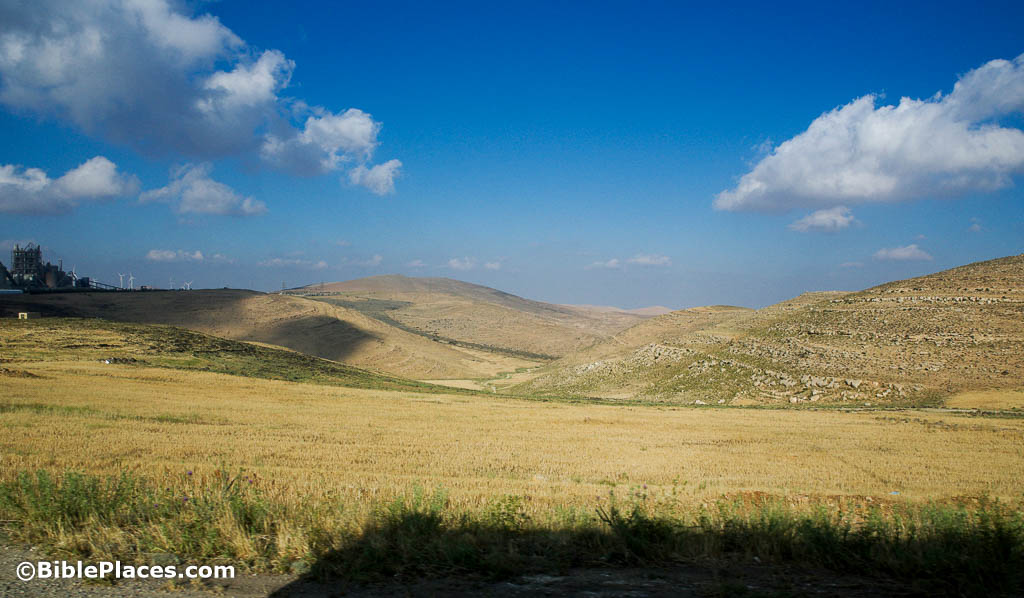
"There was a man in the land of Uz whose name was Job"

Click photograph for higher-resolution version.

The location of the land of Uz is uncertain (Job 1:1). The Edomite plateau, shown here, would fit most of the clues in the book (farming, rivers, hills, towns, thunderstorms, even occasional hail and snow). Job’s great livestock holdings would indicate a pastoral setting, although urban references (gates, walls, nearby neighbors) would suggest something other than raw wilderness. A connection between Edom and the land of Uz also appears to be made in Lamentations 4:21, “Rejoice and be glad, O daughter of Edom, who dwells in the land of Uz.”

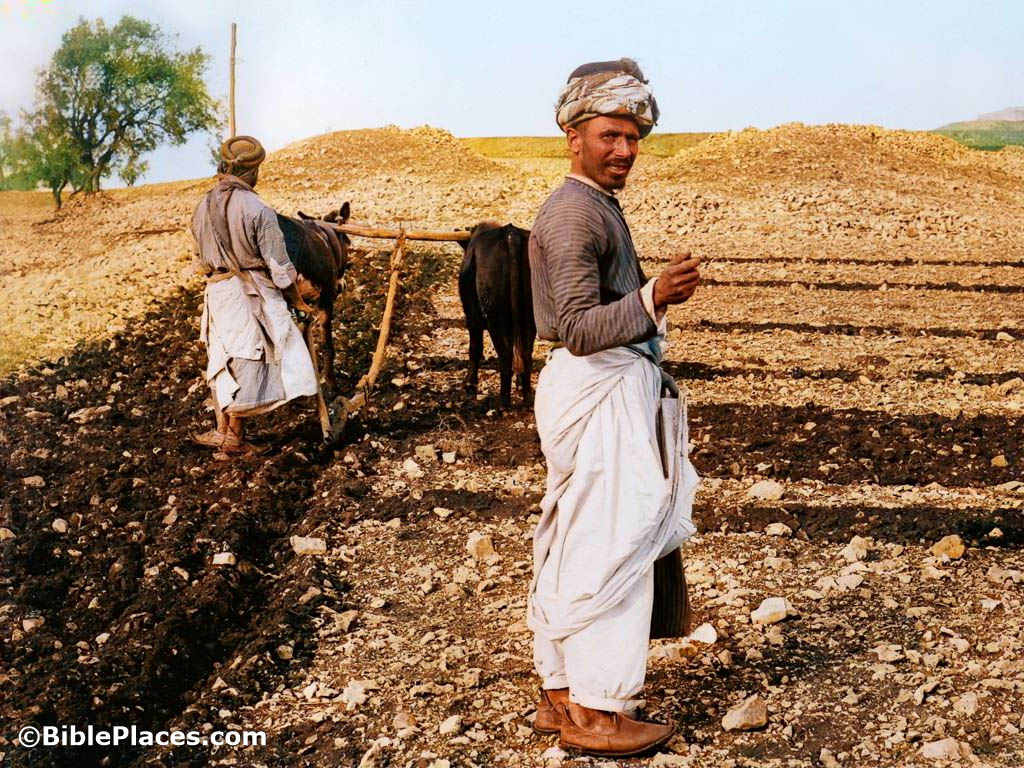
"Those who plow iniquity and sow trouble also harvest it"

Click photograph for higher-resolution version.
According to Job’s friends, God’s world operates according to a strict system of cause and effect (Job 4:8). One example that Eliphaz gives is from agriculture. Plowing was usually necessary to loosen the soil for the planting of seed. The method used by these two men is quite similar to the way in which the ancient Israelites would have plowed their fields in preparation for planting. Similarly, Job’s misfortunes can only be explained, his friends claim, as the harvest that results from Job’s secret sins. This American Colony photograph was taken between 1900 and 1920 and colorized by generative AI.

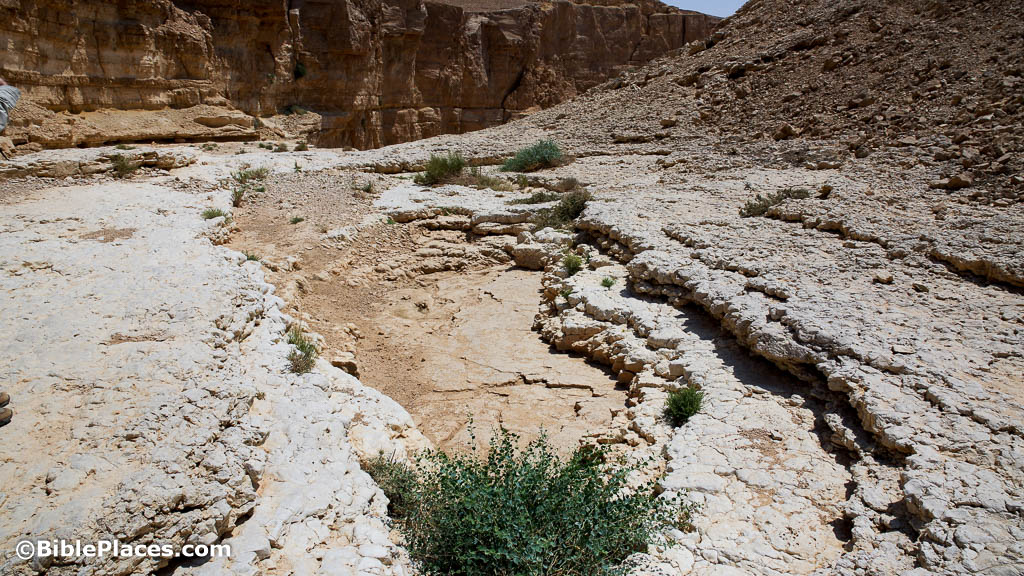
"But my brothers have been like a treacherous wadi"

Click photograph for higher-resolution version.

Like his friends, Job uses many metaphors from nature, including comparing his friends to a treacherous wadi (watercourse; Job 6:15). At the end of his own resources, Job was hoping for steadfast love (hesed) from his friends, but they have failed him. Job uses an extended metaphor to compare his friends to a Middle Eastern wadi which overflows with water in the winter but then completely dries up in the summer. Job compares himself to a caravan that travels off the route in desperate search of water only to arrive at a wadi and find it bone dry. His friends are like these worthless wadis, of no help in Job’s time of desperate need. Nahal Qetura, shown here, is a wadi located on the west side of the Arabah, a few miles north of the Timna Valley and in the possible region of the land of Uz.

"Surely there is a place where silver is mined, and another where they refine gold"

Click photograph for higher-resolution version.

One of the most beautiful chapters in the book, Job 28 is a wisdom poem that marvels over man’s ingenuity in extracting precious metals from the earth (28:1). Man has located the sources of treasures like silver and gold as well as practical metals like iron and copper. These resources are hard to find, buried in deep darkness far below the earth’s surface. By traveling into remote areas and sinking shafts into the ground, man discovered these treasures of tremendous value.

As great as man’s ability is to discover hidden riches, he has utterly failed to locate the subterranean vein where wisdom is buried. No mine shaft has ever been sunk to bring understanding out of the earth. True wisdom, Job declares, is found only in the Lord, and only the man who fears him is truly wise.

The ancients were not only skilled in discovering these precious metals but also in refining them. This relief shows various steps in the process of refining ore to metal in an Egyptian workshop. There are two sets of men at the left who are working the bellows for furnaces, using foot-powered pumps. On the right they are pouring molten metal into molds. This wall painting is located in the tomb of Rekhmire, the “Governor of the Town” at Thebes (modern Luxor).

"It cannot be valued with the gold of Ophir, or with amethyst or lapis lazuli"

Click photograph for higher-resolution version.

Ophir is mentioned thirteen times in the Bible, and each reference is related to gold (e.g., Job 28:16). The exact location of Ophir is uncertain, but it seems to have been located in south Arabia or east Africa. Solomon had a fleet of ships in the Red Sea that brought gold from this area (1 Kgs 9:26-28).

Lapis lazuli was transported along trade routes all over the ancient Near East and was as popular in Mesopotamia as it was in Egypt. The famous funerary mask of Tutankhamun made liberal use of both gold and lapis lazuli. By contrast, the book of Job says, wisdom is supremely more valuable.

This necklace consists of lapis lazuli beads and gold triangles. It was photographed at the Bible Lands Museum in Jerusalem.

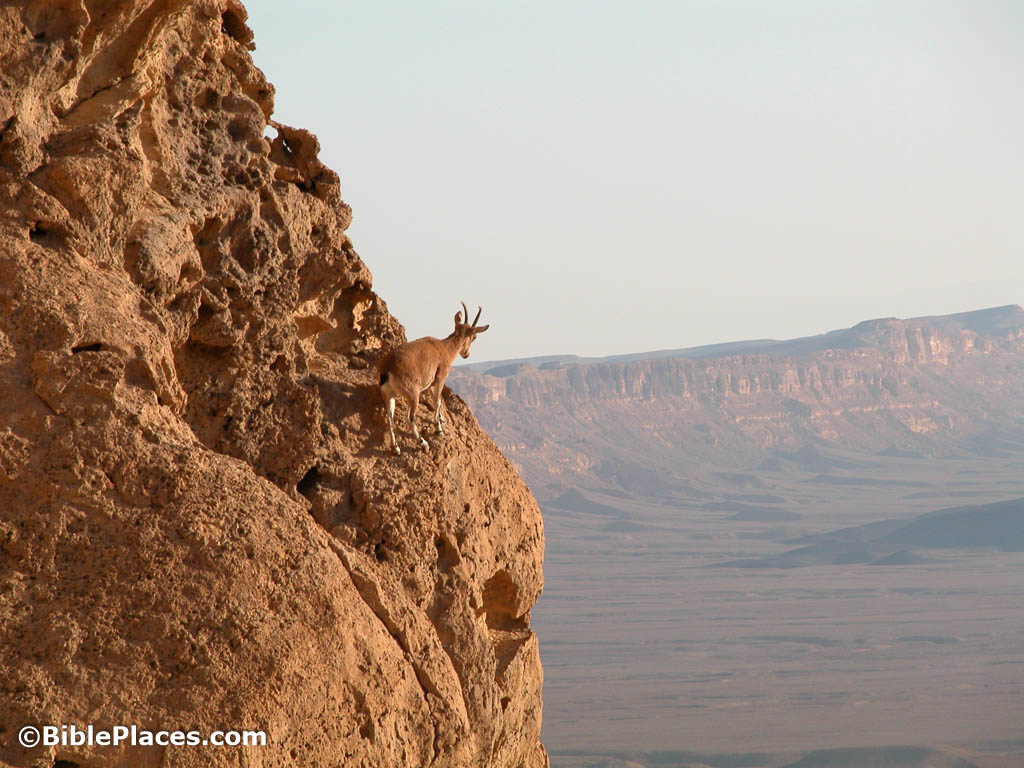
"Do you know when the mountain goats give birth?"

Click photograph for higher-resolution version.

As Job and his three friends wrestle with the question of Job’s suffering, everyone has assumed that man’s wisdom is sufficient to explain it. To the three friends, Job’s suffering is caused by his sin. But Job believes that his suffering can only be explained as divine failure. When God finally speaks, he explodes the retribution principle as the governing paradigm of the world. By asking seventy rhetorical questions, Yahweh exposes the severe limitations of human wisdom. In one of those questions, the Lord asks Job if he knows when the ibexes give birth (Job 39:1). Since Job does not know this or so many other realities in creation, he has no right to question God.

Ibexes are beautiful creatures that are quite elusive to man, and while Job may have caught a glimpse of one coming to a spring for water, he surely has not been able to follow them to their homes and watch them bear young. Job knows nothing about the gestation cycles of ibexes, and yet God watches over them with great care, from conception to birth to adulthood.

Although ibexes are found in groups during much of the year, females leave the herd to give birth in a secluded place. It is now known that ibex gestation lasts about 5 months. This photo of a young ibex was taken at Makhtesh Ramon in southern Israel.

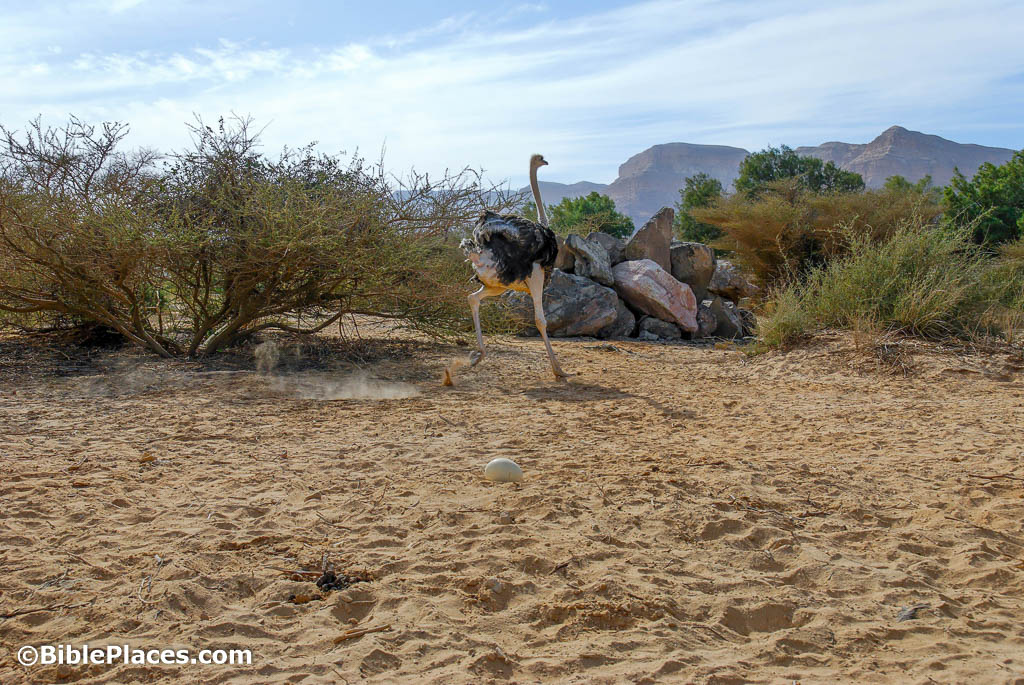
"She abandons her eggs on the ground and leaves them to warm in the dust"

Click photograph for higher-resolution version.

When God questions Job about the ostrich, he observes that this creature’s design is utterly contrary to what man in his wisdom would create (Job 39:13-18). The ostrich has wings but cannot fly. Confined to the ground, it must lay its eggs in the sand, but it is not mindful of them being trampled by the beasts. This is because God did not give the animal wisdom. Would Job ever create such a creature? And yet, in his divine pleasure, God made this goofy-looking creature unbelievably fast, leaving horse and rider in its dust.

Ostriches do have a tendency to abandon their eggs, simply letting them lie on the ground as shown here. This photograph was taken at the Haibar Nature Reserve in southern Israel.

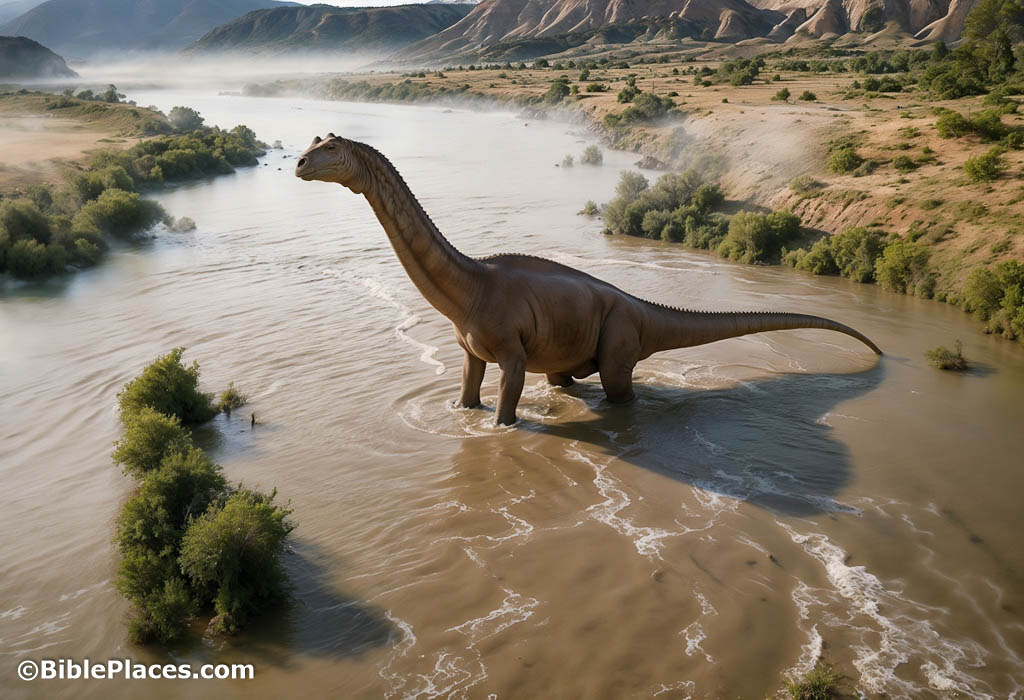
"Behold now Behemoth, which I made as well as you"

Click photograph for higher-resolution version.

The identity of “Behemoth” is controversial (Job 40:15). Some scholars consider it to be a fictional or mythical beast. Others seek to identify it with an animal still living today; the most common suggestion of this view is the hippopotamus. Other proposals include the elephant and water buffalo.

Another approach is to identify Behemoth with an animal that has since become extinct, such as one of the sauropod dinosaurs. Sauropods had long necks and tails, a large body cavity, relatively small heads, and four pillar-like legs. Some of the larger specimens are estimated to have stood over 70 feet (21 m) tall, as much as 150 feet (46 m) long, and to have weighed as much as 80 tons (72 t). Their teeth indicate that they were herbivorous.

Our collection includes dozens of photographs of all of the proposals, along with images such as this one created with generative AI showing a dicraeosaurus, a genus of sauropod dinosaur.

This week we are offering Job for only $29, including immediate download and free shipping (reg. $59). This collection includes more than 1,600 PowerPoint slides illustrating each chapter verse by verse. Purchase this today as a DVD+download or as download-only.

Share This Newsletter

Do you know someone who would enjoy this newsletter? Please pass it on to friends whom you think might appreciate it. They can subscribe here

The BiblePlaces Newsletter is cost-free and spam-free. Email addresses will never be used for any purpose other than this newsletter. If you have questions about the subscription process, see this page.

All contents © 2025 Todd Bolen. Text and photographs may be used for personal and educational use with attribution. Commercial use requires written permission.