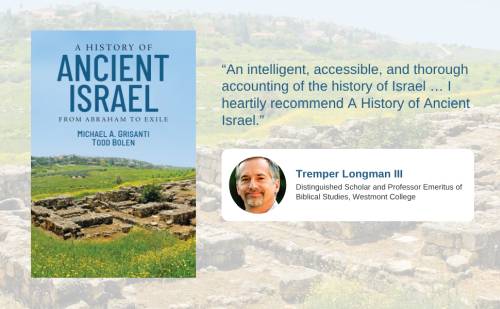
When reading a book, I often jot a short evaluative comment at the end of each chapter to remind my future self of its value and potential use in teaching or elsewhere. If I were making such notes for my own new book, A History of Ancient Israel, I would give the chapter on Ahab and Jehoshaphat one of my highest marks.
What I mean is that this era of history, beginning with Ahab’s father Omri, is so greatly illuminated by archaeological discoveries, geographical understanding, and chronological connections. It is only when you bring the evidence together that you can identify historical realities otherwise lost to time.
Let me illustrate this with some chronological discoveries I made. It’s worth noting from the start that these discoveries depend upon the reliability of Scripture. I suspect that one reason some of these connections have been overlooked is that many scholars who have studied this period have not regarded the biblical chronological data as sufficiently reliable to build upon. If you are unwilling to trust the biblical records, you are unlikely to discover what emerges when the chronological details are brought together.
Another reason, to be sure, is that it took scholars a while to figure out how to interpret the chronological records of Kings and Chronicles, recognizing the use of such things as coregencies and accession-year and non-accession-year reckoning. But the work of several generations has brought us to a point where I think we can say there is broad agreement among Bible-believing scholars, with relatively few points still debated.
But what I’ve done in my study of the era of Ahab and Jehoshaphat is to go beyond dates that the kings ruled to build a detailed chronological reconstruction of what happened, year by year. That means factoring in the years that kings were born and married, when their children were born, when they went to battle, when famines occurred, and so on. Sometimes that leads to fascinating insights.
For example, we can better understand the details of the alliance between Israel and Phoenicia that was sealed by the marriage of Ahab and Jezebel. I date this marriage to about 878, around the time when Jezebel’s father Ethbaal became king of Tyre. Ahab and Jezebel’s daughter Athaliah must have been something of a “honeymoon baby” if she was to marry Jehoshapat’s son Jehoram in time for their son to be of sufficient age to become king of Judah before Jehu killed him in 841.
The alliance between Ahab and Jehoshaphat, king of Judah, came in two stages, beginning with the marriage of Athaliah and Jehoshaphat’s son Jehoram in about 866. At this point, Israel and Judah were commercial allies only. Jehoshaphat apparently only grew comfortable with a military alliance thirteen years later when he joined Ahab in fighting the Arameans at Ramoth Gilead, an engagement that ended with Ahab’s death from a seemingly random arrow.
One of the most surprising discoveries of my study was seeing just how much happened within one year of Ahab’s death in 853: Moab immediately rebelled, Judah was invaded by a coalition from across the Dead Sea, Jehoshaphat and Ahaziah attempted a maritime venture, Ahaziah died, and a seven-year famine began. The Bible does not explicitly bring these events together, but a careful chronological reconstruction reveals that they were all unfolding in the same tumultuous year.
There is much more that I could discuss, but I’ll end with a few observations about the ministries of Elijah and Elisha. First, their ministries overlapped more than most readers realize. On the chronology I reconstruct, Elijah sent a letter to Jehoram about five years after Elisha participated in the campaign against Moab. This may be surprising to those who assume that the events of 2 Kings 2–3 are presented in chronological order. Second, it is possible to place all of the recorded events of their ministries into a coherent chronology without dismissing any of the biblical accounts as historically unreliable.
I’m referring to dating the three-year famine (ca. 861–858) prior to the contest on Mount Carmel (ca. 858), followed by the three Aramean campaigns (857–853). Elisha’s ministry began ca. 854, a seven-year famine began ca. 852, the servant girl in Naaman’s house was captured ca. 850, Aramean forces came knocking on Elisha’s door ca. 847, Elijah ascended to heaven ca. 845, Naaman was healed ca. 844, and Elisha foretold Hazael’s accession ca. 843.
In the book, I explain the rationale for this historical sequence and provide detailed charts with all of the dates. I may have goofed in places, but that’s part of the nature of scholarship: I’ve learned much from others, and I hope that others will build upon—and correct, where necessary—the work I’ve done.
I started this post expecting to write not only about chronological discoveries but also about geographical insights as well as the wonderful archaeological discoveries relevant to Ahab and Jehoshaphat (ivories!, water systems!, stables!, etc.). But chronology proved more than enough for one post, and the rest will have to wait. It is always better for the writer to be finished writing before the reader is finished reading.