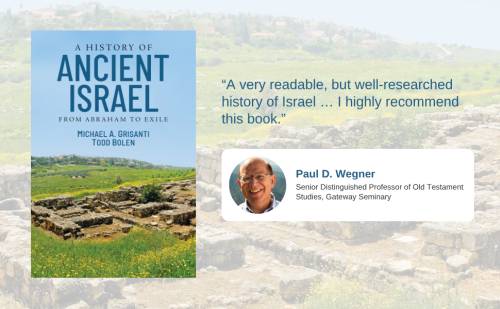
If you are looking for an era of Israel’s history where archaeological discoveries and extrabiblical records have much to contribute to the biblical account, the reigns of Hezekiah and Manasseh are hard to beat. Archaeologists have found an enormous amount of evidence in Jerusalem and throughout the land of Judah, and the Assyrian records are abundant, both in inscriptions and visual depictions. The challenge of reconstructing this era is not that so little evidence has survived, but that so much has—and the surviving records do not always agree.
One of the most challenging historical knots I worked to untie concerns Sennacherib’s invasion of Judah. Some things are clear, including Sargon’s death in 705, which sparked a widespread revolt against Assyrian rule. I think it’s also clear that the accounts in 2 Kings 18–20 and Isaiah 36–39 are not arranged chronologically. Hezekiah’s illness must have preceded the defeat of the Assyrian army, as indicated by God’s promise during the illness that he would deliver Jerusalem from Assyria
But when did Hezekiah pay tribute? Before Sennacherib invaded or after? The biblical account places it before the Assyrian threat to Jerusalem, but Assyrian texts state that Sennacherib received it after he returned home. I think I’ve found a convincing solution. In the book I explain why Hezekiah made a conditional offer of surrender that was refused, but he later followed through with his commitment to send tribute. I also argue that Sennacherib never subjected Jerusalem to a full-scale siege. That seems to be a common assumption, but a blockade is quite different than a siege.
Few events in ancient Israel’s history are as richly documented archaeologically as the Assyrian invasion and Hezekiah’s preparation for it. Much of this is familiar to those well-versed in the subject, but I relish walking the reader through the discovery of the Broad Wall, the importance of the lmlk inscriptions, and the famous tunnel of Hezekiah with its inscription. The Lachish siege reliefs are the most impressive visual witness to life (and death) in ancient Judah, and what makes them even more remarkable is that archaeologists have uncovered specific features depicted in those reliefs, including the massive Assyrian siege ramp. Decades of excavation have revealed destruction layers at some of the forty-six cities of Judah that Sennacherib boasted of conquering.
Manasseh’s fifty-five-year reign fell under the shadow of Assyria and caused irreparable damage to Judah, and I’ve tried to bring together the surviving evidence for this era. One of the most intriguing questions concerns the historicity of Manasseh’s deportation to Babylon, his repentance, and his subsequent return to Jerusalem. I argue that Manasseh was deported around 648 BC, right at the time when Ashurbanipal had suppressed a major Babylonian rebellion. I also point to Assyrian precedents for restoring a king to his throne, and I explain how Manasseh’s repentance shortly before his death helps explain why his reforms were so limited.
The era of Hezekiah and Manasseh illustrates particularly well how our understanding of the biblical account is enriched by a careful study of Israel’s geography, Assyrian history, and the archaeological record. The ancient writers left much out, often pointing readers to the annals of the royal courts. But those royal annals are lost and the courts themselves long since destroyed, so we have to do a lot of digging, both textually and archaeologically, to recover the history that the original readers knew so well. In my experience, the rewards are well worth the effort.