Discoveries:
Tablets excavated at Gezer and the nearby Tel Hadid indicate that Israelites were not living in the area following the Assyrian invasions in the late 8th century BC (Haaretz premium).

A new study by Tel Aviv University has determined that the kingdom of Edom was flourishing in the 12th and 11th centuries BC, led in part by a high-tech copper network. The underlying journal article is available here.

Tin ingots from the 13th-12th centuries BC discovered near Haifa were apparently mined in Cornwall, England.

“Egyptian authorities have unintentionally discovered several historical monuments dating back to the Greco-Roman and Ptolemaic era in roughly 20 archaeological sites in the east and middle of Alexandria.”

A temple of Ptolemy IV was discovered in northern Sohag, Egypt, while drilling for a sewage drainage project.

An archaeologist in Aphrodisias, Turkey, discovered a Roman milestone that had long been used as a table base in a coffee shop.

Excavators continue to work to expose the forum area in ancient Alexandria Troas.

Nadav Shragai reports on the Adonijah seal impression and other discoveries that have come as a result of the excavations at the foundations of the western wall of the Temple Mount.


Museums and Exhibits:
The Bank of Israel in Jerusalem has opened an archaeological exhibit featuring “several spectacular ancient coin caches,” one of which includes more than 10,000 large coins.

Two Roman statues discovered last year near Beth Shean are joining the permanent collections of the Gan Hashlosha–Sahne Museum.

The largest-ever exhibition of treasure from King Tut’s tomb will be on display at the Saatchi Gallery from November 2, 2019 to May 3, 2020.

The Palestinian Museum in Bir Zeit recently won the Aga Khan Award for Architecture. The museum does not have a permanent collection.

New York’s Metropolitan Museum is returning a beautiful gold coffin of a high-ranking priest to Egypt after learning the item was stolen and its import papers forged.


Books:
Available at a pre-pub discount on Logos: Zondervan Handbook of Biblical Archaeology, by Randall Price and Wayne House.

Two new books from the Oriental Institute:

  • Discovering New Pasts: The OI at 100, edited by Theo van den Hout. Purchase ($134). Free download.
  • 100 Highlights of the Collections of the Oriental Institute Museum, edited by Jean M. Evans, Jack Green, and Emily Teeter. Purchase ($80). Free download.

The Times of Israel reviews Jodi Magness’s new book, Masada.

The German Protestant Institute of Archaeology in the Holy Land (GPIA) has produced a catalogue of the exhibition “Tall Zirā’a—Mirror of Jordan’s History.”

In tomorrow’s roundup, we’ll cover tourism, lectures, and videos.

HT: Agade, Joseph Lauer, Ted Weis, Keith Keyser, Explorator, Jared Clark

I mentioned in my introduction to this book that Ancient Jerusalem Revealed really provides a “who’s who” in modern Jerusalem archaeology. Dan Bahat is another well-known name, having served as district archaeologist of Jerusalem for some years and having written the Illustrated Atlas of Jerusalem. Bahat is also known for his excavations of the Western Wall Tunnel, and this article provides information from more recent work.

The main point that Bahat wants to make in this article is that Amos Kloner is wrong about the dating of the arched bridge that begins with Wilson’s Arch and runs west. All agree it originally dates to the Herodian period and was destroyed by the Romans. Kloner challenged Bahat’s dating to the Umayyad period, proposing instead that was rebuilt in the Late Roman period (AD 70-330). Bahat is back to prove that he was right all along. This debate does not interest me much, so I’m going to move along.

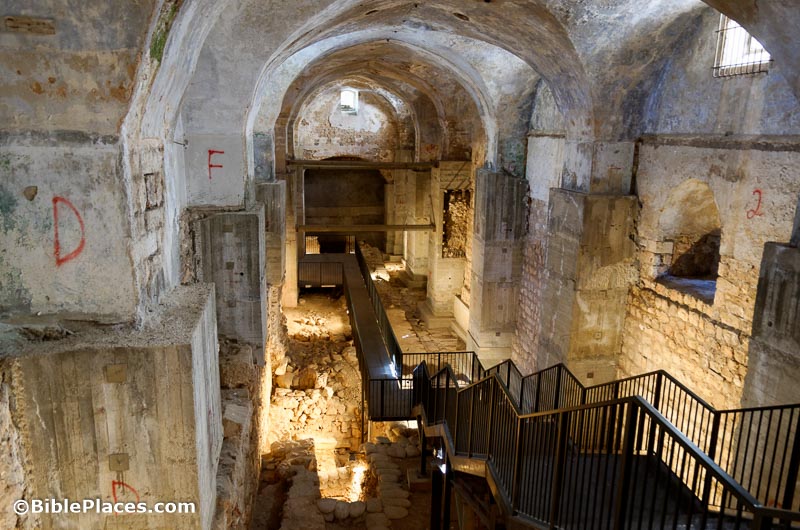
Unlike the Triple Gate article from last week, this chapter has more illustrations. I especially like the one showing the two-story vault structure supporting the bridge, built over a couple of ritual baths with a four-sided mikveh used for the purification of vessels in the foreground. The reconstruction of the Temple Mount in the Crusader era is strange, however: I don’t think that the Dome of the Rock used to be on the northern end of the Temple Mount.

A few other discoveries round out the article:

  • A three-story Crusader building
  • A Roman-era latrine beneath the three-story Crusader building
  • A Hasmonean ritual bath beneath the latrine beneath the three-story Crusader building

Every article concludes with a selected bibliography. This one has six entries, including one by Bahat, two by R. W. Hamilton, and one by Charles Warren.

From 1997 to 1999, Yuval Baruch and Ronny Reich excavated along the southern wall of the Temple Mount. More specifically, they unearthed material in front of the Triple Gate and along the wall to the southeastern corner of the Temple Mount. Their work is summarized in a chapter they wrote in Ancient Jerusalem Revealed.

The first interesting discovery they made was of a ritual bath (mikveh) underneath the wall of the Temple Mount. Since this predates the Herodian construction, it dates to the Hasmonean period. The mikveh has a double entrance divided by a quarried pilaster. Those are my favorite kind.

A second find is more briefly described: they discovered the fragment of a Herodian doorpost that matches the western doorpost of the Triple Gate. I am sad that there was not a photo.

They also found fragments they believe belonged to the Royal Stoa on the Temple Mount above.

These were thrown down when the Romans destroyed the city. The authors don’t mention, but I will add, that it is absolutely amazing just how little is preserved of this structure that Josephus described as “more noteworthy than any other under the sun” (Ant. 15.412). BTW, if you’re looking for a handy description of the “magnificent stones and wonderful buildings” of the Temple Mount, I wrote an essay on this for the Lexham Geographic Commentary on the Gospels.

Here’s another remarkable fact: the excavators revealed some 80 meters of the Temple Mount wall east of the Triple Gate, and they determined that a sloped street ran along the top of a series of 18 vaulted shops, yet they found no actual evidence for the street itself. It is amazing to me how much of antiquity has just vanished.

I love the photo of the arches burned into the Temple Mount wall. While it was a sad day for Jerusalem shopkeepers, it provides a poignant scene of the city’s destruction in AD 70. (I have a less dramatic photo here.)

Ronny Reich is the mikveh expert, so I was interested to read his suggestion that ritual baths near the Temple Mount can be dated based upon which direction they pointed. Those quarried along a southeast-northwest axis are pre-Herodian, while those oriented north-south are Herodian. The change in orientation is owing to the dominant feature in the area: the earlier ritual baths follow the natural topography of Mount Moriah, while the later ones are aligned according to Herod’s Temple Mount.

Baruch and Reich save the best for last. They propose that the sloped street that ran from the Triple Gate eastward was used for bringing sheep into the Temple Mount for slaughter. It also was periodically used for the removal of the red heifer. In support of this is the fact that the street is sloped, not stepped, and they contend that the third gate of the Triple Gate was used for animals, not people. This, they believe, makes better sense than a 200-foot high bridge spanning the Kidron Valley.

I enjoyed reading this article, but it would have been better with more illustrations.

Ronny Reich and Eli Shukron excavated what I consider to be one of the most interesting discoveries of recent years related to the New Testament. Their work at the southern end of the City of David began when construction work on a sewer line accidentally revealed several beautiful stone steps.

After several years of work, the entire northeastern side of the first-century Pool of Siloam was revealed. Our IBEX students worked with the excavators on this project a few days at a time over the course of several years, and so the published results are of particular interest to me.

As with other chapters in Ancient Jerusalem Revealed, the archaeologists wrote the report. They begin by sketching out the history of excavation in the area, with the surprising note that five steps from the southern side of the pool were already revealed by Biss and Dickie in their excavations in 1898. But they didn’t realize what they had found.

The pool itself measures 50 meters on the exposed side, and an estimated 60 meters on the perpendicular sides. They uncovered the entire length on the northeastern side, including both corners. Why didn’t they go further? The article only hints at the reason: The pool “is the property of the Greek Orthodox Church.” A less professional report would have added, “and it is ironic that it is Christians who obstinately refused to allow excavation of an important site mentioned in the New Testament.”

The pool was built in two phases, and this is more important than you might think. The first phase was made of plastered stairs, but these could not withstand the large numbers of people who used the pool. But here’s the interesting part: the construction style of this phase indicates that the pool was built by workmen who specialized in constructing ritual baths.

It is, of course, tempting to dismiss the identification of the Pool of Siloam as one large ritual bath on the grounds that the lead excavator (Reich) did his doctoral dissertation on ritual baths, and we know how you end up seeing your own specialty everywhere you look. But Reich supports this theory with two additional points: (1) holes to support modesty partitions have been found in the stone steps; (2) the design of the staircase, with five steps between landings, is ideal for people trying to reach the water level at varying levels.

The date of the pool is not controversial. The first phase was built in the mid-first century BC and the pool went out of use in the First Jewish Revolt (AD 66-70).

On the northern end of the excavation area, the archaeologists uncovered a paved esplanade that was made of stones similar to those in the Herodian street below Robinson’s Arch. They identified the location of a row of columns and found a number of column drums in various places in their excavations. One of those drums had a mason’s mark with two Hebrew letters (het, tsadi) and three vertical lines. A street led from this esplanade to the north, underneath which they found a large drainage channel. This has been publicized in the past because it was apparently used as a hiding place for refugees in the Jewish Revolt.

This is a brief summary of the whole. The article is 11 pages long and includes 12 photos and 2 diagrams, many of them large and excellent.

A resident of the northern Israeli village of Araba discovered a Bronze Age settlement on his way to work.

This week Bryan Windle looks at el-Araj, the other candidate for Bethsaida. He provides the evidence both for and against this identification.

The Kingdom of Copper: Copper Production and Social Complexity in Iron Age Faynan, Jordan, is a good story that has been very creatively produced. (The subdomain “storymaps” is suggestive.)

In the last few years, Zedekiah’s Cave (aka Solomon’s Quarries) has become “a major venue for concerts and cultural events.”

Jerusalem looks as it has for the thousands of years, but that’s all about to change, writes Michael Kimmelman in the NY Times, because they are building a cable car to the Western Wall. (I think a case is considerably weakened when it is grossly overstated. And the cable car does not go to the Western Wall.)

Tourism to the West Bank is growing.

A high-tech analysis of the Temple Scroll helps to explain why this very thin parchment was so bright and possibly why it was so well preserved.

The excavations at Gath made it on Jeopardy this week. And you can now register for the penultimate season there.

Leon Mauldin shares several photos from Shepherds’ Field in Bethlehem.

If you enjoy virtually touring Israel, you can join John DeLancey as it posts daily about his current trip.

Tomorrow Duke is celebrating the conclusion of its years of excavating at Sepphoris.

Ahmed Shams describes the Library of Congress’s collections of photos related to the Sinai Peninsula Research project.

Archaeology in Jordan (AIJ) is a new, biannual open access (OA) newsletter published online by ACOR aimed at raising scholarly awareness of archaeological and cultural resource management projects being carried out in Jordan and to make this information accessible to a wider audience.”

I am on The Book and the Spade this week, talking with Gordon Govier about my visit to Susa, the Persian capital where Esther lived.

There will be no roundups for several weeks.

HT: Agade, Joseph Lauer, Charles Savelle

I am personally very interested in Jerusalem in the Old Testament period (aka First Temple period), so I’m going to indulge myself by writing yet again on a third article (of four total) from that era in Ancient Jerusalem Revealed: Archaeological Discoveries, 1998-2018. This article is also by Eilat Mazar, and it is entitled “The Royal Quarter Built by King Solomon in the Ophel of Jerusalem in Light of Recent Excavations (2009-2013).”

As before, I am handicapped by not being able to show you the diagrams and archaeological photos in the article. There really are some spectacular views, without overgrown weeds, faded placards, or some tourist who just won’t move out of your way! But my goal in these brief summaries is to give you a sense for what they’ve found, along with a pointer to where you can read more.

Let’s start with a definition: the Ophel, according to this article, is the area between the City of David (to the south) and the Temple Mount (to the north). I’m not so sure that this is how the Bible uses the term (cf. 2 Chr 27:3; 33:14; Neh 3:26-27; 11:21), but that’s how it is used here. If you want to see these discoveries in person, you need to go to the “Southern Temple Mount Excavations,” later renamed the “Jerusalem Archaeological Park” (as if there is only one), and marked by the Davidson Center near the entrance.

This article focuses on Mazar’s work on the southern end of the excavation area (just north of the modern road that takes buses to the Western Wall). Here she found some monumental architecture which she dates to the time of Solomon. In fact, four of the five buildings date to the time of Solomon, with the fifth from the time of David. She writes, “One gets the impression that the construction of buildings in the Ophel ended during the third quarter of the 10th century BCE.”

Building I she identifies as “the Far House,” proposing that it served King David and his allies when he fled from Absalom (2 Sam 15:17). The NASB translation reads, “The king went out and all the people with him, and they stopped at the last house.” Mazar writes, “The features of bayt ha-merhaq [the far house] as described in the Bible match in date and location those of the early structure in the Ophel and it is possible that they are the same building.” I think I would have more confidence in that conclusion if we had other buildings from this time period to compare it with (and thereby determine that this in fact was the “farthest” one), but we don’t.

Building II was a fortress-tower even further than the “far house,” but she dates it to a few decades later. She estimates its size at 50 by 40 feet, though much of the structure has not yet been uncovered.

But she thinks it fits with a description in Nehemiah 3:27 of “the great projecting tower.”

Building III is the gatehouse and casemate wall. Other archaeologists aren’t so sure that this was a gatehouse (only a portion of the structure was preserved), but if it is, this is the only known gatehouse from Jerusalem prior to the “Middle Building” mentioned in the Babylonian conquest description of Jeremiah 39.

Building IV is the “Straight Wall” and it has a length of more than 100 feet, with a width of 8 feet.

Nehemiah mentions a portion of the wall that is called “straight” (Neh 3:25), and Mazar believes that she has found it.

Building V is the casemate wall, also built during the time of Solomon, as one of the elements in “the wall of Jerusalem” (1 Kgs 3:1). So Mazar has found this as well.

This is all truly fascinating, especially given the almost complete lack of material elsewhere in Jerusalem from the time of David and Solomon. My advice, though, to someone who has identified so much is to stop digging before you run out of biblical names to associate with your discoveries.