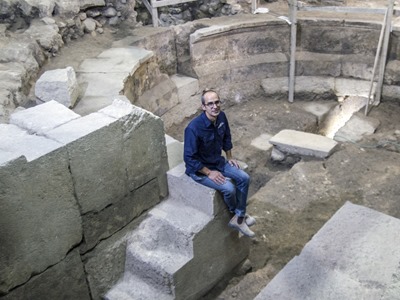
Archaeologists have learned a lot in the first season of a renewed expedition to Masada, but they’re not saying much yet.

The tomb of an 18th-Dynasty goldsmith has been discovered on Luxor’s West Bank.

“Excavations at an ancient mound in the central Anatolian province of Kayseri shed light on writing from around 2,000 B.C.

The Plutonium of Hierapolis is being restored so that it can be opened to tourists next year.

The ancient stadium of Laodicea is being restored.

Scholars are using new technology to read palimpsests at St. Catherine’s Monastery.

Israel’s Good Name describes two recent field trips to the Sorek Stalactite Caves and to Tel Burna.

After years of delay, the Louvre Abu Dhabi will open two months from today.

HT: Explorator, Agade

Haaretz reports on Steven Fine’s study that the reliefs of the Arch of Titus were originally painted in full color.

“The Arch of Titus – From Jerusalem to Rome and Back” is a new exhibition opening this week at the Center for Jewish History in Manhattan.

Have scientists discovered the body of Pliny the Elder?

Scientists at a university in Rome have determined what causes ancient parchments to develop purple spots and deteriorate. The journal article is here.

Mark Hoffman has created a list of free online Bible resource sites and downloadable Bible apps and programs.

Carl Rasmussen explains that the apostle Paul visited the area of modern Albania, probably on the Via Egnatia.

The Biblical Archaeology Society has a new streaming video site, with a 75%-off introductory offer.

The deadlines are approaching for many funded fellowships at the Albright Institute in Jerusalem.

Letters from Baghdad will be screened at the Oriental Institute Museum in Chicago on October 11.

The event is free, but registration is required.

Now free (pdf): The Assyrian Dictionary of the Oriental Institute of the University of Chicago

Now free (pdf): The City of Ebla: A Complete Bibliography of Its Archaeological and Textual Remains. (Click the small pdf icon to download).

Early reviews of Lois Tverberg’s forthcoming book are very positive, including my own.

HT: Joseph Lauer, Agade

The discovery of a Neolithic model of a clay silo from Tel Tsaf is leading scholars to rethink the history of food storage.

Gabriel Barkay recently gave a tour of the Temple Mount to members of the US Congress.

John DeLancey is blogging about his Israel tour, and on Wednesday he took his group to el-Araj, a candidate for New Testament Bethsaida.

Students from Oakland University involved in the Lachish expedition this summer gained knowledge and experience.

Shmuel Browns shares some photos of sinkholes at the Dead Sea.

The Anglo-Israel Archaeological Society has posted its schedule of fall lectures.

If you’re not familiar with Solomon’s failure in establishing his 12 administrative districts, take a look at Wayne Stiles’s post and map.

I’ve been waiting for Craig Keener’s four-volume commentary on Acts to be available in digital format, and Accordance has it first, and at a great introductory sale price.

Accordance also has a sale on the NICOT and NICNT bundle at about half of what I paid for it on Logos.

Phillip J. Long has written the first full-length review of the Photo Companion to the Bible.

Two of my favorite Bible teachers, both born in 1928, died this week: Stanley Toussaint (DTS) and Robert Thomas (TMS).

HT: Joseph Lauer, Agade

Several dozen seal impressions have been discovered in excavations in the City of David. These bullae date to the period after the fall of the northern kingdom in 722 BC and the archaeologists suggest that the names on them may belong to refugees who immigrated to Jerusalem at that time.

The IAA press release is here, and the story is reported in a number of news sources. The Times of Israel incorporates many photographs and one video into its story.

The dozens of clay imprints were used on letters and documents which were bound by string and sealed by wet clay pressed with the sender’s mark or name. The impressive trove was discovered at recent digs uncovering three Late Iron Age buildings frozen in time by the destruction caused by the 586 BCE Babylonian siege. The discovery was made by a team of Israel Antiquity Authority archaeologists led by co-directors Dr. Joe Uziel and Ortal Chalaf.
Among the dozens of bullae is a rare find of an intact sealing, bearing the name “Ahiav ben (son of) Menahem,” referring to two kings of Israel but found in the capital of the Kingdom of Judah, Jerusalem.
[…]
According to co-director Ortal Chalaf, these Israelite names and other findings point to the possibility that after the destruction of Israel, refugees fled the Kingdom of Israel for the Kingdom of Judah, and settled in Jerusalem. After settling, the use of their names on official correspondence shows that these Israelites gained important roles in the Judaean administration, said Uziel.
“These names are part of the evidence that after the exile of the Tribes of Israel, refugees arrived in Jerusalem from the northern kingdom, and found their way into senior positions in Jerusalem’s administration,” according to the two co-directors.

The full story is here.

An ancient cemetery has been discovered on the west bank of Luxor.

Jared Owen discusses the identity of a pharaoh’s head discovered in 1995 at Hazor.

A 2-minute video explains how Petra declined.

Underwater ruins of the lost Roman city of Neapolis, found off the coast of Tunisia, confirm its destruction by a 4th AD tsunami.

Haaretz: “Scientists have debunked the claim that prehistoric peoples living in central Turkey 8,500 years ago invented copper smelting, putting an end to one fierce controversy.”

A Turkish writer laments the situation in the land of the ancient Hittites with the lack of tourists, expulsion of German archaeologists, and deterioration of ancient sites.

The San Antonio Museum of Art examines in depth its statue of Antinous, a favorite of Roman Emperor Hadrian.

Carl Rasmussen has revised his interpretation of the “farmer’s sarcophagus.”

Most of the convictions of Raphael Golb for impersonating Dead Sea Scrolls scholars were upheld in appeals court.

The Jordan Times profiles the work of the Spanish Archaeological Mission in Jordan for the last 60 years.

Ferrell Jenkins notes the latest books published by Carta Jerusalem. All three look great!

HT: Ted Weis, Charles Savelle, Joseph Lauer, Agade

As excavations get underway at Kiriath Jearim, Haaretz (premium) reports on a 9-foot-wall discovered there and Finkelstein’s belief that the site held a temple that competed with Jerusalem.

The “ancient coin” the 9-year-old girl found last week is in fact a modern souvenir.

The bones of people killed at Khirbet el-Maqatir during the First Jewish Revolt were recently reburied in Ofra. Leen Ritmeyer posts more information and images.

Leen Ritmeyer shares a photo of a Temple Mount model made of Legos.

Wayne Stiles explains the significance of the Gezer boundary stones.

John DeLancey explains Hezekiah’s Tunnel, with help from a couple of videos including one narrated by Ronnie Reich.

Bill Schlegel has created a 5-minute video about Bethsaida in which he uses aerial footage to explain the two candidates and identify which site is most likely Bethsaida.

Lois Tverberg shares her experience and photos from the el-Araj dig this summer.

G. M. Grena has created a video tutorial on how to identify a LMLK seal impression. (Is his computer running Windows 95?)

R. T. France identifies seven differences between Galilee and Judea in the time of Jesus.

Israel’s Good Name describes his experience as a square supervisor at the Gath excavations.

Accordance has a big sale that includes a couple of collections from Carta, including the Carta Super Combo and the Carta Select Combo.

HT: Mike Harney, Agade