A lot happened while we were traveling in June, and I think it is going to take us four roundups to catch up. Today we begin with stories related to Israel.

Archaeologists have discovered a Crusader-era tunnel in Tiberias that apparently led from the fortress to the harbor.

Students excavating in Modiin discovered a collection of women’s jewelry from the Crusader period.

Excavations at the site of Huqoq in Galilee have discovered agricultural installations in use in either the Middle Bronze Age or the Roman-Byzantine period.

Weekly reports are available for ABR’s first season at Shiloh: Week 2 by Mark Hassler, Week 3 by

Andrew Kvasnica, and Week 4 by Gary Byers.

Scholars at Tel Aviv University have used multispectral imaging to reveal text on ancient “blank” potsherds from the First Temple period.

Emek Shaveh has petitioned Israel’s high court to halt excavations in the Western Wall tunnels.

An alert hiker reported suspicious activity which led to the capture of two antiquities thieves near the site of Sepphoris.

The new National Campus for the Archaeology of Israel remains unopened due to a lack of donations. This article in Apollo magazine reviews the controversy over moving archaeological material from east to west Jerusalem.

Haaretz reports on a new exhibit at the Israel Museum, “Faces of Power: Coins from the Victor Adda Collection.” These 75 gold coins depict Roman emperors and their wives and have never been publicly displayed before.

A nighttime audiovisual show at the City of David begins later this month.

The Israeli government has temporarily restricted civilians from visiting the Golan viewpoints overlooking Qunetra.

Appian Media has released a free (and downloadable), 10-minute video on Magdala.

Wayne Stiles notes the irony that “the Church of the Holy Sepulchre demonstrates the need for the place it hallows.”

There are several coming Israel tours of note. Wayne Stiles is taking a group October 26–November 6 and another March 16-27, 2018. Joel Kramer (SourceFlix) is leading a trip March 11-24.

This weekend, fans are reenacting the Battle of the Horns of Hattin in which the Muslims defeated the Crusaders in 1187.

HT: Joseph Lauer, Charles Savelle, Agade
Share:

Archaeologists excavating in the Timna Valley near Eilat have discovered fabric that was dyed red and blue. This is the first time that such a colored clothing has been discovered from this ancient period. The Times of Israel provides a summary of a journal article and includes some photographs and a video.

Since 2013, Dr. Erez Ben-Yosef of Tel Aviv University has directed excavations in the Timna Valley where his team has found textiles dating back to the Iron Age (11-10 centuries BCE). On some of the fragments, there is a decorative pattern of red and blue bands.
In an article published Wednesday in the scientific journal PLOS ONE, the researchers hypothesize that the metalworkers, considered fine craftsmen, “were probably entitled to wear colorful clothing as a mark of their high status.”
According to Ben-Yosef and the IAA’s Dr. Naama Sukenik, the findings indicate that the society at Timna, identified with the Kingdom of Edom, was hierarchical and included an upper class that had access to colorful, prestigious textiles.
The concept of highly prized, skilled laborers flies in the face of conventional wisdom, which had supposed that slaves had largely manned the isolated copper mines.

Personally I think the speculation about the identification of the workers is unwarranted, given that we have essentially nothing to compare this with given the lack of preservation of perishable materials in the rest of Israel. And if the dating to the 10th century is correct, then this area was likely under the control of Israel, not Edom (2 Sam 8:14; 1 Kgs 9:26; 2 Chr 8:17). But one can certainly conclude that the workers here had access to a good shopping mall.

The official press release is posted here. The AFTAU has issued a press release here. Some high-res photos are available here.

HT: Joseph Lauer

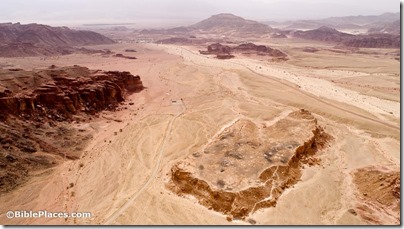
Timna Valley Slaves Hill aerial from north, ws032317820
“Slaves’ Hill” in Timna Valley;
“Solomon’s Pillars” is located on the left
Share:

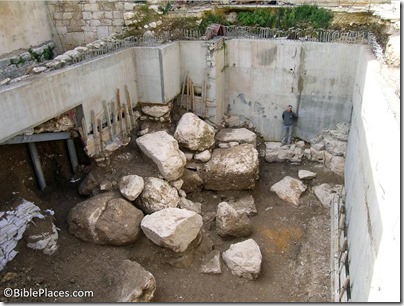
The massive “Spring Tower” built over Jerusalem’s Gihon Spring was originally dated by archaeologists to the Middle Bronze Age. A new study, however, indicates that the fortifications were constructed in the 9th century BC, the time when Jerusalem was ruled by Jehoshaphat and Joash. The new dating is based on radiocarbon dating of material found in sediment underneath boulders at the tower’s base.

The previous discovery and dating to the 18th century BC radically changed our understanding of the development of the city, suggesting that Jerusalem was home to an advanced civilization about eight centuries before David’s conquest. This new re-dating will force the re-writing of the city’s history, not only in Canaanite times but in the Judahite period as well.

One can speculate what might have prompted such construction and which king it occurred under. I haven’t read the full study (available here for $35), but from other research I wouldn’t put too much weight on the date, as radiocarbon dates in the 9th century usually have quite a bit of flexibility. But if the tower dates earlier than the time of Hezekiah, one can only wonder why he considered the relatively recent fortification insufficient and the need to construct a water tunnel essential.

A summary of the research is posted at the website of the Weizmann Institute of Science.

HT: Joseph Lauer

Spring-Tower,-tb022304573
The north wall of the Spring Tower during excavations in 2004
Share:

I’ve talked with a few people recently who weren’t aware of some of what we’re doing and some of the options available, so I thought I’d take a minute to provide a brief summary.

First, you don’t have to check the blog website every day to keep up with our weekend roundups and other reports. You can subscribe to receive the blog by email here.

Second, every weekday we post a photo with a verse or caption on Facebook, Twitter, and Instagram.
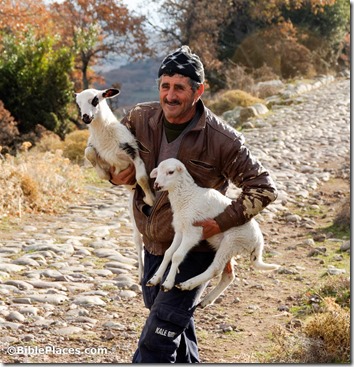
Here’s today’s photo:

shepherd
“He tends his flock like a shepherd: He gathers the lambs in his arms and carries them close to his heart” (Isaiah 40:11).

Third, our BiblePlaces Newsletter is an infrequent but valuable source of our latest projects. This is a good way to make sure you know what we’re creating, even if you’re not interested in the daily or weekly photos and posts we do. We are preparing a major announcement for later this summer.

All of these subscriptions are free, and we promise to treat you like we want to be treated (no spam, no pestering, nothing stupid).

And if we try to sell you anything, we promise it will be awesome.

Join us on any of these as you like! And feel free to tell your friends about us.

Share:

A 3,700-year-old Egyptian burial chamber containing the remains of a ‘Pharaoh’s daughter’ was found south of Cairo at Dahshur’s royal necropolis.

Archaeologists have discovered “a cachette of non-royal mummies of men, women and children buried in catacombs eight metres below ground level in the desert neighbouring the bird and animal necropolis at the Tuna Al-Gabal archaeological site” in Egypt.

Two Egyptian men illegally digging for antiquities were killed when their house collapsed. And the
Egyptian government has increased the penalty for antiquities theft for a maximum of a life sentence.

An international team of experts met in Cairo to determine how best to transport King Tut’s artifacts to the new museum.

Egypt has begun to register its Jewish sites and antiquities.

An exhibit of recently discovered artifacts is now on display at the Luxor Museum.

Turkey is planning to restore and open the stadium of Perga.

Carl Rasmussen recently visited a new archaeology display in a station for the metro tunnel that connects Europe and Asia.

The city of Rome has begun restoration works on the Mausoleum of Augustus with the plan to open it to tourists by 2019.

John DeLancey shares a new video of a recent performance of “Jerusalem of Gold” by the Portney
Brothers and he explains the song’s significance.

The diet of Jerusalemites in the first century AD was primarily sheep and goats, followed at a distance by cows and chickens.

“Methuselah,” the date palm tree sprouted from a 2,000-year-old seed, is now 12 years old.

I’m traveling much of the month of June and will post as I am able. Roundups will probably resume in July.

HT: Joseph Lauer, Ted Weis, Charles Savelle, Agade, Explorator, Paleojudaica

Share:

A new study suggests that the Philistines brought their pigs with them when they sailed to the coast of Israel.

The second issue of the Tel Aviv University Archaeology Newsletter has reports on projects at
Masada, Kiriath Jearim, Timna Valley, City of David, and more.

David Hendin reports on the most significant numismatic discoveries in Israel in recent years.

Wayne Stiles looks at lessons to be learned from sieges in the Bible.

Charlie Trimm explains how soldiers relieved themselves while in battle.

Lexham Geographic Commentary: The Gospels is now available as a standalone purchase in Logos.

The Acts through Revelation volume is in pre-order status.

A new database identifies 20,000 archaeological sites at severe risk of destruction.

Access the Collections is a new feature of the Oriental Institute website to encourage visitors to explore their photographic and document archives.

Recently released:

Hazor VII: The 1990–2012 Excavations: The Bronze Age, edited by Amnon Ben-Tor et al.

Socoh of the Judean Shephelah: The 2010 Survey, by Michael G. Hasel, Yosef Garfinkel, and Shifra
Weiss (Eisenbrauns)

Khirbet Qeiyafa in the Shephelah, edited by Silvia Schroer and Stefan Münger (Academic Press Fribourg)

The Twice-Told Tale: Parallels in the Bible, collated by Abba Bendavid (Carta)

  • A collation of parallel Bible texts showing the duplications, differences, and silences

We’ll have more stories in part 3 of the roundup tomorrow.

HT: Joseph Lauer, Ted Weis, Charles Savelle, Agade

Share: