A final report on the Italian excavations in the Church of the Holy Sepulcher revealed a clear sequence: from stone quarry to farmland to cemetery to church. The final report requires subscription.
Authorities used a huge crane to lift a 25-ton Jewish ritual bath from the ground in Kiryat Gat in order to protect it from ongoing construction.
A new virtual exhibition, From Trash to Treasure: Nahal Omer“ highlights how the remains of everyday life in a remote desert settlement can illuminate long-distance trade and cultural connections across the medieval world.”
Elizabeth Shanks Alexander and Abigail Snyder write about four early rabbis you should know: Rabbi Akiva, Rabban Gamaliel, Rabbi Yohanan, and Resh Lakish.
On Digging for Truth, Tim Lopez talks about a monumental building at Shiloh that he helped to excavate that may be the foundation of a permanent tabernacle structure.
We released 12 new volumes in the Photo Companion to the Bible series this week.
During excavations of the agora at Smyrna, archaeologists discovered three rooms with wall paintings and mosaics.
“For nearly 180 years, archaeologists studying Nimrud in northern Iraq have focused on palaces, temples, and royal buildings. A new project is shifting attention to the vast lower city, where most of the Assyrian capital’s people lived.”
“A scientific journal has retracted a study that claimed satellite radar could reveal hidden structures inside the Great Pyramid of Giza, finding ‘serious methodological flaws and statistical errors’ that undermined its conclusions.”
Scientists are stomping grapes in an ancient reconstructed winepress in order to determine “whether ancient Judean winemakers let the juice flow directly into the adjacent collection vats to ferment, or instead left it to ferment on the treading floor itself.”
“Archaeologists excavating the ancient city of Adramytteion in western Türkiye have uncovered an unusually personal trace of Roman domestic life: a cat and a dog depicted in a mosaic from the villa’s 2nd–3rd-century AD phase, accompanied by inscriptions giving their names.” Adramyttium is mentioned in Acts 27:2.
“A team led by Israeli researcher Yoav Vaknin has developed a method to distinguish genuine clay artifacts from modern fakes by reading faint magnetic signals locked into the objects when they were fired thousands of years ago.”
The latest Jerusalem Tracker lists “every new academic publication” that Chandler Collins “can find that is relevant for the study of historical Jerusalem,” including new books, excavation reports, articles, and book chapters.
Elon Gilad writes about another Jewish revolt, one between the Great Revolt and the Bar Kokhba Revolt, about which little is known.
Shmuel Browns, a tour guide in Israel, has begun a Substack that features his areas of interest: History & Archaeology, Hiking & Nature, Photography, and a Field Report.
Libby Backfish and Cynthia Shafer-Elliott are on the Biblical World podcast to discuss their recent book, Grounded Theology in the Hebrew Bible: Exploring the Cultural Context that Formed Ancient Israel.
Eric Cline asks (and answers) the questions of who the Sea Peoples were (there is no simple answer) and whether they caused the end of the Bronze Age (they have been set up as a scapegoat).
The latest issue of Biblical Archaeology Review includes articles on a harbor town in the days of Israel’s judges, monumental tombs in the Kidron Valley, tombs in the Negev, gaps within the text of the Dead Sea Scrolls, and an advertisement for a new book (p. 65).
All Israel News summarizes the case that el-Araj is biblical Bethsaida, including news from this summer’s excavation.
After sixteen years of uninterrupted excavations—even during COVID and wars—i24 News visited Azekah. The excavator “said his dream is for visitors within about four years to walk through the citadel’s high walls and inner structures and along the street surrounding the fortress.”
A study of a tomb chamber in the Theban necropolis was carried out “to reconstruct how this burial space was used and reused between its construction during the Twenty-fifth Dynasty (754–656 BCE) and the Ptolemaic period (305–30 BCE).”
“A new archaeological discovery at Tell Abu Saifi in Qantara East, Ismailia, is shedding new light on the ancient Horus Military Road and strengthening the hypothesis that the site may be linked to the lost ancient Egyptian city of ‘Mesen.’”
“The pillar of St. Simeon the Stylite was returned to its original location at the Monastery of St. Simeon on Mount Simeon, northwest of Holeb (Aleppo), Syria, on Tuesday, 16 centuries after it was erected.”
If you plan to visit biblical sites, you will benefit from a good guidebook. For years I have recommended excellent resources such as Jerome Murphy-O’Connor, The Holy Land, Clyde E. Fant and Mitchell G. Reddish, A Guide to Biblical Sites in Greece and Turkey, and Mark Wilson, Biblical Turkey. These books share the same basic approach: organized by site, they explain a city’s principal features and its relevance to the Bible.
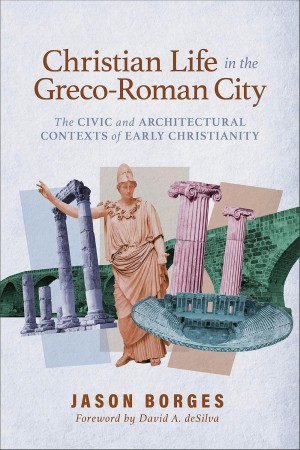
Jason Borges’s new work takes a different approach, and for travelers in Italy, Greece, and Turkey, it may be just as valuable. Instead of going site by site, Christian Life in the Greco-Roman City: The Civic and Architectural Contexts of Early Christianity goes feature by feature, teaching you how to understand what you encounter again and again in every Greco-Roman city: theaters, agoras, temples, baths, and more.
Perhaps you’ve had this experience: you visit an ancient theater, and the guide gives you the basics. At the next city, you hear the same basics. Then you arrive at a third theater, and well, here we go again. What you need is a single, in-depth exploration of what theaters were, how they functioned, how their architecture works, how they shaped society, and how they illuminate the New Testament.
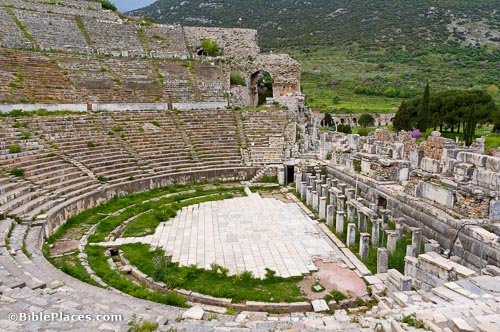
Great Theater at Ephesus
In less than an hour of your time (24 pages), Borges gives you that in-depth explanation and more. You learn that there were nearly a thousand theaters across the Roman Empire, that many could accommodate more than ten thousand spectators, that seating reflected social divisions, that Roman performances were crude and erotic, and that only one theater is explicitly mentioned in the New Testament—the theater at Ephesus in Acts 19.
You also learn the differences between theaters, amphitheaters, and circuses. Borges shows how Jesus’s teaching reveals his familiarity with public entertainment, how Paul compared the faith to athletics, and what the apostle meant when he said that he “fought with wild animals in Ephesus” (1 Cor 15:32). Borges’s mastery of early church history allows him to make various connections to Christian martyrs.
I enjoyed the chapter on the agora even more. After defining what an agora is (“the central public space … akin to a modern town square … the heart of every community”), Borges explains a number of interesting ancient words and phrases related to the agora, such as:
“when the agora is full” – a time designation referring to midmorning (ca. 10 am)
“breaking up of the agora” – the end of the morning (ca. 12 noon)
being “taken to the agora” – being brought to court, especially in cases involving mob justice
agoraios – a person who “belongs to the marketplace,” usually translated “loafer” or “idler” (Acts 17:5)
If you’ve ever wondered why some cities have two separate agoras, it’s because of those loafers. Greek elites wanted to separate the riffraff in the marketplace from the civic spaces where magistrates governed the city.
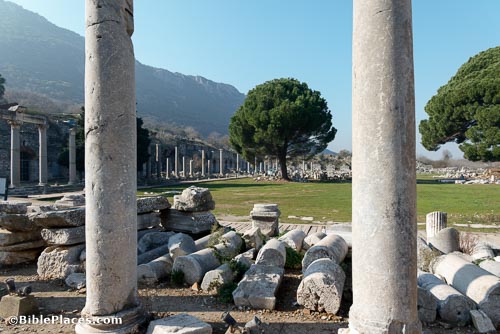
Commercial agora at Ephesus
Borges explains what Jesus meant when he spoke of the “children sitting in the agora” (Luke 7:31), why Paul went to the agora in Athens (Acts 17:17), and what important feature of the agora is mentioned twelve times in the NT (the bema). He concludes the chapter with an edifying section on the verb derived from agora, agorazō, (“to buy”). Because slave markets were a common feature of agoras, the setting gives added force to the New Testament’s language of redemption: “against this sobering backdrop, the NT authors declare a divine economy with a different market transaction: Jesus purchased us for God.”
I think any one of these chapters is worth the price of the book ($25; $15 on Kindle). You’ll find much to mark and annotate in the introductory chapter on the ancient city and in the chapters that follow on agoras, temples, baths, prisons, theaters, libraries, and necropolises. I highly recommend the book to anyone who has traveled to or will travel to the Mediterranean area, along with all those just want to better understand the world so familiar to the people of the New Testament.
The BiblePlaces Blog provides updates and analysis of the latest in biblical archaeology, history, and geography. Unless otherwise noted, the posts are written by Todd Bolen, PhD, Professor of Biblical Studies at The Master’s University.