Previously, on BiblePlaces.com Blog

We highlighted a small museum located in the German Protestant Institute of Archaeology in the Holy Land. You may want to read that post first. The founder of this museum was Gustaf Dalman (1855-1941), a key figure in the development of the Institute. His collections populate most of the museum’s displays.

Dalman first visited the Holy Land for an extended time in 1899, and he lived there continuously from 1902 until the outbreak of World War I in 1914. Though he was able to return two more times, the war essentially brought an end to Dalman’s activity in the Holy Land, and thereafter he researched it remotely from the Institute of Palestinology in Greifswald, Germany.
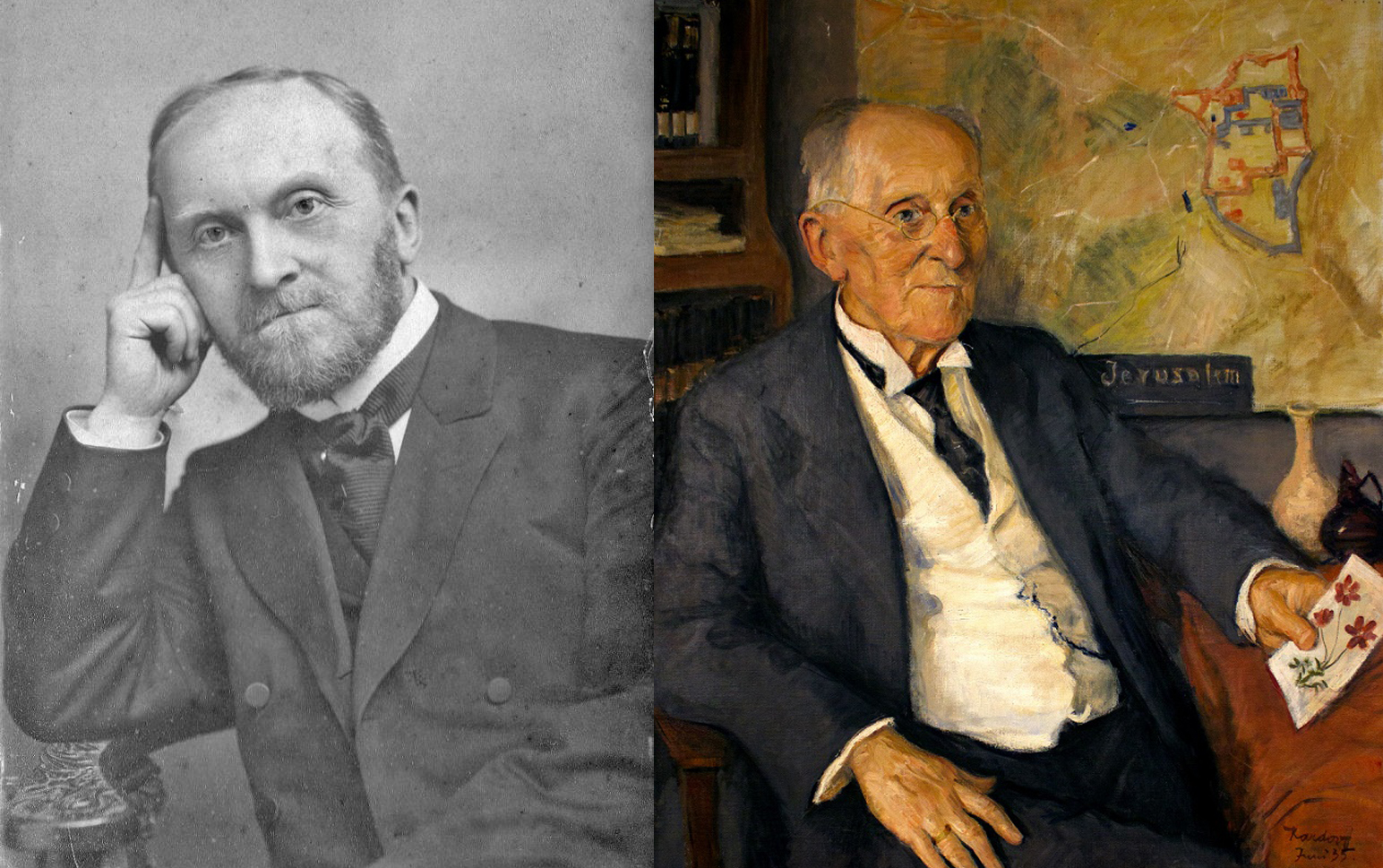
Photo sources: left, right.

In last week’s post, we mentioned the aspects of Palestinian life and the various fields of study that Dalman investigated as part of his encyclopedic research. Although some of Dalman’s writings have been translated into English, his most important work was not, at least not till now. Dalman’s magnum opus was a seven-volume work (in eight parts) entitled Arbeit und Sitte in Palästina, or Work and Customs in Palestine. An eighth volume was incomplete at the time of his death, and not until 2001 were the notes for this volume finally published. Below are the subjects covered by the eight volumes. At the very end of this post, you can view/download the detailed contents for Volume 1, Part 1. This should give a very good sense for the breadth and depth of these volumes.

  • Vol. 1, part 1: Course of the Year and Course of the Day: Autumn and Winter
  • Vol. 1, part 2: Course of the Year and Course of the Day: Spring and Summer
  • Vol. 2: Agriculture
  • Vol. 3: From Harvest to Flour: Harvesting, Threshing, Winnowing, Sieving, Storing, Milling
  • Vol. 4: Bread, Oil and Wine
  • Vol. 5: Textiles, Spinning, Weaving and Clothing
  • Vol. 6: Tent Life, Cattle and Dairy Farming, Hunting, FishingVol. 7: The house, Chicken Breeding, Pigeon Breeding, Beekeeping
  • Vol. 8: Domestic Life, Birth, Marriage and Death (it was also intended to include Singing and Music)
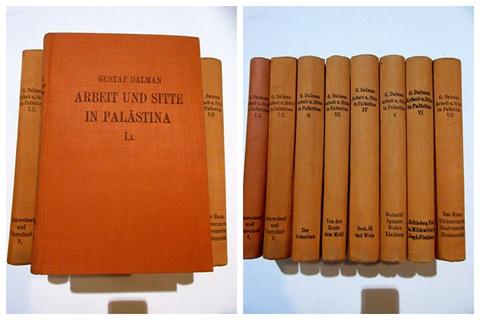
Photo source: Antiquariat an der Uni Muenchen.

Dalman, Gustaf H.
    1928-1942    Arbeit und Sitte in Palästina. 7 vols. Gütersloh: C. Bertelsmann.
    2001            Arbeit und Sitte in Palästina, Vol. 8: Fragment aus dem Nachlass. Berlin: Walter De Gruyter.

Dalman’s work is perhaps the most important window into pre-modern, agricultural/pastoral world of the Holy Land. Along with photographs like the Matson Collection, this is about as close as we today can get to seeing and experiencing daily life in Bible times. Yet, for so many of use who do not possess facility in the German tongue, Arbeit und Sitte in Palästina has remained inaccessible. That is why, a few years ago, it was exciting to find out that Arbeit und Sitte in Palästina is being translated into English. It is Nadia Abdulhadi-Sukhtian to whom we are in the debt for executing the translation. Volume 1, parts 1 and 2, were published in 2013.

Dalman, Gustaf H.
    2013    Work and Customs in Palestine, Vol. 1, Parts 1 and 2: The Course of the Year and the Course of the Day. Trans. Nadia Abdulhadi-Sukhtian. Ramallah: Dar Al Nasher.

Part 1 is available here. Part 2 is available here.
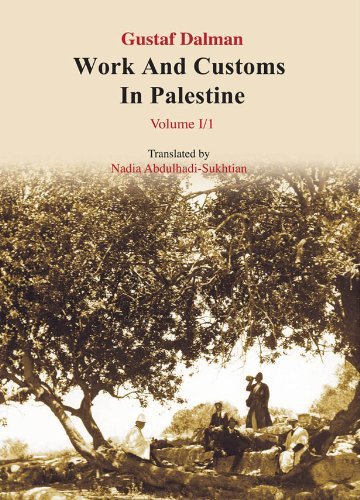
While preparing this post, we discovered that Volume 2 was published just this year. We are glad to see the project is moving along.

Dalman, Gustaf.
    2020    Work and Customs in Palestine, Vol. 2: Agriculture. Trans. Robert Schick. Ed. Nadia Abdulhadi-Sukhtian. Ramallah: Dar Al Nasher.

The only place where Volume 2 appears to be available is here. (Be advised that shipping appears to take one to one-and-a-half months.)

Detailed Contents of Volume 1, Part 1: The Course of the Year and the Course of the Day

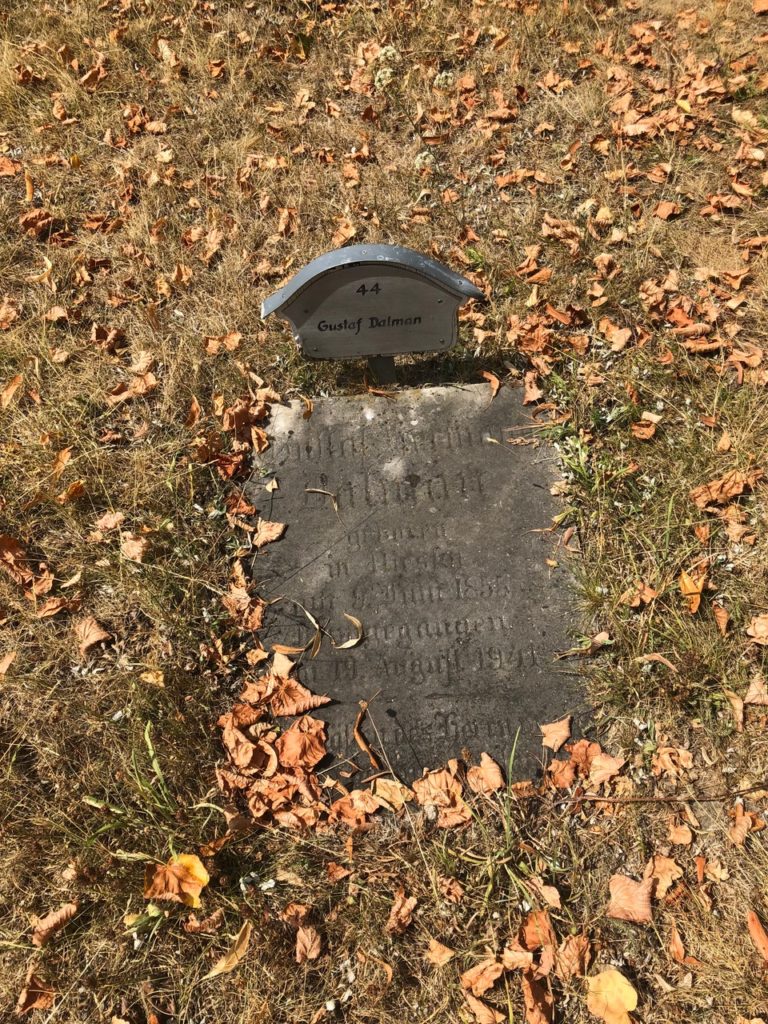
ADDED NOTE: One of our readers visited the grave of Gustaf Dalman in the town of Herrnhut, Germany. Here is a photograph the reader sent.
Share:

(Post by A.D. Riddle)

Several years ago, Chris McKinny wrote a series of posts named “Secret Places.” We resurrect it now to draw your attention to another little-known museum in Jerusalem.

If you have been to Israel a few times, and names like Edward Robinson or Charles Warren are starting to mean something to you, then you may want to add this museum to your next visit.

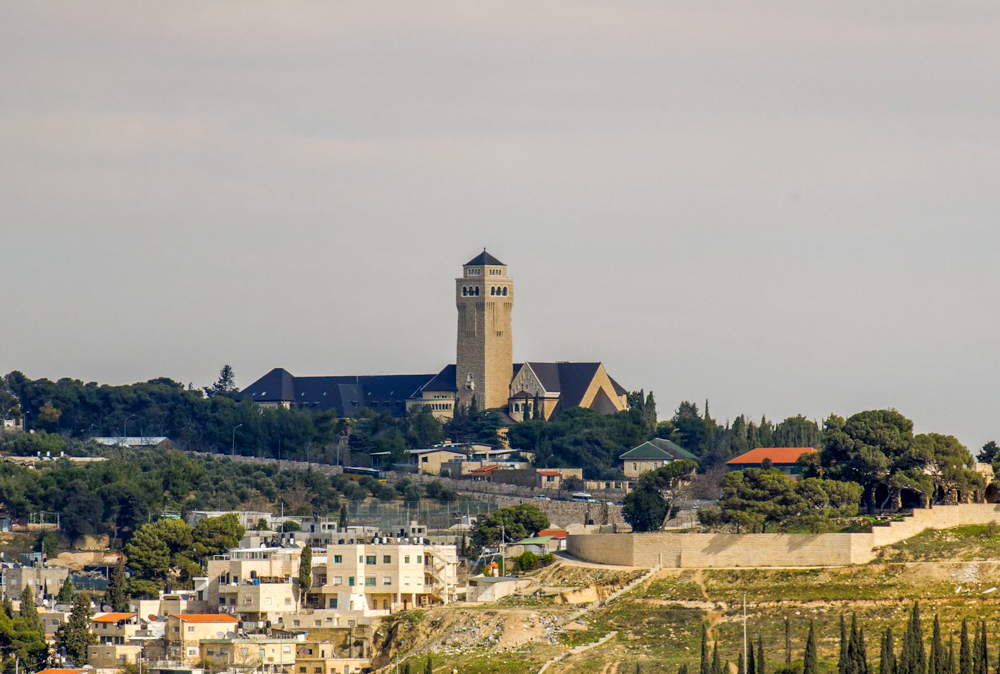
The museum is located within the compound of Augusta Victoria church/hospital on top of the Mount of Olives. The church’s bell tower is a prominent landmark that can be seen at some distance from several directions. You have certainly seen it, even if you were not aware of what it was.


The German Protestant Institute of Archaeology in the Holy Land occupies a house located right behind (east of) the church. As you walk in from the main gate and follow the road to the right, you will see green signs in front of the church that direct you towards the “German Institute of Archaeology.”

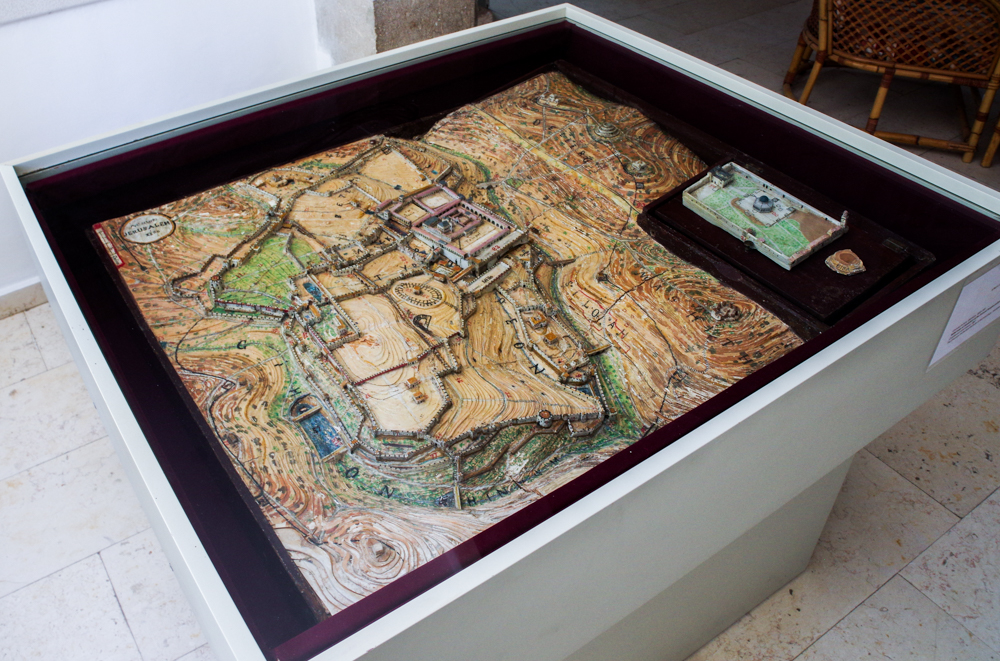
The museum is located in the lower story of this house. It highlights the work of Conrad Schick, Gottlieb Schumacher, and especially Gustaf Dalman. On display you will find large models of Jerusalem and the Church of the Holy Sepulcher constructed by Schick, survey instruments used by Schumacher to draw maps and plans, as well as signs with biographical details.

Jerusalem in the Second Temple Period, 1:25,000 scale.
Wood and cardboard model by Conrad Schick, 1867.

Most of the museum, however, is dedicated to the work of Gustaf Dalman. Dalman was the first director of the Institute. His name may be familiar to some readers as the author of Sacred Sites and Ways: Studies in the Topography of the Gospels (1935), one of the few works by Dalman translated into English. He was an expert in the study of, well, pretty much anything related to the Holy Land.

“Dalman’s main aim and starting point was to shed light on the biblical and post-biblical past of Palestine. Instead of only studying texts and relics of the past, and the Bible, he studied the daily activities and customs of the Arab population of Palestine…he combined anthropology, comparative religion, music, and biblical schalarship with geography, geology, botany, astrology, meteorology and zoology into a…new multi-disciplinary field of study…Palestinology”
(Abdulhadi-Sukhtian 2013: vii–viii).

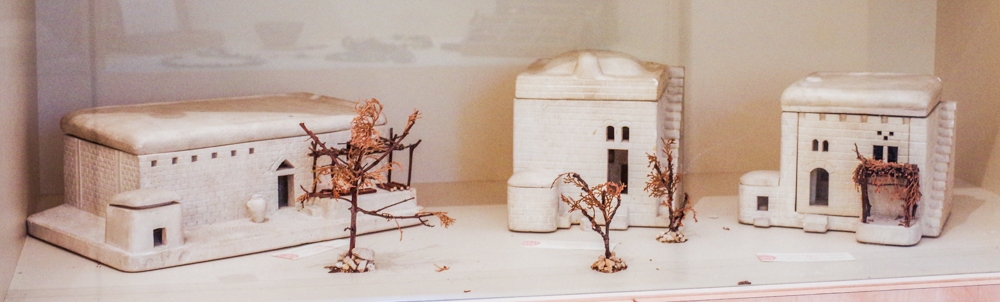
Dalman recorded and collected just about anything you can imagine, and many of these collections are represented in the museum: photographic slides, ancient pottery and coins, herbs, rocks, and limestone models of tombs, presses and Palestinian houses. The models have removable roofs and walls so you can see the interior layout of the structures. It is a little mind-boggling that one man produced all this work.

Limestone models of Palestinian houses.

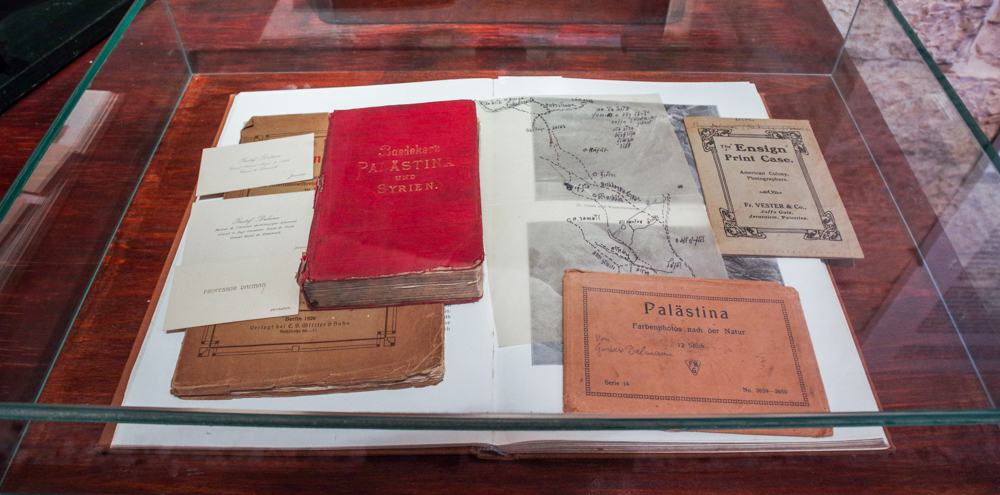
Theologians and pastors would come to the Institute for a three-month course taught by Dalman. A map in the museum shows his itinerary for field trips and a display case contains Dalman’s personal copy of Baedeker Palestine and Syria guidebook.

Gustaf Dalman’s personal materials, including business cards and Baedeker guide.

The museum is not large. You are free to visit, but the Institute requests that you call or email beforehand if you have a group. I would recommend keeping groups very small—ten people would start to feel crowded. A visit will only take about an hour, and most of the labels and signs provide English translations. While you are in the Augusta Victoria compound, the church has a collection of inscribed ossuaries in one of the side rooms. Some of the ossuaries have names like Matthew, Jesus, and Mary. The church also has a life-size replica of the ark of the covenant, and the Bibles of Kaiser Wilhelm II and Empress Augusta Victoria. From the top of the bell tower, on a not-particularly clear day, I was able to make out Baal Hazor, Nebi Samwil, the Dead Sea, and Herodium. It provides a nice view of Jerusalem’s Old City as well.

Contact information for the German Protestant Institute can be found on their website.

Citation
Abdulhadi-Sukhtian, Nadia, trans.
    2013    Work and Customs in Palestine, Vol. 1: The Course of the Year and the Course of the Day. 2 parts. Ramallah: Dar Al Nasher.

Share:

by Chris McKinny

Today at 12 PM Central Time (my time zone and a little more than two hours from now) – I will be lecturing on the historical geography of Libnah and Ether. This will be continuing the series of online lectures that our project has been presenting on in the absence of an archaeological excavation season.

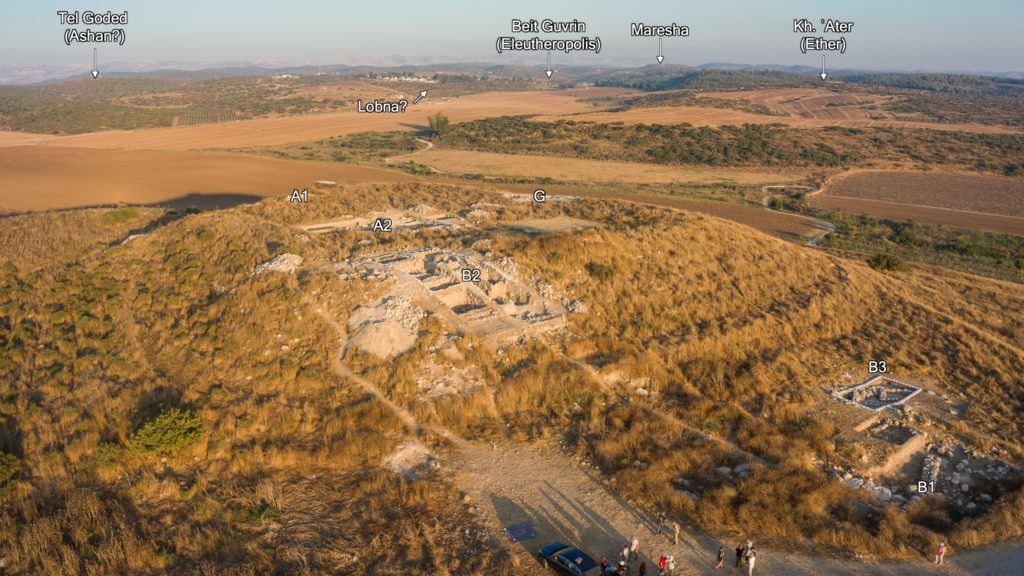
As readers of this blog might already know – Libnah is likely to be identified with Tel Burna – a site that our project has been exploring for ten seasons.

This fall – we hope to investigate Khirbet ʿAter – a nearby site that is commonly identified with the biblical site of Ether (e.g., Josh 15:42). In this lecture – I will discuss the various reasons why Tel Burna and Khirbet ʿAter should be identified with Libnah and Ether respectively. I will also discuss our initial impressions of the archaeological remains of Khirbet ʿAter and our future plans.

Here are the details:

Chris McKinny: “In the Shephelah… Libnah, Ether (Josh 15:42)” The Historical Geography of Libnah and Ether (click for recorded video)

Tel Burna (Libnah) foreground with surrounding towns
Map of the slain kings of Joshua 12 – readers of the blog might remember an earlier post on this subject
Share:

Restoration of the ancient theater and stadium of Aizanoi in western Turkey has begun.

The ships and boats from Thonis-Heracleion have much to say about how Egyptian shipwrights of the Late and early Ptolemaic periods built their vessels, as well as the range of decisions that were made when they reached the end of their working lives on the waters of the Nile.”

Among those arrested in an investigation of trafficking of looted antiquities is a retired curator from the Louvre.

Facebook has announced it will remove content that seeks to sell any and all historical artifacts.

Now online: the first installment of the publication project on the records of the Pennsylvania excavations at Nippur 1889-1900 in searchable digital form (pdf).

“During the Early Iron Age, people dwelled among the ruins of the palace at Knossos in what we may refer to as a ‘landscape of memory’, one imbued with the collective memories of a bygone era.”

“Egyptian archaeologists are taking advantage of the global anti-racism movement to renew their calls on the French government to remove a statue of Jean-François Champollion, kneeling on the head of a Pharaonic king.”

Recent fires at Susa and Ecbatana in Iran apparently caused no damage.

Zoom lecture: The Discovery: 1000-Year-Old Bible Refound in Cairo Synagogue, by Yoram Meital, June 28 at 8:00pm Cairo time. To register, email [email protected].

Carl Rasmussen shares more about Aphrodisias, including The Theater and Its Artifacts and Jews, Proselytes, and God-Fearers at Aphrodisias.

Note: there will be no roundups the next two weekends.

HT: Agade, Joseph Lauer, Ted Weis, Mark Hoffman, Alexander Schick, Explorator

Share:

Just as the Biblical Museum of Natural History was about to open in Beit Shemesh, “a plague of biblical proportions struck.” Virtual tours are available at the museum’s website. They are also offering a new book by the museum’s director, The Torah Encyclopedia of the Animal Kingdom, Vol. 1: Wild Animals.

The Hashemite Custodianship of Jerusalem’s Islamic and Christian Holy Sites 1917-2020 CE: White Paper, by the The Royal Aal Al-Bayt Institute for Islamic Thought (108pp). The labeled photograph of the Temple Mount on page 81 may be of particular interest.

New from Appian: An 80-page study guide to accompany “Lessons from the Land: The Gospels.”

“In Search of King David’s Lost Empire” is a long piece by Ruth Margalit that reviews the history of the maximalist-minimalist debate. Some responses by Eilat Mazar, Gabriel Barkay and others may be found here.

Assyrian soldiers had the edge with the invention of the socketed arrowhead. The underlying IEJ article is on Academia.

An article in the Jerusalem Post summarizes a recent BAR article on life at Tel Hadid near Gezer after the Assyrians deported the Israelites.

Israel should preserve more archaeological sites uncovered in salvage digs, argue some archaeologists. The article reports that there are 35,000 ancient sites in the country.

Tony Cartledge describes his experience in excavating a 12th-century Canaanite temple at Lachish, including his wife’s discovery of what turned out to be a scepter.

Charles Savelle links to three podcast episodes he has enjoyed on Thutmose III and the Battle of Megiddo.

HT: Agade, Joseph Lauer, Ted Weis, Mark Hoffman, Alexander Schick, Explorator

Share:

One of the advantages of the present crisis is that conferences that you probably would not be able to fly to are now easy to watch from home. And some of them are free, including one this weekend.

This one is hosted by “Windows into the Bible University” and it’s a virtual conference on “The New Testament in Archaeology and Ancient Judaism.” Registration is free but required.

Here is the schedule, with all times Eastern:

Saturday, June 27

10:00 am: Marc Turnage, “The Son of David: Solomon, Healing, Exorcism, and Jesus”

11:30 am: Archie Wright, “The Development of Satan in the Second Temple Period and the New Testament”

12:45 pm: Mark Nanos, “How to Read Paul and His Letters Within Judaism”

​3:00 pm: Mordechai Aviam, “On Disciples and Pottery: Excavating el-Araj and the Identification of Bethsaida”

4:30 pm: Round Table Discussion, “Reading the New Testament In Light of Ancient Judaism,” with Marc Turnage, R. Steven Notley, Archie Wright and Jeffrey Garcia

Sunday, June 28

2:00 pm: R. Steven Notley, “Reading the Gospel Parables as Jewish Literature”

3:30 pm: Jeffrey Garcia, “Crossing the Streams: John, Jesus and the Rabbis on Charity and Deeds of Lovingkindness”

4:45 pm: Marc Turnage, “The Kingdom of Heaven: Politics and Redemption in Ancient Judaism”

For more details and to register, go here.

Share: