I am home. I can’t say any more about it now, but those who follow our work will benefit from my trip in the months and years ahead. On to the first installment of what really amounts to a roundup for the month of May:

“Three extremely rare Jewish-minted coins dating from the 4th century BCE were recently discovered by the Temple Mount Sifting Project.”

“The study of four donkeys found buried under the houses of Canaanite merchants in the ancient city of Gath is giving archaeologists new clues about early international trade between ancient Egypt, Canaan and Mesopotamia 5,000 years ago.”

Infrared analysis has allowed researchers to view previously unknown text of some Dead Sea Scroll fragments.

“The Temple Mount Sifting Project takes its show on the road with a pilot program in which it uses dirt to connect students to the past and future of the Jerusalem holy site.”

A Bar Kochba Revolt coin discovered near Modiin suggests more widespread support for the rebellion than was previously believed.

An article in The Times of Israel addresses the sensationalized headlines about discoveries at Tel ‘Eton as well as some criticism from Israel Finkelstein.

David Gurevich looks at how archaeological discoveries in Jerusalem in recent decades affects our knowledge of the Great Revolt.

The Bible Lands Museum Jerusalem (which now allows photographs) has a new exhibit on the biblical tekhelet (blue).

Some scientists are calling for higher-resolution satellite imagery to be made available for Israel.

Mariusz Rosik interviews me about my photography work, including the new Photo Companion to the Bible. If you prefer the Polish translation, you can find it here.

HT: Joseph Lauer, Agade
Share:

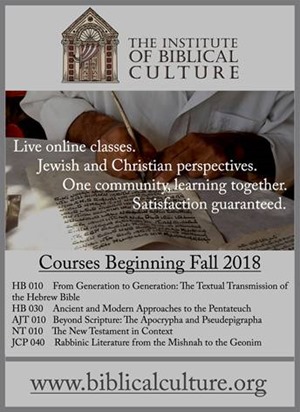
The Institute of Biblical Culture has just launched, and they are registering now for courses beginning in the fall. These live online courses are taught by Jewish and Christian professors on subjects such as biblical literature, biblical archaeology, and biblical backgrounds. You can start here, or go straight to the list of classes being offered this fall.

Here’s one suggestion: you can take a course on Rabbinic Literature, including Mishnah and the Talmud, from a rabbi. The early bird discount ($100 off) ends on Friday.
clip_image002

Share:

I’ve been eagerly awaiting the ESV Archaeology Study Bible for several years now, as the publisher contacted me at an early stage about including some of our photos in it. Now that the project is completed, I am very pleased to see the results. I think this will be a very useful study Bible for many.

Let’s start with the numbers. In addition to the ESV Bible text, the reader gets to enjoy:

  • 2,000+ study notes
  • 400+ color photographs
  • 200+ maps and diagrams
  • 200+ sidebars
  • 15 articles

That’s a lot. To take it on a smaller scale, I counted 15 sidebars accompanying John 1–7, including Bethany and the Place of Jesus’ Baptism, Stone Vessels and Ritual Purity, The Temple Mount, Herod’s Temple, etc.
Image result for esv archaeology study bible

You get a sense for the helpful background information included in the sidebars by looking at those for 1 Corinthians, including Celibacy in Antiquity, Greco-Roman Sacrifice, Roman Banquets, the Isthmian Games, Meat Markets, and House Churches.

Wherever you flip in the Bible, you find abundant explanatory information. I’m doing some work on the post-exilic period and I see these helpful articles:

  • Ezra: Zerubbabel’s Temple
  • Nehemiah: Topography of Jerusalem
  • Esther: Darius’s Foundation Record at Susa

I didn’t expect to see much for the Psalms, but I was very wrong—nearly every page is half-filled with study notes. I am very impressed.

Who is responsible for all of this?

John Currid was the editor for the Old Testament and David W. Chapman was the editor for the New Testament. They were helped by a couple of dozen scholars who wrote study notes and articles. Here are a few names that may be familiar to our readers:

  • Steven M. Ortiz: Joshua, Judges, Ruth
  • Lawrence T. Geraty: Ezra, Nehemiah, Esther
  • Boyd Seevers: Isaiah–Daniel
  • Paul H. Wright: Matthew–Luke
  • Mark Wilson: Acts, Revelation
  • Articles written by Barry Beitzel, Larry G. Herr, Barry Beitzel, Gerald L. Mattingly, and others

As you would expect from Crossway, the approach is generally conservative. Regarding the difficult issue of the Conquest, I think that some conservative scholars who have worked for years on this issue will be disappointed that their research was essentially ignored. It will be interesting to see what reviewers say about this.

Did I mention that there are many maps and charts? The maps are similar to the ones in the well-known ESV Bible Atlas, but of course in a study Bible like this, you get them right in the text where you need them, without the need to pull your atlas off the shelf.

Overall, I think this is a fantastic resource, and I’m very grateful that our team could contribute some of the photographs. Those who tell us that we should make our photos into a book are now going to hear this reply from me: buy the ESV Archaeology Study Bible!

Image result for esv archaeology study bible

Share:

A bust of the Roman Emperor Marcus Aurelius was found in the Temple of Kom Ombo, in Aswan, Egypt.

The subway project in Thessaloniki has yielded over 300,000 artifacts and provided additional information about the city’s 2,300-year-old history.

New evidence shows that Mycenae was destroyed by violence, not by an earthquake (Haaretz premium).

“An eagle-eyed scholar has identified the shadowy outlines of passages from the Bible behind an eighth-century manuscript of the Qur’an – the only recorded palimpsest in which a Christian text has been effaced to make way for the Islamic holy text.”

Pierre Tallet will be lecturing on “The Discovery of the Oldest Papyri of Egypt in Khufu’s Harbor in Wadi el-Jarf (Red Sea)” at the Museo Egizio in Turin on April 30.

Students at Brown University reenacted the Battle of Kadesh between the Egyptians and the Hittites.

CyArk and Google Arts and Culture are partnering to create 3D models of ancient Corinth and other archaeological sites.

On sale for $0.99 for Kindle: Walking in the Footsteps of Jesus, by Wayne Stiles

The Agade list is archived by SBL, and you can find subscription information here.

The new ESV Archaeology Study Bible is a tremendous resource. I hope to post on it here shortly, but in the meantime, you can listen to an interview on The Book and the Spade with John Currid, watch a short video of Currid explaining why archaeology can’t prove the Bible (and doesn’t need to), or watch the publisher’s video introduction. You’ll find the best price for a couple more days at Westminster Bookstore (their genuine leather copy is about the same price as Amazon’s hardcopy; I have a leather copy and it’s beautiful).

HT: Ted Weis, Agade, Joseph Lauer, Mike Harney, BibleX

Share:

A symposium is being held this week in Jerusalem on “The Dead Sea Scrolls at Seventy: Clear a Path in the Wilderness.” The full program is here. The poster is here.

Brad Gray investigates the geographical connection between the leper healings of Naaman and the 10 lepers in the latest episode of The Teaching Series.

Ten students were killed by a flash flood when hiking in Nahal Tzafit this week.

The Druze celebrated their annual pilgrimage to Jethro’s tomb in Galilee last week.

Ferrell Jenkins has written about “the Great Rift” in preparation for a series of articles about the Aravah. His post includes several beautiful photos.

Episode Five of Digging for Truth focuses on the recent excavations of Shiloh.

The site and synagogue of Umm el-Qanatir in the Golan Heights are the subject of an article in Front Page Magazine.

Timna and its copper mines are described by the BBC.

Lyndelle Webster is profiled on the Azekah Expedition blog, and she recounts how her volunteer work changed her life direction.

Israel’s Good Name shares his experience and photos from his visit to Ein Hemed.

Wayne Stiles explains the geographical and theological significance of Kadesh Barnea.

HT: Agade, Joseph Lauer, Paleojudaica

Share: