“In an statement timed just ahead of Passover, the Temple Mount Sifting Project said Sunday it had found a stone finger that may have belonged to a Bronze Age Egyptian statue, but conceded it wasn’t sure.”

For the first time ever, a reenactment of the Passover sacrifice took place in the Jewish Quarter.

Wayne Stiles has released the third video in his virtual tour of the Passion Week.

Carl Rasmussen has written a series of informative posts related to Jesus’s trial and crucifixion, including “Another Gethsemane?,” “Site of Crucifixion of Jesus?,” “Gordon’s Calvary,” and “The Burial Bench of Jesus?

John DeLancey is on The Book and the Spade discussing the latest renovations of the edicule in the Church of the Holy Sepulcher.

DeLancey also recently announced a tour this fall of Egypt, Jordan, and Israel.

An archaeologist claims that a thick layer of sand at Tel Achziv attests to a tsunami that hit the coast of Israel in the 8th century BC.

Evidence discovered below the Dead Sea suggests that there were significant droughts in the past.

On the ASOR Blog, Douglas Petrovich discusses some of his discoveries behind his theory that Hebrew is the language behind the world’s first alphabet. Alan Millard has written a response. You can get a 25% discount on Petrovich’s book with code PET25.

The Linda Byrd Smith Museum of Biblical Archaeology opens today at Harding University in Searcy, Arkansas.

Israel’s Good Name recently went on a Bar Ilan U tour of the Old City and Ramat Rahel.

The latest issue of Biblical Archaeology Review has articles on the Arch of Titus, Magdala, and three more biblical people confirmed by archaeological evidence.

Leen Ritmeyer notes two new apps that take visitors to ancient Jerusalem. Live Science has more about the Lithodomos VR app.

Divers in Italy have begun the search for a third pleasure barge of Emperor Caligula.

The site of Humayma in southern Jordan was probably founded by the Nabatean king Aretas IV early in the first century AD.

“War and Storm: Treasures of the Sea Around Sicily” is a special exhibit of recovered antiquities at Glyptotek in Copenhagen.

According to The Irish News, some of the Chester Beatty manuscripts are now on display in the Chester Beatty Library in Dublin.

John the Baptist would feel right at home at a Mariners’ game with their new menu offering of toasted grasshoppers.

Frederic William Bush, longtime Professor of Old Testament and Ancient Near Eastern Studies at Fuller Theological Seminary, died last week.

HT: Charles Savelle, Agade, Joseph Lauer, Steven Anderson

Share:

Gabriel Barkay believes that they have discovered one of the capitals from Solomon’s Colonnade on the eastern side of the Temple Mount. Leen Ritmeyer seems inclined to agree, but he clarifies an issue with a measurement.

An excavation last month of Qumran Cave 11 resulted in the discovery of an upper chamber, linen textiles, medicinal plants, and leather and wooden artifacts. An international workshop on Cave 11 will be held later this month.

An underground tunnel network from the Bar Kochba period has been discovered in the Hebron hills.

The dating of donkey dung supports a Solomonic-date for a mining camp at Timna Valley in southern Israel.

Construction has begun on the “Sanhedrin Trail,” running from Beth Shearim to Tiberias. It will be a “smart” trail that “will communicate with the hikers using an innovative, augmented reality-based application.” The project also includes the building of a visitor’s center in Tiberias.

After the Temple Mount Sifting Project sent out an urgent plea for funds, the Prime Minister of Israel stepped in to restore the lost funding. Or did he?

The Egyptian Antiquities Ministry announced the discovery of a 13th dynasty pyramid, currently being excavated in Dahshur’s royal necropolis.

A Roman bath complex has been inaugurated in Alexandria.

Magnetometers and ground-penetrating radar has been used to discover the concession stands, taverns, and souvenir shops that surrounded a Roman amphitheater in Austria. (If you substitute “NFL” for “gladiator,” it will all make perfect sense.)

“Colorising the Arch of Titus: The Spoils of Jerusalem” is a new 4-minute video that reveals the results of a recent study led by Steven Fine of the original design and colors of the famous panel.

Ferrell Jenkins shares a couple of photos of the view from Mount Nebo.

Joel Pless suggests a biblical connection in his recent interview on Pompeii and Herculaneum on The Book and the Spade.

Israel’s Good Name recently visited Solomon’s Quarries, the Jerusalem Archaeological Park, and more.

Later this month, New College of the University of Edinburgh will be hosting a conference entitled “Coins and the Bible: Understanding Ancient Coinage.”

This month, Logos is offering Jesus Through Middle Eastern Eyes: Cultural Studies in the Gospels, by Kenneth E. Bailey for only $1.99.

Winged Bull Press released several new titles on April 1. And their new shipping service is a hoot!

HT: Agade, Joseph Lauer, Mike Harney, Ted Weis, Charles Savelle, Alexander Schick

Share:

Wayne Stiles has long impressed me with his knowledge of Israel and his application of the biblical truths to our lives. He’s written three excellent books, and he has faithfully written regular posts on his blog for many years.

But I think his new project is his best yet, and I’d encourage you to take a look.

Wayne has produced a series of three videos tracing the Passion Week of Jesus, “The Week That Changed the World,” as he calls it. It is outstanding. I encourage you to check out these free videos.

It’s a perfect way to prepare for and experience the Passion Week.

See them here: www.passionweektour.com

Share:

It’s been more than 1,900 years since the Jewish people have slaughtered a Passover lamb within the walls of Jerusalem. But this one still doesn’t “count” because it’s not on the Temple Mount. From The Times of Israel:

An annual reenactment of the sacrifice for the upcoming Passover festival will be held for the first time inside the walls of the Old City of Jerusalem.
The High Court of Justice on Monday upheld a police decision to bar a group of Temple Mount activists from holding their annual ceremony at Davidson Park, an archaeological site adjacent to the Western Wall on the southern side of the Temple Mount complex.
But in an unusual move, police on Wednesday said the activists would be allowed go ahead with the reenactment on Thursday in the main square of the Jewish Quarter of the Old City.
[…]
Just like the Passover sacrifice that was offered in the time of the Temple, it will include slaughtering a lamb, flaying it in the traditional manner, throwing its blood on a model altar, and roasting and eating it.

The full article has more details including the time of the event.

Jewish Quarter courtyard from Hurva Synagogue, tb010312412
The Jewish Quarter Plaza, location of the sacrifice demonstration
Share:
(Posted by Michael J. Caba)

This series of posts examines the historical reliability of the New Testament books of Luke and Acts by comparing these books to other ancient textual sources and the archaeological record. In addition, background information on key elements of the various narratives is also given.

One of the persons mentioned in Luke 3:1-2 is “Philip, tetrarch of Iturea and Traconitis.” In addition to this biblical reference, the 1st-century AD historian Josephus also refers to Philip and notes that he was the son of Herod the Great and Cleopatra of Jerusalem (Antiquities 17.1.3). Having been born in c. 22 BC, Philip was assigned a portion (i.e., Iturea and Traconitis) of his father’s kingdom when the later died in 4 BC. Philip ruled until he died in his own turn in AD 34, and Josephus refers to Philip as a “person of moderation and quietness in the conduct of his life and government” (Antiquities 18.4.6).

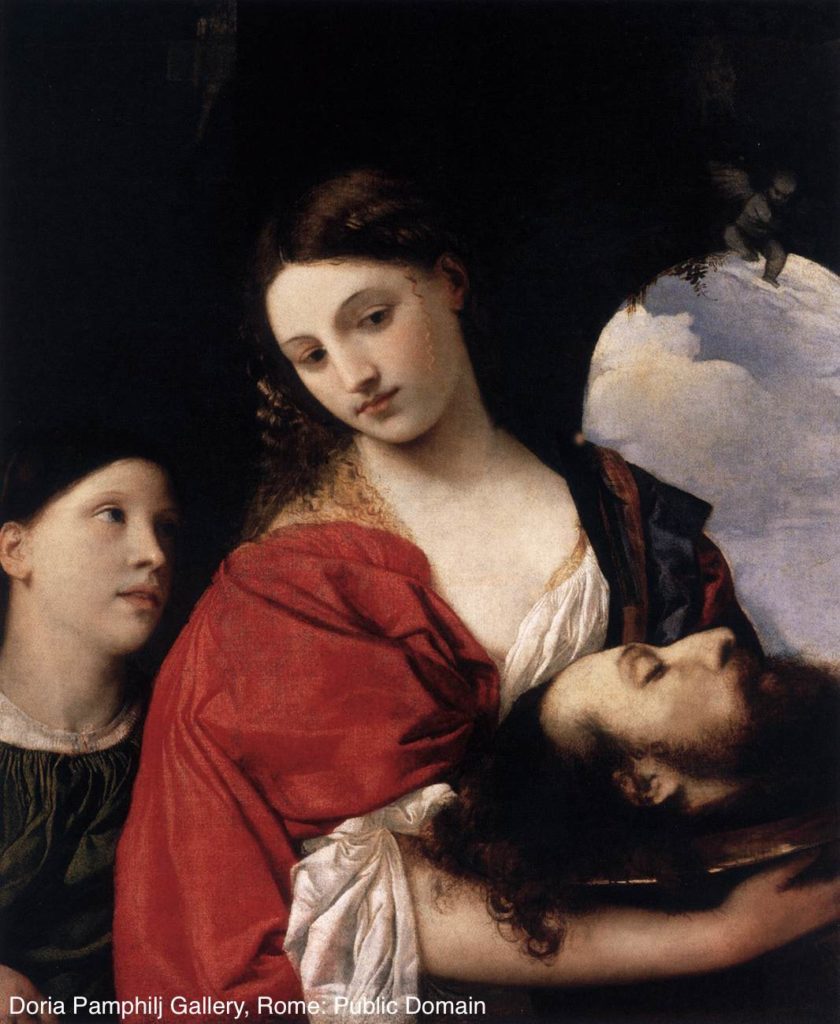
Interestingly enough, despite his apparent affinity for “moderation and quietness,” Philip married Salome, a woman with at least one episode in her life that was anything but moderate and quiet. By way of pedigree, Salome was the daughter of Philip’s half-brother Herod (tetrarch of Galilee) and Herod’s stolen wife Herodias. Further, as a younger woman she is actually the one who danced for this same Herod and his dinner guests, which, as many are aware, led to Herod’s ill-advised promise to give her “up to half” of his kingdom, which in turn led to the violent death of John the Baptist. The sordid details of the event (including the reasons for the death of John the Baptist) are recorded in Mark 6:14-29, and this rather interesting (to say the least) collection of behaviors has ever after been the inspiration for much drama and art, among which is the following work produced by Titian, the Venetian Renaissance master, in c. 1515.

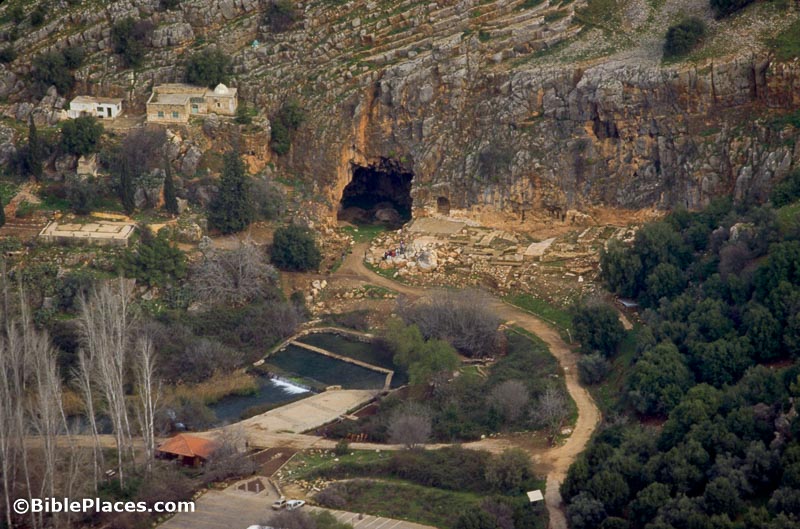
In addition, Philip reconstructed the city of Paneas (originally named for the Greek god Pan) and renamed it “Caesarea Philippi” (after Caesar Augustus and himself) to distinguish it from “Caesarea Maritima,” which was constructed by Herod the Great along the shore of the Mediterranean Sea. It was in the region of Caesarea Philippi, which is north of the Sea of Galilee, that Jesus asked his disciples, “Who do people say the Son of Man is?” In reply, Peter proclaimed, “You are the Messiah, the Son of the living God” (Matthew 16:13-20).  The following aerial photo shows the ruins of Caesarea Philippi including the Cave of Pan (near center of photo) into which offerings to the god were placed.

By way of additional note, the 1st-century AD Jewish philosopher Philo makes reference to Philip when he says that Agrippa, “the grandson of Herod the king,” was eventually given Philip’s territory to rule (Flaccus, V. (25)).

For similar correlations between the biblical text and ancient sources, see Bible and Archaeology – Online Museum.

Share: