Rossella Tercatin writes about the exhibition, “The Girl Who Wrote,” that will open at the Israel Museum when the war restrictions are lifted.

With the museums in Israel currently closed, visitors can take advantage of online offerings, including activities for children.

The Times of Israel writes about the Purim holiday in light of current events.

Bryan Windle concludes his series on Jericho, arguing that it was City V, not City IV, that Joshua conquered.

Katharina Schmidt gives an update on the archaeological excavations at the Amman Citadel in the 2024 and 2025 seasons.

Archaeologists working in Luxor’s West Bank have found a cache of painted coffins with a collection of rare papyri that dates to Egypt’s Third Intermediate Period.

A tour guide in Egypt was arrested for drawing a stick figure into the wall of an ancient pyramid.

A 14-minute video shows how Pompeii looked before its destruction.

Bryan Windle discusses the top ten archaeological discoveries related to Esther on Digging for Truth.

“This past month, the most significant news stories from the world of biblical archaeology all involved stones: a stone seal, a stone vessel workshop, and limestone blocks related to a biblical Pharaoh.”

Zoom lecture on March 9: “Sensing the Synagogue,” by Karen B. Stern ($10). You can get a preview in this BAS article.

New release: Mummy Portraits of Roman Egypt, Volume 2, edited by Marie Svoboda and Caroline R. Cartwright (Getty Museum; open-access, including pdf)

The eBook of Bringing Heaven Here is on sale through Sunday for $3.99 (Kindle, B&N, Apple, Google, Kobo).

Jodi Magness has written a retrospective piece about her career as an archaeologist.

HT: Agade, Explorator, Paleojudaica
Share:

The Israel Museum has relocated some of its significant archaeological artifacts to a secure location. A few photos are posted on Facebook.

Excavations at Emesa (modern Homs, Syria) “reveal the slow transformation of a powerful pagan city into a Christian and then Muslim one.”

Margreet L. Steiner explains why the Assyrian presence in the Levant in the 9th-7th centuries BC left its mark not in material culture but in economic transformation.

Carl Rasmussen shares a link to his recent online seminar on “The Early Church’s Encounter with the Roman Imperial Cult.” His post includes timestamps for each topic.

Hybrid lecture on March 11 at Harvard: “The Future of the Ancient Egyptian Afterlife,” by Rune Nyord (in-person registration; online registration)

ASOR webinar on March 11: “Anatolian Futures: Archaeologies of Anatolia within the Larger Mediterranean,” by Müge Durusu-Tanrıöver

New release: Sex and Sexuality in the Ancient Near East, by Stephanie Lynn Budin (Cambridge Elements; open access through March 10)

New release: For Those Who Sleep in the Dust: Essays on Archaeology and the Bible, by William G. Dever (SBL Press, $56)

HT: Agade, Arne Halbakken, Charles Savelle, Alexander Schick

Share:

A rare half-shekel coin from the First Jewish Revolt was discovered during the IAA’s Judean Desert Caves survey.

Five years after discovering a Crusader sword off the coast of Dor, a diver discovered a second one.

The Times of Israel reports on the new exhibit of the entirety of the Great Isaiah Scroll.

“The Rockefeller Archaeological Museum in Jerusalem is a singular historic gem that more people are getting the opportunity to visit thanks to the guided tours, which began this year.”

Nathan Steinmeyer looks at several examples of “mundane” archaeological discoveries that revealed dramatic insights when studied with the latest scientific methods.

Aren Maeir notes the publication of an article in which he argues that the Middle Bronze cultic structure in the City of David (as proposed by Shukron) is an Iron Age production site.

New release: A Historical Archaeology of Jerusalem: Bronze and Iron Ages, by Yuval Gadot (SBL Press, $62)

Kindle sale: Cultural Backgrounds Study Bible ($3.99, an all-time low; reg; $25; Logos $38)

On Digging for Truth, Seth Rodriquez highlights great discoveries that affirm the Old Testament.

HT: Agade, Arne Halbakken, Charles Savelle

Share:

A 4th-century basilica with a large reception hall has been excavated in Ostia.

A team of researchers has used AI to figure out the rules of an ancient Roman board game.

Authorities are taking action to reduce graffiti at the ancient site of Persepolis.

New benches outside the Roman Colosseum enable the visitor to comprehend just how much larger the amphitheater was before earthquakes destroyed the outer ring.

“A new study suggests that Alexandria on the Tigris was more than a regional city; it functioned as a capital of ancient global trade, linking India, Mesopotamia, and the Mediterranean for more than five centuries.”

New release: The Transjordan in Biblical Literature: A Critical Spatial Approach, by Aubrey Taylor McClain (Gorgias, $76). 

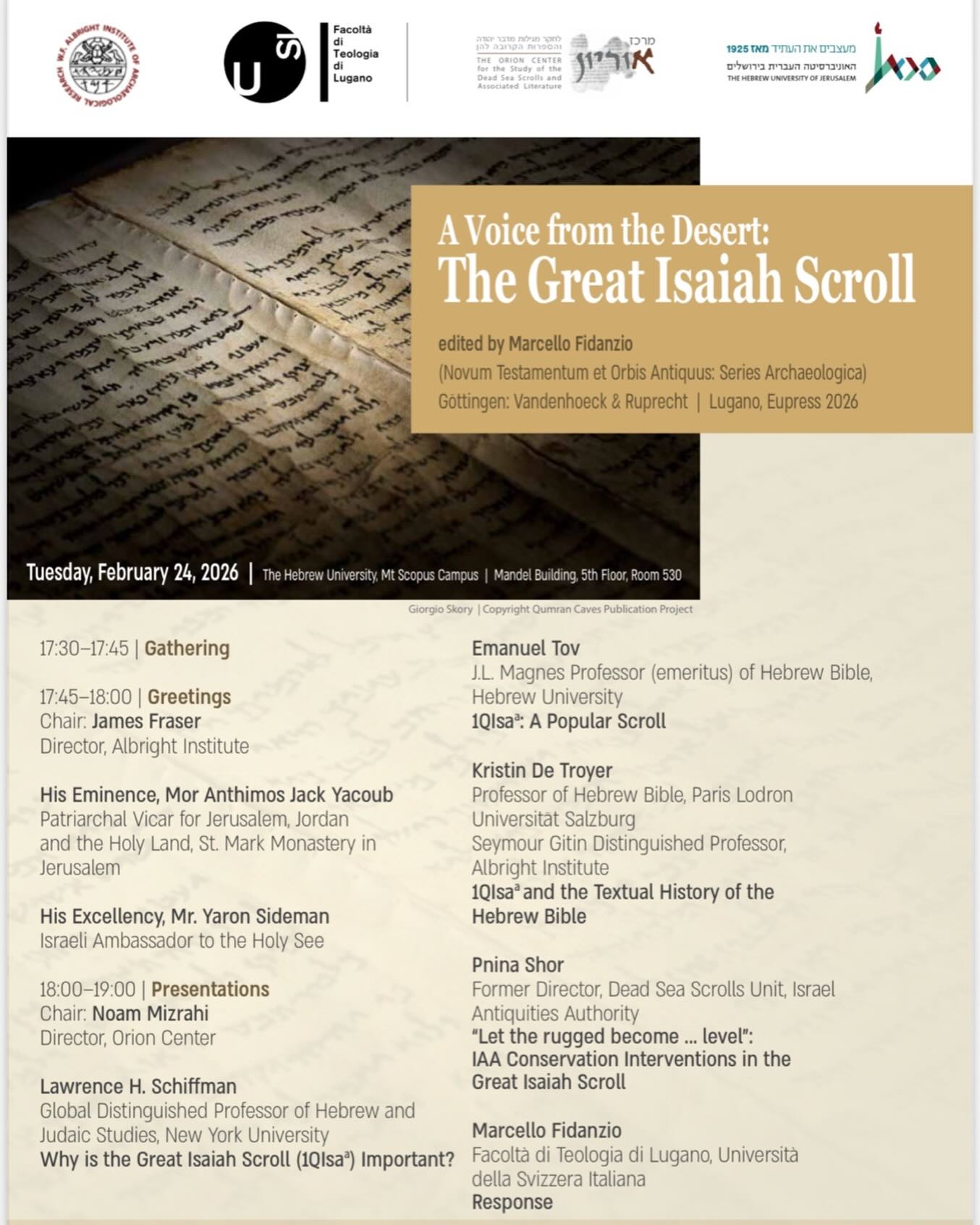
A book launch for A Voice from the Desert: The Great Isaiah Scroll will be held on Tuesday, Feb. 24, 5:30, at The Hebrew University, Mt. Scopus Campus, Mandel Building, 5th Floor, Room 530. Presentations will be made by Lawrence H. Schiffman, Emanuel Tov, Kristin De Troyer, Pnina Shor, and Marcello Fidanzio. The event is open to the public, and no registration is required.

Walking The Text has just released a “behind the scenes” series for The Lord’s Prayer. Six episodes reveal the backstory of the location shoots, the biblical scholarship, and a night in a bunker when missiles were in the air.

HT: Agade, Arne Halbakken, Ted Weis, Explorator

Share:

A stone tool workshop from the Second Temple period was discovered on Mount Scopus in Jerusalem during an investigation by the Israel Antiquities Authority into a gang of antiquities thieves.”

“A rare bronze scale pan was discovered during excavations in the ancient Jewish town of Sussiya by a father and daughter participating in an educational dig.”

A seal discovered in the Temple Mount Sifting Project is a rare find “from Jerusalem’s ‘Second Persian Period,’ the brief 14-year window of Sassanid rule between 614 and 628 CE.”

A Roman cemetery was discovered in the village of Jifna, north of Ramallah.

“The elderly patriarch and matriarch of a prominent Israelite family living in an imposing building in the Judean lowlands nearly 3,000 years ago appear to have enjoyed their own spacious room in a strategic part of the large home, suggesting they continued to play a prominent role within the multi-generation household into their golden years.”

The latest Jerusalem in Brief looks at the history of Absalom’s Pillar through a 19th-century photo, and more.

Hybrid lecture on Feb 26: “A Book in Two Scrolls: On the Bisection of Isaiah,” by Marcello Fidanzio (registration required). This lecture is in conjunction with the Great Isaiah Scroll exhibit which opens to the public on Tuesday (through June 6). The exhibition book is now available for sale in e-book (pdf) format.

Hybrid lecture at the Albright on March 4: “Current Research on the Holy Sepulchre and Faunal Remains,” by Luca Brancazi (Zoom link)

New release: Ashkelon 10: The Philistine Cemetery, by Daniel M. Master, Adam J. Aja, and Rachel Kalisher (Eisenbrauns, $91 with code NR26).

New release: Lahav VIII: The EB III and LB II to Iron II Strata in the Western City at Tell Halif: Excavations in Field III, 1977–1987, by Oded Borowski and Joe D. Seger (Eisenbrauns, $91 with code NR26).

Following the British Museum’s review of the anachronistic use of the term “Palestine,” PaleoJudaica explored what language Second Temple-era Jews used for the land.

Israel’s Good Name describes his visit to the Friends of Zion Museum in Jerusalem.

Bible Mapper Atlas has created a free poster map of Jerusalem in the time of Nehemiah.

HT: Agade, Arne Halbakken, Ted Weis, Explorator, Alexander Schick

Share:

Researchers working at Petra discovered a “rare 116-meter pressurized lead pipeline, an extraordinary feature in the eastern Mediterranean outside urban building interiors.”

An Iron Age Phoenician scarab seal was discovered on Sardinia.

“A recent study of the Ishtar temple at Assur has identified an unusual feature beneath the temple’s earliest floor: a thick layer of prepared sand.”

“A newly discovered chronicle from the early eighth century is giving medieval historians a rare new window onto the political shocks and religious debates that reshaped the eastern Mediterranean in the decades before and after the rise of Islam.” PaleoJudaica has more here.

“Imagine your car, your savings account, and your power grid were all the same thing, and alive. In the ancient Near East, that was the ox.” Lauren K. McCormick has written “an ode to oxen.”

Carlo Rindi Nuzzolo writes about the possibilities that 3D scanning opens up for the understanding of ancient artifacts.

Zoom lecture on Feb 21: “Piramesse – from the City of Wonders to Terra Incognita,” by Henning Franzmeier

Bible Archaeology Report shares the top three reports in biblical archaeology for the month of January.

HT: Agade, Arne Halbakken, Explorator

Share: