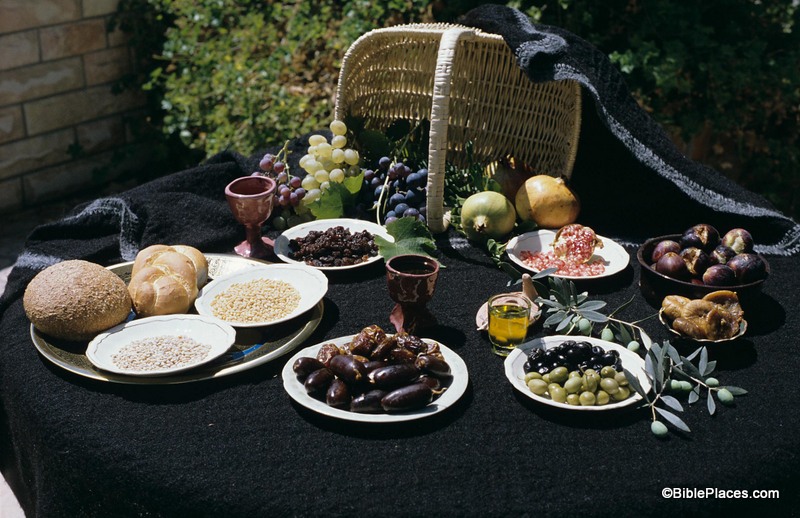
One of my book sets that was acquired through some measure of trial and tribulation is William Thomson’s The Land and the Book. If you’ve done much reading of ancient customs and how they may illuminate the Bible, then you’ve certainly heard of this three-volume work if you haven’t read it yourself. You also may have enjoyed selections from it if you have The American Colony and Eric Matson Collection that was produced by us and published for Accordance.

Logos Bible Software has put the set in its Community Pricing which gives you the opportunity to get the full text for a low price. (The way that C.P. works is that a single bid of $20 is equal to two bids of $10, so feel free to bid low if you get a friend to join you.)

To give you a sense for some of Thomson’s writings, I opened up a few of the American Colony presentations and started reading. I very quickly found a number of quotes that relate very well to my recent study and teaching in Genesis.

For instance, when I was reading Genesis 18, I was struggling with the timeline. The three men show up “in the heat of the day,” eat a prepared calf, and then walk down to Sodom by evening. Apart from the fact that this makes it very difficult (i.e., impossible) to locate Sodom on the northern side of the Dead Sea, I was wondering how the calf could have been cooked so quickly. Thomson’s experience was helpful.

With the Bedâwin it is nearly universal to cook the meat immediately after it is butchered, and to bake fresh bread for every meal. Visit any Arab sheikh, for example, whose tent is now in the valley below us, and you will witness the entire process. A sheep or calf will be brought and killed before you, thrust instanter into the great caldron which stands ready on the fire to receive it, and, ere you are aware, it will reappear on a large copper tray, with a heap of bûrgûl, cracked wheat, or of boiled rice and leben, sour milk. In Cincinnati, a hog walks into a narrow passage on his own feet, and comes out at the other end bacon, ham, and half a dozen other commodities; at the sheikh’s camp, it is a calf or sheep that walks past you into the caldron, and comes forth a smoking stew for dinner. (2: 205)

Of course, we cannot assume that the way things were in the late 1800s are the way things were more than three thousand years ago. But it is possible that traditional ways were maintained for a long time.

Certainly the practice of killing a choice animal for visitors was similar in Abraham’s day as it was among Arabs in 19th century Palestine.

Not only is this true, but amongst the Bedâwin Arabs the killing of a sheep, calf, or kid in honor of a visitor is required by their laws of hospitality, and the neglect of it is keenly resented. They have a dozen caustic terms of contempt for the sheikh who neglected to honor his guest with the usual dabbîhah, sacrifice, as it is universally called—a name suggestive of the religious rite of hospitality as practiced in ancient times by the patriarchs, and frequently confirmed by a solemn oath and covenant” (2: 205).

I’ll close with one more, this one related to the story of Esau.

In my rambles about the outskirts of the town last evening I lit upon a company of Ishmaelites sitting round a large saucepan, regaling themselves with their dinner. As they said “Tŭfŭddâl”—oblige us—very earnestly, I sat down amongst them, and, doubling some of their bread spoon-fashion, plunged into the saucepan as they did, and found their food very savory indeed. The composition was made of the red kind of lentiles which we examined in the market at Jaffa; and I can readily believe, from the little experience I had of its appetizing fragrance and substantial taste, that to a hungry man it must have been very tempting” (2: 252).

I wouldn’t let that Thomson’s experience take anything away from your disdain for a son who despised the glorious promises of God, but it is certainly valuable to be able to “see” things more clearly.

You can bid on the Logos set here. There’s a free Google version here. There are many used copies available, but they come in abridged and 2-volume formats that can make purchasing confusing. You might also consider one of the volumes in The American Colony Collection, such as the fascinating Traditional Life and Customs. For $20, you get 600 photographs and hundreds of interesting quotations from Thomson and many other early explorers.

Bedouin hospitality, having coffee in sheikh's tent, mat05980

Bedouin hospitality (photo source)
Share:

(Post by Seth M. Rodriquez)

In modern America, olive oil is something that is not given much thought or attention. It is occasionally used while cooking, but many people only encounter it while dining at an Italian restaurant when the waiter makes some available for dipping bread. All in all, it is not important in day-to-day life and we could readily do without it.

However, in biblical times, this was not the case. In fact, the opposite was true. Olive oil was something that was used everyday in every house for a variety of imporant purposes. It was used for cooking as it is today, but also much more. Olive oil was used as a base for purfume (Esth. 2:12) or used to anoint someone’s head to show them honor (1 Sam. 16:13, Luke 7:46). It was used as fuel in clay lamps to provide light (Matt. 25:3-4) even in a holy place such as the Tabernacle (Exod. 27:20). It was used in sacrifices (Exod. 29:40) and for medicinal purposes (Luke 10:34). The reason it became so important was not only because it was so versatile, but also because it was readily abundant in the Mediterranean basin where olive trees flourish. But the question arises, how was this vital product produced? One common process used in antiquity is described below.

For our “picture of the week” we will actually be focusing our attention on three photographs because they complement each other so well. They all come from Volume 13 of the revised and expanded version of the Pictorial Library of Bible Lands, which focuses on Cyprus and Crete. This volume is an entirely new addition to the collection. The previous version of the PLBL had no pictures of either island.

The first photo is entitled “Olive Press at Palaipaphos.” (Click on the photo for a higher resolution.) After the olives had been harvested, this type of press was used to break the olives up and prepare them to be squeezed by a second type of press. The olives would be placed in the bottom of the basin and the round stone would be rolled over them.

The second and third photos show the type of press used in the second stage of the process. The second photo is entitled “Olive Press at Larnaca Museum,” and the third, “Idalion Olive Press Factory.”

The top picture is a reconstruction of an olive press at a museum in Cyprus and the bottom shows the archaeological remains of the same type of press at the site of Idalion. They both are of the same type of press but are photographed from opposite angles: the round circles in the foreground of the bottom picture are barely visible in the background of the top picture. Placing the pictures side by side, you can get a good idea of how this type of press worked.

After the olives had been broken up, they were placed in flat, circular baskets and laid on top of the stone circles.  Several baskets would be stacked together. The stack would then be pressed using the large wooden beams shown in the top picture. The pressure on the beams would come from the stone weights which can been seen in both of these pictures: the standing stones with holes drilled through their top section. These stones would be tied onto the beam pulling it down and placing pressure on the baskets and the olives, forcing the oil to ooze out. The oil would then drip down onto the stone bench and would be caught by the circular channel which had been cut into the bench. Within the channel, the oil would be funneled into a spout where it would pour into a basin or vessel. From there the oil would be taken and used for a variety of purposes.

These and other photos of Cyprus are included in Volume 13 of the Pictorial Library of Bible Lands and can be purchased here. More information on olives and olive trees can be found on the BiblePlaces website here and at the Life in the Holy Land website here.

Share:

Vandals spray-painted anti-Christian graffiti on the Dormition Abbey church. UPDATE: The graffiti was near the Dormition Abbey, just outside Zion Gate on the door of the Franciscan Convent.

Haaretz has a photo. (Thanks, Dina.)

Israel and Jordan are planning to work together to rehabilitate the Jordan River.

The case for the authenticity of the Gospel of Jesus’ Wife is getting weaker.

Aren Maeir posts an archaeological note relating to Sukkot.

If you’re interested in historical fiction set in the life of the early church, The Scribes is currently free for Kindle.

The problem with blackmail is that it never stops, even between governments and world-class museums.

How is the Messiah related to the feast of Sukkot? Wayne Stiles explains and illustrates.

HT: Jack Sasson

Man with four species during Sukkot at Western Wall, cd091006002

Sukkot prayers (photo source)
Share:

The Jerusalem Post describes a new program that will allow tourists with smartphones to watch videos instead of enjoying the ancient sites.

Visitors to Judea and Samaria should bring their smartphones along with bottles of water, if they want to learn about the biblical sites that dot Route 60.
Thanks to a program of the Council of Jewish Communities of Judea, Samaria and the Gaza Strip, new signs have been placed at selected spots along the highway, known as the Path of the Patriarchs.
Signs have also been posted at archeological sites in the settlements of Elon Moreh, Susisya and Shiloh as well as in Hebron and by the Lone Tree in Gush Etzion.
Each sign has a bar code that can activate smartphones, whose users have downloaded the free app Scanlife. Once activated, smartphone owners can view videos describing the sites.

The full story is here. Perhaps the plan is not as awful as it sounds.

HT: Charles Savelle

Lebonah valley, tb070507648
The Lebonah Valley along the Road of the Patriarchs
Share:

Nir Hasson writes of Israel’s efforts to survey the whole country for any signs of man-made activity from the past. Archaeologist Adam Zertal has worked on the survey for the last 34 years and is the focus of the report in Haaretz.

“It could be said there isn’t a meter we haven’t covered,” says Prof. Zertal, who walks using crutches, a remnant of an injury from the 1973 Yom Kippur War. “Walking is my rehabilitation. I walk slowly with crutches. The younger guys go much faster.”
This is how the national archaeological survey, one of Israel’s longest-running scientific projects, is being carried out. The aim is to clamber down every ravine, scale every hill and walk through every furrow in the country.
The Israel Antiquities Authority seeks to precisely map every historical and archaeological site west of the Jordan. The project, which began in 1964, is due to end – if at all – in a few decades.
Six years ago the authority stopped publishing thick volumes of the survey’s results; it now uploads the data onto the Internet. It recently launched a revamped website containing 3,000 archaeological sites out of the 25,000 sites mapped to date in half the country.

The Hebrew version of the article has several illustrations, and Joseph Lauer has provided the legend for the survey map:

Red- Active survey sites

Blue – Completed survey sites

Grey – As-yet unsurveyed sites 

Each square on the map – 10 x 10 kilometers

Map-468
Illustration from Haaretz

The IAA website has more details about the survey’s progress and goals. The online database with the 3,000 sites is available here.

I recently compiled, with the help of some friends, a preliminary bibliography of archaeological surveys of Israel and Jordan published in the last few decades. If you know of any additional works, please let me know and I will update the list. The Hebrew publications for the regional surveys are given here.

Share:

Charles Jones has put created an excellent Roundup of Resources on Ancient Geography. Bookmark this one!

There are enough scholars who have serious doubts about the authenticity of the “Gospel of Jesus’ Wife” that when a report circulated that Harvard Theological Review had decided to not publish the article, many scholars believed it. Brian LePort has some of the back and forth.

Mark Hoffman excavated at et-Tell (Bethsaida?) this summer and is sharing his photo book of the dig. (No account is needed to flip through it, and full screen provides the best view.)

Jodi Magness is interviewed in the WAMC Academic Minute about her excavations of the Huqoq synagogue.

Cornell University has received a $200,000 grant from the National Science Foundation for dendrochronology and radiocarbon dating research in the Near East.

A conference at Tel Aviv University in late October will focus on Ancient Greece and Ancient Israel:
Interactions and Parallels (10th to 4th Centuries BCE). The details are available here.

SourceFlix’s latest short is called “Fishers of Men.”


Biblical Archaeology Review is now available as a digital subscription, with the bonus that you get last year’s digital issues.

Robert Mullins gives a day-by-day account of the first season at Abel-beth-maacah. His excitement is justified.

HT: Joseph Lauer, Jack Sasson

Abel Beth Maacah from northwest, tb062900201
Abel Beth Maacah from the northwest
Photo from Pictorial Library of Bible Lands
Share: