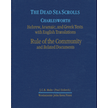
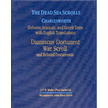
Christianbook.com is running a special on two volumes of James Charlesworth’s The Dead Sea Scrolls. Retailing for $150 each, they are available now for $20. These are not the first books to buy on the Dead Sea Scrolls, but they are essential for more careful study of the sectarian literature.

21994: The Dead Sea Scrolls, Volume 1: Rules of the Community and Related Documents The Dead Sea Scrolls, Volume 1: Rules of the Community and Related Documents
By James H. Charlesworth / Westminster John Knox Press

“This important work brings together all copies of the Dead Sea Scroll text known as THE COMMUNITY RULE (also called the Manual of Discipline), with original Hebrew and English translations on facing pages. This volume offers the most up-to-date research, an indispensable compendium for anyone doing research on the scrolls.” [taken from BIBLICAL ARCHAEOLOGY REVIEW] THE DEAD SEA SCROLLS Vol. 1 was winner of the Biblical Archeological Society Publication Awards–Best Scholarly Books on Archaeology for 1995. Includes introduction, selected bibliography, and footnotes.

22037: The Dead Sea Scrolls, Volume 2: Damascus Document, War Scroll, and Related Documents The Dead Sea Scrolls, Volume 2: Damascus Document, War Scroll, and Related Documents
By James Charlesworth / Westminster John Knox Press

The Princeton Theological Seminary Dead Sea Scrolls Project was established to make available the first comprehensive edition of texts, translations, and introductions to all the Dead Sea Scrolls that are not copies of books in the Biblia Hebraica. Hence the documents composed at Qumran, as well as the Jewish writings composed elsewhere but found in the 11 Qumran caves, are collected in this series.

Amazon has volume 1 for $110 and volume 2 starting at $90.

HT: Peter Wong

Share:

In an article published in the new issue of Biblical Archaeology Review, Emile Puech’s view of the Qeiyafa Ostracon is summarized. He believes that it “announces the installation of a centralized royal administration and it makes this announcement to a distant frontier province. He concedes that it is difficult to establish with certainty whether the new royal administration is that of Saul or David. On balance, however, he concludes that, most likely, the ostracon refers to Saul’s accession.”

Gordon Franz discusses three possible locations for the temple to Augustus near Panias/Caesarea Philippi. He concludes that the site of Omrit is likely the backdrop for Peter’s confession.

Using satellite images taken over a span of 40 years, Shmuel Browns shows how the Dead Sea is shrinking.

The first quarter of 2012 saw a record number of tourists to Israel.

The Israel Nature and Parks Authority says that if visitors pay they are less likely to trash a site.
Aren Maeir has announced a major scholarship for those wishing to join the excavations at Gath and/or Tel Burna this summer. The application deadline is May 6.

HT: BibleX

Omrit temple from east, tb032905151

Roman temple at Omrit
Share:

A local CBS station has more on the new Leviticus fragment of the Dead Sea Scrolls going on display this summer in Fort Worth.

The fragment is 14.5 centimeters long and 8 centimeters high. It was put on display for CBS 11 in the MacGorman Chapel. Seminary President, Dr. Paige Patterson, is thankful to have it.
[…]
The scrap is called Paleo Leviticus. Paleo means old and Leviticus is the name of the third book in the old testament.
The Dead Sea Scrolls were first discovered in 1947. A shepherd looking for a goat threw a rock into a cave in Qumran and heard something shatter.
[…]
One of the scriptures in the fragment is Leviticus 22:21. It tells how a special offering needs to be without defect or blemish which is symbolic of the Messiah.
Steven Ortiz, a Biblical Archeology Professor at the seminary said, “What we do in archeology is actually put the flesh and blood on the actual stories.”
Ortiz is currently involved in two important digs in Israel and Cyprus.
He said, “I think a lot of times, people sitting in pews hear these stories and think of them like Aesops Fables and what we do in archeology is actually put the flesh and blood on the actual stories.”

That recalls a statement by William F. Albright: “Writing without artifacts is like flesh without a skeleton, and artifacts without writing are a skeleton without flesh.”

The story includes a video with images of the fragment. More information about the exhibit can be found here.

HT: Joseph Lauer

Share:

The news report was that Tel Shiloh would receive about $1.3 million for renovation and preservation of the site, besides an additional $2.5 million from private sources. Only a few bloggers seem to note the new archaeological excavation underway on the southwestern side of the tell, with work scheduled to begin on the proposed tabernacle site in a few weeks.

Arutz-7: “Muslims hurled stones and shoes at police escorting Jewish and Christian visitors on the Temple Mount in Jerusalem’s Old City on Tuesday.”

JPost: “The Tourism Ministry on Tuesday launched an online ballot where the public can vote on what shape the NIS 833 million renovation of the Dead Sea will take in the coming years.”

NASA has a photo showing the weekend’s snowfall on Mount Hermon and the ranges to the north.

Wayne Stiles connects the beauty on display at Neot Kedumim with the Passover holiday.

The Jerusalem Post has a new column named “All Out Adventure.” It begins with a rather tame outing to Sataf in the Judean hills.

Tom Powers has an interesting and well-illustrated post on the Historic Valley Railway that once connected Damascus to Haifa.

G. M. Grena teases his readers with an Arabic-English riddle. I think I can make some sense of it.

James Hoffmeier’s recent lecture on what his archaeological work in Egypt tells us about the exodus is online for viewing.

The royal garden at Ramat Rahel is described in a brief but helpful summary by LiveScience.

HT: BibleX

Shiloh excavations on southwest side, tb010212234

Recent excavations at Shiloh
Share:

The Museum at the Lowest Place on Earth is scheduled to open in April. Displays will share the history of the area, including artifacts from Bab edh-Dhra, Numeira, and the Monastery of Saint Lot.

The museum is located at Deir Ain Abata on the southeastern side of the Dead Sea.

The latest issue of Biblical Archaeology Review has been published. The cover story, not online, will be of interest to many readers here. Amihai Mazar asks “Was King Saul Impaled on the Wall of Beth Shean?” Hershel Shanks writes an editorial on ancient toilet practices.

Amazon is selling the brand-new Rose Guide to the Temple (previously recommended here) for only $20. I’m not sure how long that deal will last.

The life and work of British archaeologist John Garstang is now being celebrated in an exhibition at the Blackburn Museum.

Haaretz reports on some of the history and controversy of the early 20th century photographs of Elia Kahvedjian.

A visit to the synagogue of Baram provides a window to Jewish life in the land of Israel for the last 2,000 years.

HT: Jack Sasson, Joseph Lauer

Baram synagogue, tb032807948

Synagogue of Baram
Share:

Question: I read in a commentary the claim that the Dead Sea is visible from the top of the Mount of Olives. When I was there we didn’t go all the way to the top. Is this true? –K.P.


Answer: On most days you would not be able to answer this question because the air is so hazy. On a rare clear day, you would have this view just up the slope from Bethphage, with a sliver of the Dead Sea visible below the horizon.

Bethphage from Mount of Olives showing wilderness, mat02531

View of the Dead Sea from the Mount of Olives (photo source)
Share: