A sonar survey has identified a large stone structure on the floor of the Sea of Galilee. It may be related to the contemporary third-millennium BC site of nearby Beth Yerah (Khirbet Kerak). The scientific article includes illustrations.

Archaeologists have discovered a port on the Red Sea from the time of Pharaoh Cheops.

Admission to the Israel Museum is free on Independence Day, April 16.

Sharks are rare in the Mediterranean Sea but not in the Red Sea. One came close to swimmers in Eilat last week.

Gannon University in Erie, Pennsylvania, has inaugurated its Archaeology Museum Gallery.

If Israel was ever mapped out on the game of Monopoly, Megiddo would be Boardwalk.

Kyle Pope has written a good article on “The Hinnom Valley and Jesus’ Teaching on Final Punishment.” Barry Britnell shares a photo of the valley.

Details for volunteers for this summer’s dig at Tel Burna are now available. Apply before May 1.
zmetro has four 360-degree panoramas of Laodicea. The excavators and restorers are making great progress at the site.

HT: Charles Savelle, Tony Lawrence, Jack Sasson, Joseph Lauer

ijna12005-fig-0004
Stone structure under the Sea of Galilee 
Illustration by Shmuel Marco
Share:

Archaeologists working for the Israel Antiquities Authority (IAA) recently excavated a unique ritual bath (mikveh) in the Kiryat Menachem neighborhood of Jerusalem (southwest of the Old City). Three separate collecting tanks (otzar) were carved into the rock in order to collect as much rainwater as possible.

The IAA press release quotes Benyamin Storchan, director of the excavation:

Numerous ritual baths have been excavated in Jerusalem in recent years, but the water supply system that we exposed in this excavation is unique and unusual. The ritual bath consists of an underground chamber entered by way of steps. The miqwe received the rainwater from three collecting basins (otzar) that were hewn on the roof of the bath, and the pure water was conveyed inside the chamber through channels.
The ritual baths known until now usually consist of a closed cavity that was supplied with rainwater conveyed from a small rock-cut pool located nearby. The complex that was exposed at this time is a more sophisticated and intricate system. The bath was apparently associated with a settlement that was situated there in the Second Temple period. Presumably, due to the rainfall regime and arid conditions of the region, the inhabitants sought special techniques that would make it possible to store every drop of water.
It is interesting to note that the bath conforms to all of the laws of kashrut, like collecting the water in it naturally without human contact, and ensuring that the water does not seep into the earth which is why the bath was treated with a special kind of plaster.

The full press release is here, and three high-res photos are available in a zip file. The story is also reported by the Jerusalem Post and Arutz-7.

mikveh-kiryat-menachem-iaa-3
Archaeologist Benyamin Storchan stands in the immersion chamber of the mikveh.
mikveh-kiryat-menachem-iaa-1
Aerial view of the excavations
mikveh-kiryat-menachem-iaa-2
Aerial view of three storage tanks and channels
All photos courtesy of the IAA. The second and third are by Skyview.
Share:
(post by Chris McKinny)


For an introduction to this series see here.


It seems only a short time ago that archaeologists were saying that there were only 3 positively identified 1st century CE synagogues in Israel – Herodion, Masada and Gamla (See “Synagogues” in Anchor Bible Dictionary, Meyers 1992: 6.255). In the case of Herodion and Masada – these are relatively late synagogues as they were both converted from Herodian structures during the first Jewish Revolt (66-73 CE). The Gamla synagogue represented the only tangible archaeological evidence of a synagogue built for the primary purpose of being a synagogue (versus later retrofitting).

The 2009 discovery of the first century CE synagogue at Magdala changed that perception. We have discussed this discovery on several occasions, including a debate regarding the function of the building and the possibility of excavating at the site with costs covered by the excavation. I asked on a recent visit and this offer still stands, according to the staff at the site. Also from what I gathered their work will continue long after 2013, as they had stated previously – see here for pictures of volunteers from fall 2012.


Directions 


View Secret Places: BiblePlaces in a larger map (toggle between different map view in top left corner – other views might provide easier driving directions)

Getting to the first century remains at Magdala is quite simple – from Tiberias it is a mere five-minute drive to the north of town – make a right at “Magdala Hawaii” and turn into the construction site – there will be a sign that says “Magdala” and two small office buildings on each side of the road in front of the excavations.

Touring Suggestions 

Upon arrival you will be met by a security guard who will ask you to donate money to the project (there is no admission fee) – he will also give you instructions on where you can and cannot go on the site. The guard might also offer a few words of insight about the site – take what he says with a grain of salt. The following instructions are tentative as visiting protocols will change as the Magdala Center project develops (for comparison note the complete absence of buildings in this area in the Google Maps view above).

Update 4/8/2013 – Entrance information: Opening time  Monday-Friday 8-1pm. Email contact (HT: Shmuel Browns)

Historical Background and Discussion

Magdala means tower (Hebrew – migdal). It is never mentioned by name in the Gospels, rather the site name only appears when identifying Mary Magdalene apart from the other Marys (e.g. Matthew 27:56). Had the other Marys been named Salome instead of the ubiquitous “Mary” it is likely that even “Magdalene” would not be part of the New Testament record.

Before the founding of Tiberias as capital of Galilee in 20 CE under Herod Antipas, Magdala (Josephus calls the site Taricheae, which means fish) was the main administrative center (toparchy) of eastern Lower Galilee beneath the authority of Sepphoris, Antipas’ Galilean capital. In 20 CE, the capital shifted from Sepphoris to Tiberias and Magdala lost its administrative significance, but remained an important site. Later on in the 50s CE the site was ceded to Herod Agripa II (son of Agrippa I, grandson of Aristobolus, great-grandson of Herod the Great) and later still in 66 CE it was the site of a  naval battle between the Romans under Vespasian the result of which was the total defeat of the Jewish forces (including the execution of thousands inside the stadium at Tiberias). This naval war also produced one of the most interesting archaeological finds of all-time – the so-called “Jesus Boat,” which probably owes its exceptionally rare preservation to the unique events that transpired during the onset of the first Jewish Revolt. (For more information regarding Magdala’s historical background see James Strange “Magdala Magdalene,” Anchor Bible Dictionary 4:463).
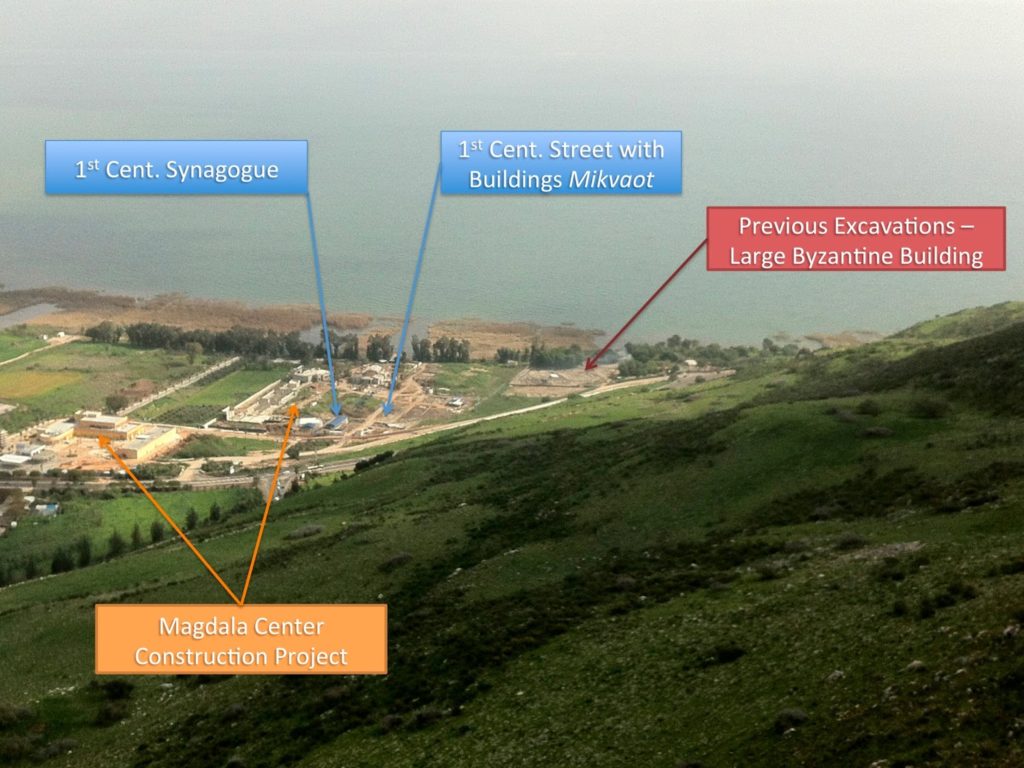
Magdala from the eastern side of Mt. Arbel looking east towards the Sea of Galilee

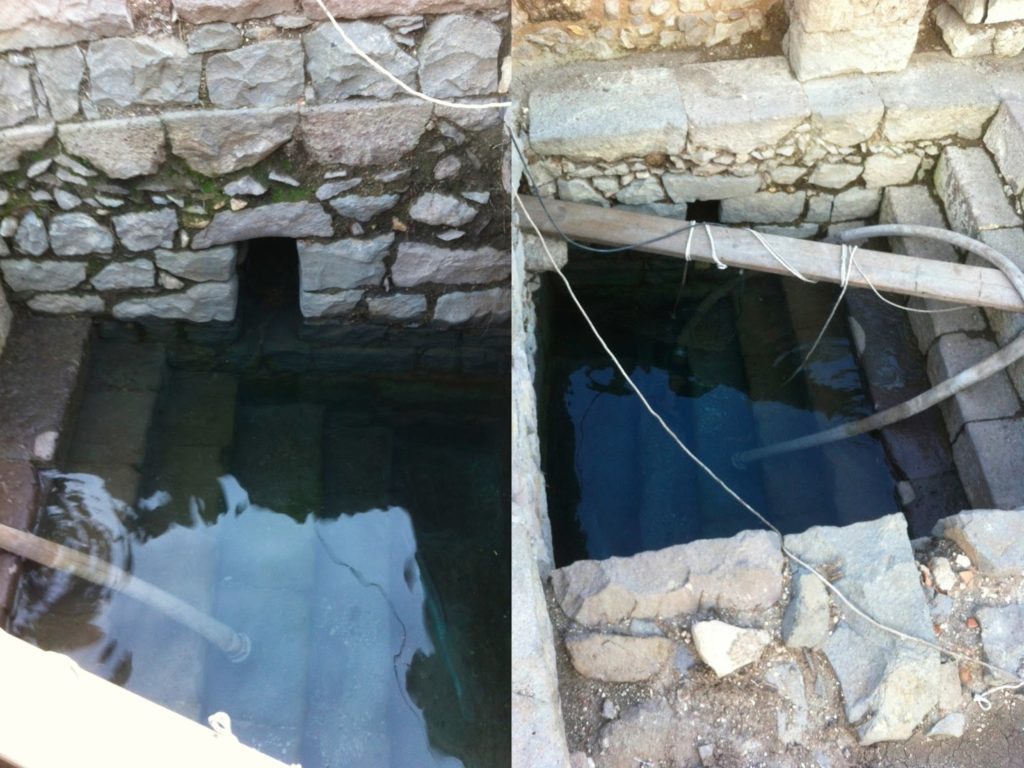
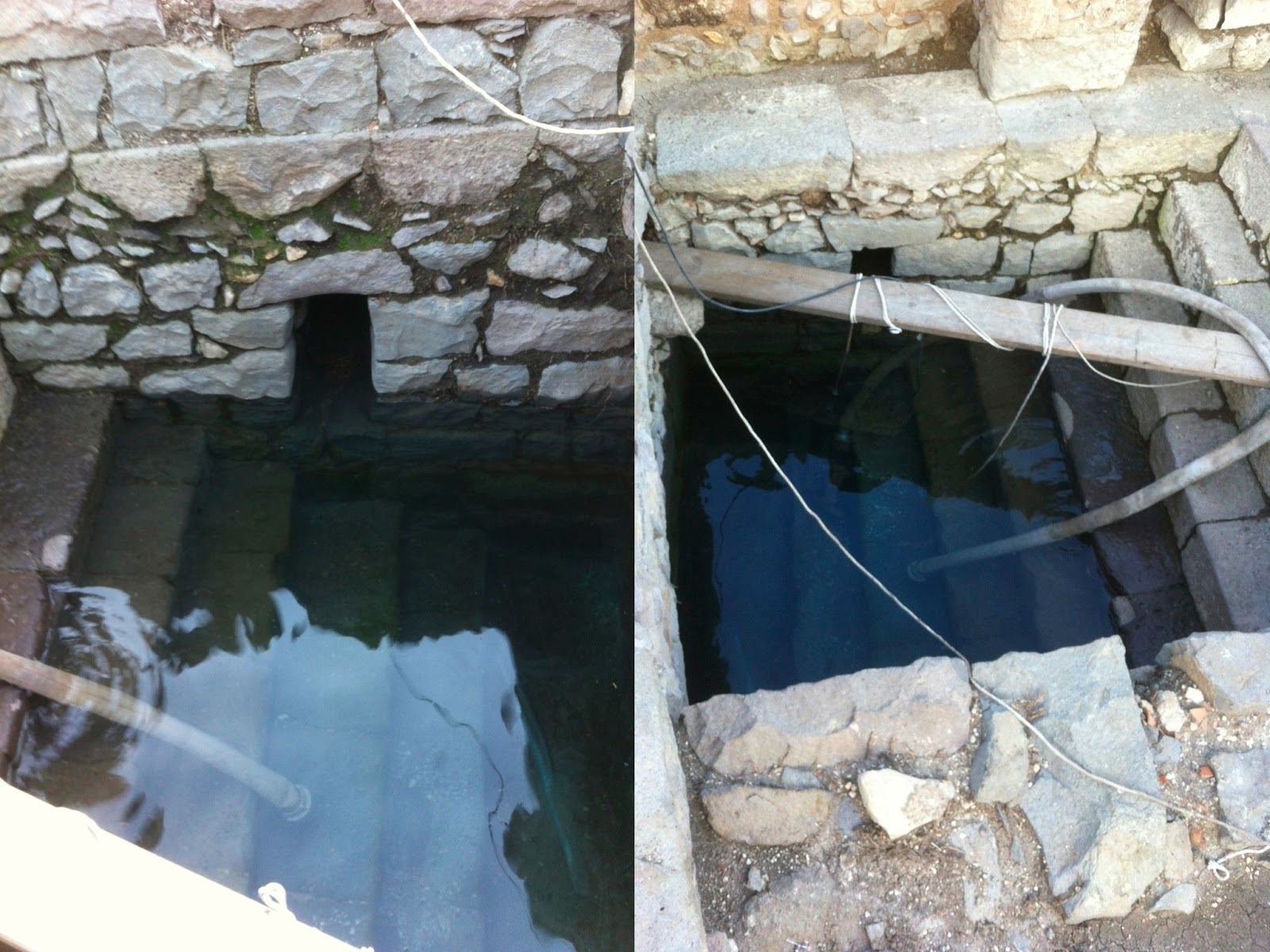
The synagogue is on the left side of the road, as of March of 2013 visitors could still not go into the synagogue itself, but you will be able to view the beautiful synagogue from a distance. As fascinating as the synagogue is – what caught my eye was the extremely well-preserved, presumably first cent. CE street ca. 30 meters south of synagogue (see picture above). Along this street one can easily make out several mikvaot (ritual baths) that seemed to be fed by means of a canalization system and remains of the foundations of buildings constructed from basalt (black volcanic rock typically used in construction in the Golan Heights).
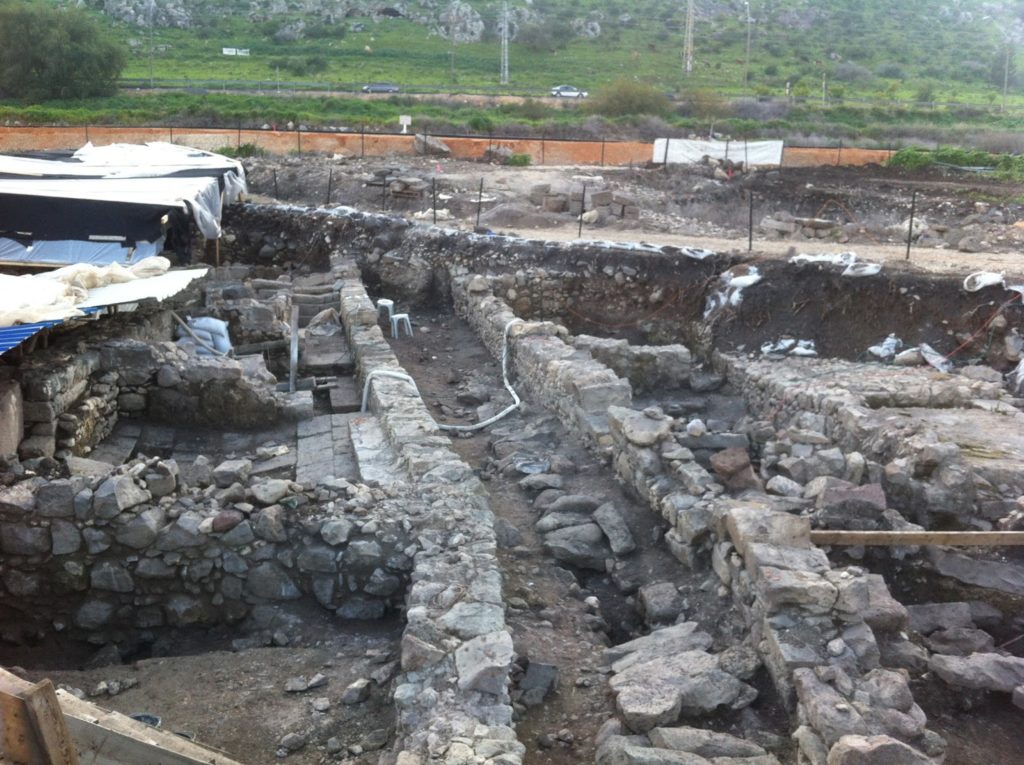
Magdala Street – notice the slabs in the center of the street that cover the canalization/sewage system, the mikvaot are to be found on the left side of the picture (that is the south side of the street – the picture is looking west to the foot of Mt. Arbel with highway 90 in the distance)

Mikvaot? There are at least four of these along this street, notice the extremely well-preserved steps and opening for presumably filling the pool. 

While final say will go to the excavators of this important site, it seems quite clear that the remains around the synagogue, including the street with presumed mikvaot, all date to the same time period – the excavators have claimed that the synagogue is first century CE on the basis of coinage and pottery. It therefore seems likely that the connected buildings date to the same time period. Beyond the clear connection of this site to Mary Magdalene of the Gospels this Early Roman town has the potential to illuminate many details of first century, Galilean village dynamics.

In conclusion, this exciting new site should be considered a “required” stop on any trip to Israel that makes it to the Sea of Galilee. In the opinion of this author, Magdala is a more important site for folks interested in New Testament and Second Temple Judaism than say, Tabgha or Chorazin (primarily 4-5th cent. CE Byzantine remains with New Testament textual connections). Magdala has the potential of illuminating our understanding of first century daily village life (i.e. the very time of Jesus’ ministry) in the same way that Qatzrin has illuminated our understanding of everyday Jewish life in Mishnaic/Talmudic times. 

Share:

The Israel Antiquities Authority has issued a press release on the latest discovery:

Recently impressive remains of an industrial installation from the Byzantine period which was used to extract liquid were exposed on Hai Gaon Street.
Installations such as these are usually identified as wine presses for producing wine from grapes, and it is also possible they were used to produce wine or alcoholic beverage from other types of fruit that grew in the region. Yafo’s rich and diverse agricultural tradition has a history thousands of years old beginning with references to the city and its fertile fields in ancient Egyptian documents up until Yafo’s orchards in the Ottoman period.
According to Dr. Yoav Arbel, director of the excavations on behalf of the Israel Antiquities Authority, “This is the first important building from the Byzantine period to be uncovered in this part of the city. The fact that the installation is located relatively far from Tel Yafo adds a significant dimension to our knowledge about the impressive agricultural distribution in the region in this period. The installation, which probably dates to the second half of the Byzantine period (sixth century – early seventh century CE), is divided into surfaces paved with a white industrial mosaic. Due to the mosaic’s impermeability such surfaces are commonly found in the press installations of the period which were used to extract liquid. Each unit was connected to a plastered collecting vat. The pressing was performed on the mosaic surfaces whereupon the liquid drained into the vats. It is possible that the section that was discovered represents a relatively small part of the overall installation, and other elements of it are likely to be revealed in archaeological excavations along adjacent streets which are expected to take place later this year.”

The full story is here. Three high-resolution images are available here. Haaretz has a report here.

inst west-east
Byzantine winepress excavated in Jaffa. Photo by IAA.
Share:

The Times of Israel takes its readers into the new Herod exhibit at the Israel Museum one week ahead of its opening. The article includes many photos, but may be slow loading.

Wayne Stiles has put together some great visual resources of Caesarea, including photos, video, map, and Google Street View.

City Lights over the Middle East – NASA has posted a short video taken from the International Space Station.

Air pollution has been a problem since the days of ancient Rome.

The Oriental Institute has launched its Integrated Database. Phase II will include images.

Metro publishes the “Top 10 archaeological finds of all time.”

Yosef Garfinkel will be lecturing on “Sanctuaries and Cult at Khirbet Qeiyafa” at the Southern
Adventist University’s Lynn H. Wood Archaeological Museum Lecture Series.

Keith Schoville is retiring from The Book & The Spade radio program.

I am excited to announce that our photo collection Views That Have Vanished is now available as a
module for Accordance. The collection now has all the bells and whistles you would expect from Accordance.

HT: Daniel Wright, Aren Maeir, Charles Savelle, Jack Sasson

views-vanished-bivin-accordance
Screenshot from Views That Have Vanished
Share:

The rain in Israel has turned to snow. Jerusalem is all but closed. A meter of snow fell on Mount Hermon overnight. The Sea of Galilee is up 6 inches. Haaretz is calling this the biggest storm in a decade with Israel’s main highway closed for 9 hours. Wind gusts in Haifa reached up to 75 miles per hour.

BBC reports that Gaza’s archaeological treasures are at risk from war and neglect.

Ferrell Jenkins explains the significance of Gaza.

Artifax and The Book & The Spade Radio program have posted their Top Ten 2012 Discoveries.

They are similar to our (unnumbered) list. Leen Ritmeyer picks his top two.

The conclusion from the 2012 excavations south of the Temple Mount (aka “Ophel”) is posted in an 11-minute video, concluding with a tour by archaeologist Eilat Mazar.

Thirty Days in the Land with Jesus: A Holy Land Devotional, by Charles H. Dyer, is for sale on Kindle for $1.99 this week. The 248-page book was released in 2012.

HT: Charles Savelle

Ophel Walls Iron Age tower, tb010112136

Iron Age tower in Ophel Excavations
Photo from Pictorial Library of Bible Lands
Share: