From the Times of Israel:

Israeli archaeologists digging under a road in Jerusalem have uncovered the remains of an agricultural community that could yield new information on the lives of residents before and after the rise of the Hasmonean dynasty around 2,200 years ago, the Israel Antiquities Authority said Monday.
The excavation in the city’s modern-day Kiryat Hayovel neighborhood has yielded a perfume bottle, wine press, bread oven and the remains of houses and agricultural buildings, according to an IAA statement.
Archaeologists also found a hand-made lead weight with a letter carved on it — seemingly the letter “yod,” the tenth letter of the Hebrew alphabet and the equivalent of the English letter “y.”
The community seems to have been active both before and after the Maccabees took Jerusalem and re-dedicated the Temple in 164 BCE, marking the beginning of Hasmonean rule, according to the IAA.
That victory is commemorated this week by the festival of Hanukkah.

The story continues here. Kiryat Hayovel is three miles southwest of the Old City.

HT: Joseph Lauer

workers-revealing-rock-cut-foundations-635x357-IAA
Excavations in Kiryat Hayovel. Photo by Israel Antiquities Authority.
Share:

From the Christian News Network:

Archaeologists have uncovered what they believe is a road that was traveled by Jesus and the disciples in the ancient town of Bethsaida.
In conducting a dig near the Northeastern shore of the Sea of Galilee in Israel, which was originally meant to serve as a mission to find artifacts from the Roman period, archaeologists came across a distinctive discovery.
“We uncovered a paved street from the time of Jesus’s disciples, which runs westward through the residential area from the corner of the Fisherman’s House down toward the Jordan valley,” Nicolae Roddy of Creighton University in Omaha, Nebraska, one of the leaders of the dig, told the publication Popular Archaeology. “I tell people that Andrew, Peter and Phillip almost certainly walked on it because they would have had to have gone out of their way to avoid it!”

The article does not include a photo, and I don’t see any other reports on this besides this brief one.

HT: Joseph Lauer

Bethsaida house of fisherman, tb060105684

Newly discovered road ran from the “house of the fisherman” shown above toward the Jordan River. Photo from the Pictorial Library of Bible Lands.
Share:

A press release from the American Friends of Tel Aviv University announces the recent discovery of a holy place that was not always a holy place.

Tel Aviv University researchers have uncovered a unique 11th-century BCE sacred compound at the site of Tel Beth-Shemesh, an ancient village that resisted the aggressive expansion of neighboring Philistines. The newly discovered sacred complex is comprised of an elevated, massive circular stone structure and an intricately constructed building characterized by a row of three flat, large round stones. Co-directors of the dig Prof. Shlomo Bunimovitz and Dr. Zvi Lederman of TAU’s Sonia and Marco Nadler Institute of Archaeology say that this temple complex is unparalleled, possibly connected to an early Israelite cult — and provides remarkable new evidence of the deliberate desecration of a sacred site.
[…]
After ruling out the use of the site as a domestic structure, the researchers knew that they had found something unique. Excavations revealed almost only shards of painted chalices and goblets found spread on the floor but no traces of domestic use. One of the three flat stones was surrounded by animal bone remnants, and the two other stones were seemingly designed to direct liquids. These clues convinced Prof. Bunimovitz and Dr. Lederman that they had uncovered a likely place of sacred worship.
But the temple didn’t remain sacred. Samples of earth taken from layers above the destroyed temple and analyzed at the Weizmann Institute of Science revealed astonishing results. Directly above the temple was a packed-in layer containing phytoliths (remains of weeds that are commonly eaten by livestock) and spherulites (microscopic remnants of manure produced by grass-eating animals), indicating the presence of animal pens directly on top of the sacred site, explains Prof. Bunimovitz. Intermittent burning in order to clean the pens likely resulted in the concentrated state of the layer.
This desecration was no accident or coincidence, the researchers believe. Instead, it represents the see-saw of political might between the Philistines and the local population. Presumably the Philistines gained temporary control of Beth-Shemesh, and brought in livestock to live on what they knew had been a sacred site to their enemies.

The article does not mention Samson, but this is roughly the period when he lived in the town across the valley.

HT: David Coppedge

Zorah and Eshtaol from Beth Shemesh, tb062300343
View from the excavations of Beth Shemesh towards Samson’s place of birth and burial
Share:

The Jerusalem Post reports on recent discoveries made in connection with development projects in the Jerusalem area. (Emphasis added.)

In order to secure the necessary construction permits from the Interior Ministry, public works projects need approval from the IAA [Israel Antiquities Authority]. Preconstruction surveys during preparation for the expansion of Highway 1 around the Motza Interchange have yielded a plethora of new discoveries, including Iron Age buildings at Tel Motza, explained Dr. Doron Ben Ami, a chief researcher at the HU archeology institute. At the Motza Stream, archeologists discovered ruins dating back to the Neolithic period and an enormous underground water reservoir from the Crusaders.
Pre-construction surveys of the Ramot highway have yielded discoveries of Roman terraces. And when baseball fans in Ramat Beit Shemesh decided to build a baseball field, they discovered a new field of dreams: Just a few centimeters below the surface, there were hundreds of clay pots and figurines.
Nearby, archeologists discovered an enormous burial ground from the Bronze Age.
Even in the posh Jerusalem neighborhood of Rehavia, construction of fancy new apartments can sometimes lead to the most startling archeological discoveries. A 6-meter-high column was unearthed during construction of a new apartment building on the leafy neighborhood’s Abarbanel Street, leading scholars to believe it could have been a Byzantine era quarry. The column was mostly likely destined for one the magnificent cathedrals of the era before it cracked and became dangerous to move.

The full story is here.

HT: Joseph Lauer

Share:

Excavations along a highway in northern Israel revealed a 50-acre site dating to the Neolithic period. One of the most impressive discoveries was a small stone bowl with several hundred stone beads.

Among the special finds that were uncovered in the excavation is a group of small stone bowls that were made with amazing delicacy. One of them was discovered containing more than 200 black, white and red stone beads. Other important artifacts are clay figurines of animals (sheep, pig and cattle) that illustrate the importance of animal breeding in those cultures. The most importance finds are stone seals or amulets bearing geometric motifs and stone plaques and bone objects decorated with incising. Among the stone plaques is one that bears a simple but very elegant carving depicting two running ostriches. These objects represent the world of religious beliefs and serve as a link that connects Ein Zippori with the cultures of these periods in Syria and Mesopotamia. According to Milevski and Getzov, “The arrival of these objects at the ʽEin Zippori site shows that a social stratum had already developed at that time that included a group of social elite which used luxury items that were imported from far away countries”.

The full press release is here, and three high-resolution images are also available. The discovery is reported by the Jerusalem Post and Haaretz.

DSC_1523

Photo by Clara Amit, courtesy of the Israel Antiquities Authority
Share:

Nadav Shragai has written an extensive and interesting report of the newly discovered reservoir near the Temple Mount. If you’re interested in Jerusalem in the Old Testament period, this is a must-read.

2.5-minute video takes you inside the reservoir (Hebrew).

The Western Wall has passed its annual health check-up.

Excavation reports on the Mount of Olives reveal settlement in the OT and NT periods.

“I am the gate for the sheep,” said Jesus. A new 2-minute video short from SourceFlix illustrates what that means with footage from the Middle East.

Whether you love the water-soaked landscape of Caesarea Philippi or the parched terrain of the Judean wilderness, you can enjoy some great weekend reading, illustrated with slideshows and videos.

BibleX points to a couple of publications now online for the Church of the Holy Sepulcher in Jerusalem.

The IDF has begun clearing 700 mines from the Jordan Valley.

Sitting at the Feet of Rabbi Jesus, by Ann Spangler and Lois Tverberg, is marked down to $2.99 for Amazon Kindle for a few days.

Christianbook.com has some good deals on reference works beginning today:

HT: Joseph Lauer

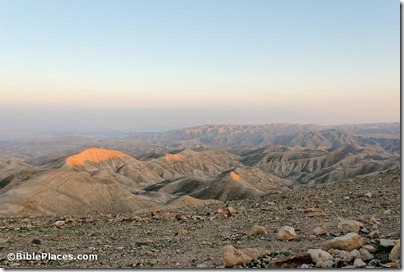
Judean wilderness at sunset, tb021107716
The Judean wilderness at sunset
Share: