Recent discoveries of a cultic significance were announced today in a press conference at Hebrew University. Archaeologists Yosef Garfinkel and Saar Ganor believe that they have found religious objects from the time of King David at Khirbet Qeiyafa in the Shephelah of Judah.

The three shrines are part of larger building complexes. In this respect they are different from Canaanite or Philistine cults, which were practiced in temples – separate buildings dedicated only to rituals. The biblical tradition described this phenomenon in the time of King David: “He brought the ark of God from a private house in Kyriat Yearim and put it in Jerusalem in a private house” (2 Samuel 6).
The cult objects include five standing stones (Massebot), two basalt altars, two pottery libation vessels and two portable shrines. No human or animal figurines were found, suggesting the people of Khirbet Qeiyafa observed the biblical ban on graven images.

The two portable shrines are of great interest and may help us to understand some difficult terms in the Hebrew Bible.

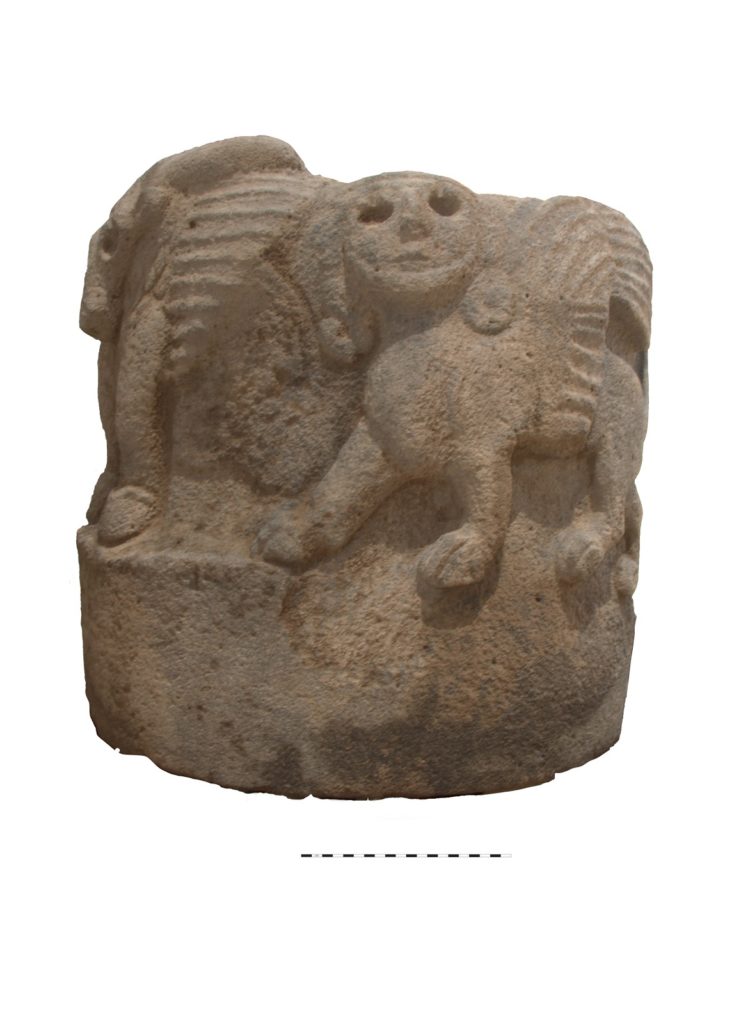
Two portable shrines (or “shrine models”) were found, one made of pottery (ca. 20 cm high) and the other of stone (35 cm high). These are boxes in the shape of temples, and could be closed by doors.
The clay shrine is decorated with an elaborate façade, including two guardian lions, two pillars, a main door, beams of the roof, folded textile and three birds standing on the roof. Two of these elements are described in Solomon’s Temple: the two pillars (Yachin and Boaz) and the textile (Parochet).

huQeiyafapotteryKhirbet Qeiyafa pottery altar (Photo: Hebrew University of Jerusalem)

The stone shrine is made of soft limestone and painted red. Its façade is decorated by two elements. The first are seven groups of roof-beams, three planks in each. This architectural element, the “triglyph,” is known in Greek classical temples, like the Parthenon in Athens. Its appearance at Khirbet Qeiyafa is the earliest known example carved in stone, a landmark in world architecture.
The second decorative element is the recessed door. This type of doors or windows is known in the architecture of temples, palaces and royal graves in the ancient Near East. This was a typical symbol of divinity and royalty at the time.

huQeiyafastonearkKhirbet Qeiyafa stone ark (Photo: Hebrew University of Jerusalem)

The press release has more details. The archaeologists believe that the site is Israelite because of the absence of pig bones and graven images.

Do these discoveries undermine the biblical narrative of Israelite monotheism? Such is the insinuation of the archaeologists.

The biblical tradition presents the people of Israel as conducting a cult different from all other nations of the ancient Near East by being monotheistic and an-iconic (banning human or animal figures). However, it is not clear when these practices were formulated, if indeed during the time of the monarchy (10-6th centuries BC), or only later, in the Persian or Hellenistic eras.

In other words, the presence of cultic material outside of Jerusalem challenges the biblical claim that Israelites worshipped only one God in one place. But there is no such biblical claim. Scripture is very clear that though the Lord commanded the Israelites to worship only at the central altar (Deut 12), the Israelites perennially failed to keep this command. The Bible is very open about this failure, recording stories such as Gideon’s idolatry (Judg 8:27); Micah’s shrine (Judg 17-18), and Saul’s pursuit of witchcraft (1 Sam 28). David was very mindful of the temptations:

Psalm 16:4 (NIV) — The sorrows of those will increase who run after other gods. I will not pour out their libations of blood or take up their names on my lips.

What discoveries like these from Qeiyafa show is not that monotheism evolved only late in Israel’s history but that God’s covenant people failed to worship in the prescribed way, just as the Bible records.

Share:

A local imitation of an Athenian tetradrachma was discovered on the surface of Tel Azekah recently. Excavations begin at the site in July.

The Egyptian government has announced that “a big archaeological slab dating back to the era of Ramesses III” was found at the Karnak Temple.

Last week I was looking down on Tel Jokneam (Yokneam) from Muhraqa on Mount Carmel and wondering what was going on there. Joe Yudin has the answer: “Tel Yokneam is in the midst of a vast restoration project by the local communities’ schoolchildren in conjunction with the Antiquities Authority and the National Parks Authority.”

Wayne Stiles: “Perhaps because of the atrocities of Manasseh, Jesus used the Hinnom Valley as an illustration of eternal torment (Matthew 18:9).” Stiles compares the redemption of the evil king with the transformation of the valley today.

Ferrell Jenkins is posting photos of his current tour in western Turkey and Greece, including Smyrna, Pergamum, and more.

I like the photo of the Hidden Waterfall at En Gedi now posted at The Bible and Interpretation.

Aren Maeir was interviewed on the LandMinds program (part 1, part 2, part 3, part 4).

As a follow-up to the recent post on Esther in the Dead Sea Scrolls, it may be noted that only 1 manuscript (4Q118) with 4 complete words is preserved of the much longer 1-2 Chronicles (ABD 1:995).

HT: Joseph Lauer, Jack Sasson

Hinnom Valley from east, tb091306311

Hinnom Valley from the east
Share:

The Samaritans celebrated Passover on Mount Gerizim yesterday. Because the holiday fell on Shabbat, the sacrifice was held at noon, making photography a bit easier. The ceremony was previewed by Gil Zohar in the Jerusalem Post.

Israel Hayom has side-by-side photos of the new Mattaniah seal with a seal impression.

Luke Chandler expects that Yosef Garfinkel’s press conference next week will be about cultic finds from the 11th-10th centuries at Khirbet Qeiyafa. Aren Maeir has heard that the announcement will be “very special” and he makes a few guesses.

Archaeologists have now found five ritual baths in the “caves of refuge” in the Arbel cliffs.

I was at the Israel Museum a few days too early and entrance to a display of the earliest coins ever minted was blocked. Featuring 500 coins from two private collections, the “White Gold” exhibit opens on Tuesday and continues through March 2013.

Shmuel Browns reports, with photos, on the destruction of a mosaic floor in a monastery near the Elah Valley. A photo showing graffiti painted by the vandals is posted at Ynet News.

It’s hard to beat the $1.99 price tag at Christianbook.com on The Bible and The Land, by Gary M. Burge. (112 pages, softcover, mentioned previously here; $10 at Amazon).

HT: Joseph Lauer, Jack Sasson

Arbel cliffs from northwest, tb022107201

Cliffs of Arbel with caves
Share:

A seal from the days of the First Temple has been discovered below the southwestern corner of the Temple Mount. From the press release by the Israel Antiquities Authority:

The remains of a building dating to the end of the First Temple period were discovered below the base of the ancient drainage channel that is currently being exposed in IAA excavations beneath Robinson’s Arch in the Jerusalem Archaeological Garden, adjacent to the Western Wall of the Temple Mount. This building is the closest structure to the First Temple found to date in archaeological excavations.
In the excavations, underwritten by the Ir David Foundation, a personal Hebrew seal from the end of the First Temple period was discovered on the floor of the ancient building. The seal is made of a semi-precious stone and is engraved with the name of its owner: “Lematanyahu Ben Ho…” (“למתניהו בן הו…” meaning: “Belonging to Matanyahu Ben Ho…”). The rest of the inscription is erased.

Two people with the name Mattaniah are mentioned in 1 Chronicles 25:4, 16 and 2 Chronicles 29:13.

The full press release is here. Leen Ritmeyer comments on the location of the find. Joseph Lauer passes on word that some information in the press release is incorrect. According to Zachi Dvira (Zweig), “This was not sifted at our site. And the visitors sift only the debris from the Temple Mount.

Only our staff workers do the sifting for other excavations.”

mattaniah-seal-jerusalem-iaa_0105

Mattaniah seal. Photo by Clara Amit, courtesy of the Israel Antiquities Authority.
Share:

A unique discovery in Jerusalem a couple of weeks ago was surprisingly carried by only one news source—Israel Hayom. Joseph Lauer saw the report and passed it on.

An Egyptian scarab, dating back to the 13th century B.C.E. (the era when some scholars speculate the Exodus may have occurred) was uncovered on Thursday at an excavation sponsored by the Israel Antiquities Authority at the City of David National Park.
The seal is about a centimeter and a half in length and was used to stamp documents.
It bears the name, in Egyptian hieroglyphic writing, of the sun god Amon-Ra, one of Egypt’s most important deities. It is made of soft gray stone and also bears the imprint of a duck, which was apparently one of the sun god’s symbols.
[…]
“This is the first time we’ve found a scarab of this kind in the City of David,” said archaeologist Eli Shukrun, who is directing the dig along with Dr. Joe Uziel.

The full story, with a photo, is here. I wonder why the Israel Antiquities Authority didn’t report this.

Perhaps they had already prepared their Passover story (the recovery of Egyptian coffins) and didn’t want to save it for next year. I’m curious too where they discovered the scarab. I’ll be in the City of David next week and post what I learn.

UPDATE: Aren Maeir has corrected me in the comments below. This is not the first Egyptian scarab found in the City of David. I misread Shukrun’s quote: it’s the first scarab of this kind that he has found in the City of David. The post above has been changed accordingly. My apologies for the error.

City of David sign, tb051908123

Sign at entrance to City of David National Park
Share:

If you want to capture the hearts and minds of the people, you won’t do it through blogs but through TV specials. Whether or not the movie producers really want to convince people to “believe” or just buy the DVD and book is not clear to me, but the The Resurrection Tomb Mystery (aka The Jesus Discovery) puts forth claims that very few scholars have found convincing.

Some of the latest discussion is reviewed by James McGrath, and Mark Goodacre provides a simple summary of the claim.

The claim at the heart of the new documentary is that this tomb belonged to some of Jesus’ disciples, his earliest followers, probably Joseph of Arimathea himself, the man who buried Jesus.  The basis for the claim is twofold: (1) One of the ossuaries is said to feature a picture of a fish, pointing downwards, that is spitting out a stick man.  They interpret this as depicting the Hebrew Bible’s story of Jonah and the fish, and they suggest that this is being used as a symbol of early Christian resurrection. (2) Another of the ossuaries features an inscription that they interpret as referring to resurrection.

Goodacre is unconvinced, saying that “the case that this tomb belonged to Jesus’ disciples is very weak.” He then provides his top ten problems with the proposed interpretation.

1. Weak circumstantial evidence alone.

2. Handles on a fish?

3. Layered patterns of geometric shapes.

4. The Composite Computer-Generated Image.

5. The original excavators did not see a fish.

6. Fish in the margins.

7. The handled half-fish.

8. The Inscription Does Not Clearly Refer to Resurrection.

9. The Tomb Does Not Clearly Date to the time of Jesus.

10. Witnessing to Resurrection Does Not Make the Tomb Christian.
Goodacre’s blog explains each point. James Tabor has responded here. The spiritual “mission” of the program is to convince viewers that Jesus rose spiritually but not bodily from the grave. Though the producers obscure this by claiming to have discovered an early “high Christology,” their view constitutes a direct attack on historic Christianity as taught by the apostles until today.

And if Christ has not been raised, our preaching is useless and so is your faith. More than that, we are then found to be false witnesses about God, for we have testified about God that he raised Christ from the dead (1 Cor 15:14-15).

Share: