More information about the videocamera discovery of inscriptions on burial boxes in the Patio Tomb in Jerusalem is being disclosed in advance of this morning’s press conference.

James Tabor has issued a press release through his institution, the University of North Carolina Charlotte. He claims that four of the seven ossuaries in the tomb have unique features.

MSNBC reports on the discovery and includes some evaluation by John Dominic Crossan and Ben Witherington. The article includes another photo of the fish.

The Bible and Interpretation is slated to post an academic paper on the tomb at noon today.

PaleoBabble has awarded Simcha Jacobovici a PhD. in Non Sequitur Thinking.

HT: Joseph Lauer

Share:

Just ahead of his big press conference tomorrow in New York, the “Naked Archaeologist” Simcha Jacobovici has released a photo and some details of a discovery inside a burial cave south of Jerusalem. The dramatic find is a sketching of a fish swallowing or spewing a person along with a Greek and Hebrew inscription with the words “resurrected” or “arise” and “Yahweh.”

While hundreds of Jonah-type inscriptions have been discovered throughout the Roman empire, this is apparently the first such known from Jerusalem, indicating the early presence of Christians in the city where Jesus rose from the dead. The Jonah-fish symbol was used by early Christians because of Jesus’ prediction that he would be like the prophet: “For as Jonah was three days and three nights in the belly of a huge fish, so the Son of Man will be three days and three nights in the heart of the earth” (Matt 12:40).

The information provided to Haaretz is preliminary and intended to stir up interest as more details (and big-time spin) are revealed in the press conference, the book release, and the Discovery Channel TV show.

The article notes that the “excavation” was with a video camera sticking through the floor of an apartment. Apparently the burial cave has not been opened because of ultra-Orthodox objections.

Potentially this provides the earliest archaeological evidence for followers of Jesus in the land of Israel. Though the report doesn’t say so, some archaeologists have apparently dated the inscriptions to about AD 50.

Naturally this brief article raises more questions than it answers. We expect to learn more in the next 24 hours.

HT: Joseph Lauer

jonah-fish-ossuary-jacobovici-haaretz1

Ossuary drawing from Jerusalem.
Photo: Associated Producers Ltd./Haaretz
Share:

In contrast to the IAA report on the Givat Yona excavations (previously criticized here), Ran Shapira has written a well-researched and accurate report on the excavations of the site within modern Ashdod.

A commenter on the previous blog post also observed that the place “of Saint Jonah” is depicted on the Medeba Map (c. AD 600). As can be seen in the photo below, its location is quite a bit north of Ashdod and in the area of Dan’s (original) tribal allotment. The map probably refers to Tell Yunis, 4 miles (6.5 km) south of Joppa.

It may also be noted that the Survey of Western Palestine records about half a dozen sites preserving the name Jonah, most of them in Galilee.

medeba-map-jonah

Medeba map showing the place of Jonah in the vicinity of Joppa, not Ashdod
Share:

The claims are grand, indeed:

A British excavation has struck archaeological gold with a discovery that may solve the mystery of where the Queen of Sheba of biblical legend derived her fabled treasures.

The archaeologist is claiming to have found a gold mine, a temple, and a battleground. The gold mine is the basis of the connection with Sheba, for 1 Kings 10:10 reports that the Queen of Sheba gave Solomon 120 talents [4.5 tons] of gold.

If you read on further, however, you learn that the gold mine has not been excavated. In fact, the entrance is blocked by stones. You won’t be surprised by what follows:

Schofield will begin a full excavation once she has the funds and hopes to establish the precise size of the mine. Tests by a gold prospector who alerted her to the mine show that it is extensive, with a proper shaft and tunnel big enough to walk along.

So somebody searching for gold has convinced an archaeologist to publicize her “discovery” in order to raise the money to dig for treasure.

Schofield found above the blocked mine a “20ft stone stele (or slab) carved with a sun and crescent moon, the ‘calling card of the land of Sheba.’” That’s a curious statement given that evidence for the ancient kingdom of Sheba is sparse and most scholars believe that it was located not in Ethiopia but in Yemen. I’d be interested to know more about this “calling card.”

The article says that Louise Schofield is “an archaeologist and former British Museum curator,” and credits her with the establishment of multinational rescue excavations in Turkey and an environmental development project in Ethiopia. The latter is being done by a charity that Schofield founded to help the poor develop a sustainable lifestyle. According to another website, Schofield “was for 13 years Curator of Greek Bronze Age and Geometric Antiquities at the British Museum, and was responsible for the Mycenaean collection.” She also authored The Mycenaeans.

If you wish to pursue the subject further, I’d recommend starting with this post at Paleojudaica and following the links. As of this writing, the story is only being reported by the Observer.

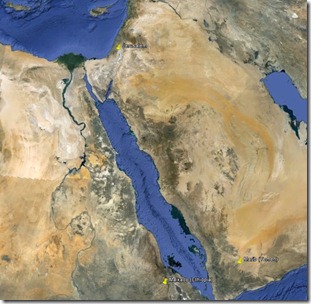
The screenshot below shows the area of the present discovery (Maikado) along with the location of Marib, another candidate for the capital of ancient Sheba.
sheba-possible-locations

Possible locations of Sheba in relation to Jerusalem
Share:

Aren Maeir provides links to grants for volunteer excavators.

Maeir also lists nine sites in the Shephelah that will be under excavation as of this summer: Azekah,
Beth Shemesh, Burna, Eton, Gath, Gezer, Qeiyafa, Socoh, and Zayit. That bodes well for the future of this blog.

Robert Mullins will begin a new excavation this summer for Azusa Pacific University at Abel Beth 
Maacah. Mullins will also be lecturing on March 19 in Beverly Hills on “The Many Temples of Beth Shean.”

If you’ve ever wondered what that palatial structure atop Mount Gerizim is, Tom Powers has found the answer.

Daniel Wallace says that the first New Testament manuscript from the first century has been discovered.

Wayne Stiles: “Like so many great cities of yesteryear, Tel Samaria remains a testimony of all earthly glory. The only beauty that remains is what God put there to begin with.”

Leen Ritmeyer recalls the discovery of the Burnt House in the Jewish Quarter of Jerusalem.

Jodi Magness is interviewed on the Book and the Spade radio program (mp3 links: part 1, part 2).

LA Times: “The Israeli government is gradually releasing its National Photo Collection from copyright restrictions.”

The Jerusalem Post recommends the top 5 nature spots in the city.

The ASOR Blog surveys the latest in archaeology from around the world.

HT: G. M. Grena, Daniel Frese, Joseph Lauer

Abel Beth Maacah from southwest, tb040903201

Abel Beth Maacah from the southwest
Share:

Attempts to sensationalize this story by connecting it to the prophet Jonah should not be allowed to obscure the significance of a fortress recently uncovered in Ashdod. The Israel Antiquities Authority (IAA) press release blows it on all things “Jonah.”

At ‘Giv’at Yonah’, in Ashdod, Archaeological Finds were Uncovered that Verify the Existence of Life there at the Time of Jonah the Prophet
The foundation of a large fortress that was situated there during the First Temple period was exposed in an excavation the Israel Antiquities Authority conducted with funding provided by Hofit – Ashdod Development & Tourism Company, Ltd.
At ‘Giv’at Yonah’ (the Hill of Jonah) in Ashdod, which according to various traditions is identified with the burial place of the prophet Jonah, archaeological finds were exposed that verify the existence of life there during the First Temple period, at the time of this prophet.
In a trial archaeological excavation the Israel Antiquities Authority carried out on ‘Giv’at Yonah’ in Ashdod prior to development work by Hofit –Ashdod Development & Tourism Company, Ltd. remains of massive walls more than 1 m wide were found that are dated to the late eighth century and early seventh century BCE.
In the estimation of the excavation director, Dmitri Egorov, of the Israel Antiquities Authority, these walls constituted the base of a large building from the First Temple period, the time when Jonah the prophet was active, who lived in the eighth century BCE and was famous for having been swallowed by a fish after he refused to “go to Nineveh…and proclaim against it” (Jonah 1:2).

One can understand why a news organization would try to hype this discovery and in the process distort the data, but it is disturbing that a scientific governmental organization such as the IAA would fail to get basic historical and geographical facts right.

1. The IAA gets the chronology wrong. Jonah was a prophet in the first half of the 8th century, during the reign of Jeroboam II (793-753 BC). This fortress dates to the late 8th and early 7th centuries.

Thus the claim made in the headline and throughout the story is false. This should be clear later in the press release when the district archaeologist states that the fortress belonged either to the Assyrians or to the Judean king Josiah (640-609 BC).

2. The IAA gets the geography wrong. Jonah was a prophet in the northern kingdom, from the Galilean city of Gath-hepher (2 Kgs 14:25). He fled on a ship via the port at Joppa. There is no
evidence that he ever traveled to Judah or to the territory then controlled by the Philistines.

3. The IAA fails to note the value of the “various traditions” that identify the site as the “Hill of Jonah.” There is no Jewish or Christian tradition that Jonah was buried here. Only a decade ago did
“Atra Kadisha” identify it as the tomb of Jonah. It is relevant that the purpose of Atra Kadisha is to prevent the excavation of ancient Jewish tombs. The Atra Kadisha declaration follows a Muslim tradition, which is much too late to be taken as having historic value.

What is important in this story is the discovery of a fortress apparently from the time of Hezekiah when the Philistines were caught in a bit of a tug of war between Judah and the Assyrians. For more details, see Sennacherib’s Siege of Jerusalem in Context of Scripture 2.119B.

DSCN4502

Excavations of Iron Age fortress at Givat Yona. Photo by IAA.
Share: