Scientists have discovered evidence for cultivation of three of the “four species” of Sukkot in the plaster of walls at Ramat Rahel.

A model of the Temple Mount made by Conrad Schick in 1872 will be on display next week in the new Heritage Center of Christ Church, Jerusalem.

Leen Ritmeyer has notice of a program to be held on the 20th anniversary of Nahman Avigad’s death.

Yosef Garfinkel is pretty upset with Rami Arav’s review of the first excavation report of Khirbet
Qeiyafa. [Update: The post has been removed. See comment below for detail.]

The world’s largest Israeli flag is now flying over Nazareth Illit.

Joe Yudin suggests visiting some sites from King David’s life when the wildflowers are blooming.

The 50th anniversary of the publication of The Dead Sea Scrolls in English, by Geza Vermes, was celebrated last week at Wolfson College.

Bedouin gunmen in Sinai kidnapped two US tourists traveling from Jebel Musa. They were released when Egyptian police set free four Bedouin who had been in custody.

The first snowfall in Rome in 26 years kept visitors out of the Colosseum, the Forum, and Palatine Hill.

HT: Jack Sasson

UPDATE (2/7): At the request of the sponsors, I’ve removed the link to the invitation to the (private)
presentation at Christ Church.

Ramat Rahel mikveh, tb031905812

Mikveh with plastered walls at Ramat Rahel
Share:

Looking back over the year is a profitable exercise for me personally because I forget so much and so quickly. Perhaps it is the volume of information coming from all corners of the globe that trains the mind to retain very little. A review of the posts here over the past year reminds us of recent history
but it also allows us to judge what was more important and what was less.

I have compiled several lists of “top stories.” Today we will review major discoveries, top technology-related stories, and losses. Tomorrow we will survey significant stories, noteworthy posts, and favorite resources of the year.

I do not deny that what is judged “top” in these reviews may tell the reader more about us than it does about the world of biblical archaeology. These lists are entirely subjective, and since they are based on what we decided to post (and not to ignore), they are doubly subjective. The primary criteria for selection was that the story was posted on this blog and then it caught my eye when I reviewed the year’s stories. The lists follow a roughly chronological order.

Top Discoveries of 2011:

Jerusalem Water Channel (and here and here and here and here)

Ossuary of Caiaphas’ Granddaughter Recovered

Lion Statue Found at Tell Tayinat, Turkey

Philistine Two-Horned Altar from Tell es-Safi (and here)

Golden Bell Discovered in Jerusalem and Recording Released 

Ancient Sabbath Boundary Inscription in Galilee (and here)

Hercules Statue Discovered in Jezreel Valley

Roman Sword and Menorah Depiction Found in Jerusalem

Largest Mosaic Discovered in Antioch

Mikveh Discovered near Biblical Zorah

Western Wall Discovery: IAA Desperate for Headlines (and here)

Mysterious Marks in the City of David (and here)


Top Technology-Related Stories of 2011:

Archaeology in Saudi Arabia with Google Earth

X-ray Vision for Archaeologists: The “Multi-PAM” Tool

Kinect Game System To Be Used in Jordan Excavation

Five Dead Sea Scrolls Online in High Resolution

InscriptiFact: A Better Way To Read Inscriptions (and here)
 

Losses:

Anson F. Rainey (and here)

Joseph Naveh

Giovanni Pettinato

image

Ossuary of Caiaphas’ Granddaughter
Photo by Boaz Zissu, Bar-Ilan University
Share:

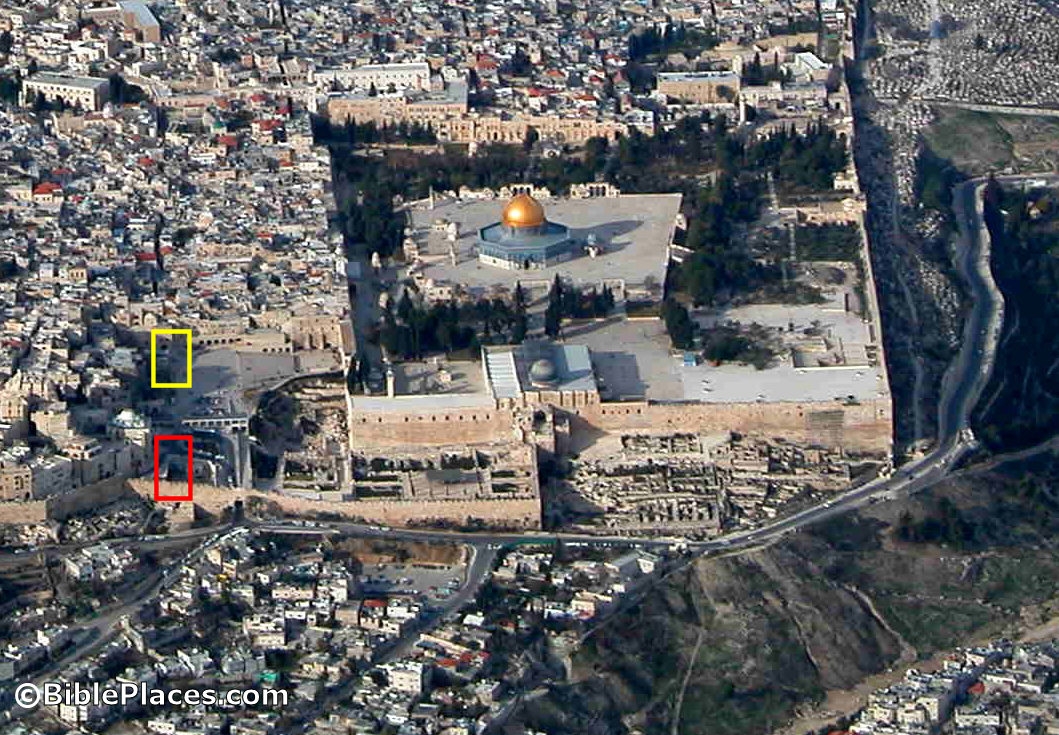
Over the years I’ve mentioned the excavation at the “back” of the Western Wall prayer plaza. The latest issue of Biblical Archaeology Review has a report by the excavators on their discoveries at the site from 2005 to 2010. Since I expect some curious student to ask me in a couple of days about the big hole in the ground, the article arrived at a good time for me. I made a few notes as I read the article that I thought I’d share here.

The earliest remains at this spot indicate that it was used as an Iron Age quarry.

Later in the Iron Age, a four-room house was constructed here. This was a Jerusalemite’s home sometime after Hezekiah fortified the Western Hill with a new wall (part of which is known today as the “Broad Wall.”) The house may have been destroyed by the Babylonian assault in 586, but this is not certain. Several personal seals were found in the building, including one depicting an Assyrian-style archer.

Curiously, there is no evidence of occupation at the site in the Babylonian, Persian, or Hasmonean periods (586-50 BC).

In the New Testament period, the Lower Aqueduct ran through this area, bringing water from
“Solomon’s Pools” to the Temple Mount. The only other discovery from the 1st century was a ritual bath (mikveh).

The most impressive remains at the site are that of a monumental street. This cardo is similar in size and design to its counterpart to the west, located today in the heart of the Jewish Quarter, but the archaeologists say that the eastern cardo was constructed in the Roman period by Hadrian (whereas the southern extension of the western was built by Justinian c. 530).

All the details are presented in a much more interesting style in the January/February 2012 issue of Biblical Archaeology Review. The article, with all of its illustrations, is currently available online, no subscription required.

 
(Yellow box = present excavations; red box = Byzantine Valley Cardo previously revealed)

Western Wall plaza excavations, tb051908178

Western Wall prayer plaza with excavations, May 2008
Share:

The process of wet-sifting debris from excavations below Robinson’s Arch on the southwestern corner of the Temple Mount has revealed a 1st-century seal impression inscribed with “pure for the Lord.” Scholars believe that this mark was used to certify offerings as acceptable for temple use. The Aramaic inscription is about 3/4 of an inch (2 cm) in diameter and has six letters.

IMG_8833Photo: IAA/Vladimir Naykhin

Excavation directors Eli Shukron and Ronny Reich commented on the value of the object:

To the best of our knowledge, this is the first time that such an object or anything similar to it was discovered in an archaeological excavation and it constitutes direct archaeological evidence of the activity on the Temple Mount and the workings of the Temple during the Second Temple period.

The full press release includes more details from the Mishnah about ritual tokens. The Israel Antiquities Authority has also released five high-resolution photos of this and related discoveries (zip file).

IMG_8827

Photo: IAA/Vladimir Naykhin

The Jerusalem Post has a three-minute video interview with Ronny Reich. The article’s statement that the inscription was found near the Pool of Siloam contradicts the official report of the IAA that the object was found next to the Temple Mount. The story is also reported by the AP, Reuters, and Arutz-7.

IMG_0351

Photo: IAA/Vladimir Naykhin
Share:

Wayne Stiles’ weekly column provides the best and most concise review of the significance of Bethlehem that I have read. You might bookmark this one for future lessons or sermons.

Yoni Cohen investigates some sites in Israel related to the festival of Hanukkah.

One of 107 cuneiform texts recently published depicts the great king Nebuchadnezzar.

Oded Borowski reviews Eilat Mazar’s new book Discovering the Solomonic Wall in Jerusalem: A Remarkable Archaeological Adventure.

Did the Magi give Jesus frankincense and myrrh because they cure arthritis?

Travelujah has the full run-down of Christmas services in Bethlehem and Jerusalem.

A retired professor, preaching tomorrow about Bethlehem in north Texas, has been to Israel 69 times.

The Star-Telegram tells his story.

Merry Christmas to all!

Bethlehem from north, tb092405372

Bethlehem from the north
Share:

A Byzantine-period bathhouse has been discovered near Moshav Tarum north of Beth Shemesh.

A cuneiform inscription discovered in the Tas-Silg sanctuary on Malta is now the westernmost such inscription known.

Haaretz reports on an archaeologist who believes he is close to finding the true tombs of the Maccabees.

Preston Sprinkle asks if Jesus was born at an inn and if he was a carpenter.

Leon Mauldin shares some photos of the traditional site of Jesus’ birth in Bethlehem and of a stone manger possibly similar to one used for the newborn.

Ferrell Jenkins links to some previous posts about the birth of Jesus and Christmas.

Aren Maeir’s idea of a Hanukkah/Christmas gift is to share one letter from an inscription found at Gath.

As far as we know, he was never known as “Herod the Great” during his lifetime. Ferrell Jenkins explains why a better appellation is “Herod the Small.”

The Bible and Interpretation is sharing one of my favorite photos of Jerusalem today (click on the thumbnail for large version).

Bryant Wood will be giving a series of lectures at Detroit Baptist Theological Seminary on March 14, 2012. His topic will be “Archaeology and the Conquest: New Evidence on an Old Problem.”

The Daily Mail publishes an illustrated account of one visitor’s five-day visit to Jordan and its main attraction, Petra.

The Jerusalem Post suggests 10 things to do over Christmas in the Holy Land. For the first time ever, live-size nativity scenes will be set up in Bethlehem and Jerusalem. Item 9 explains how you can celebrate Christmas three times this season.

HT: Charles Savelle, Jack Sasson, Joseph Lauer

Share: