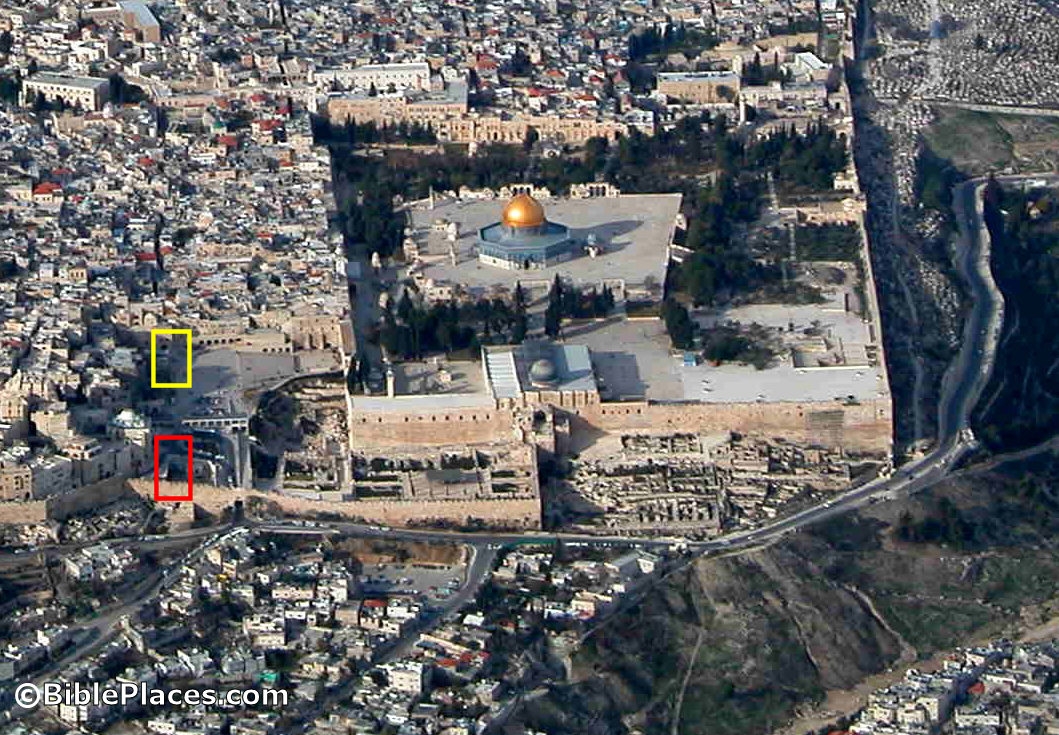
The continued excavations of the Siloam street and drainage channel by Reich and Shukrun have revealed two important objects from the first-century AD. From the Israel Antiquities Authority press release:

During the course of work the Israel Antiquities Authority carried out in Jerusalem’s ancient drainage channel, which begins in the Siloam Pool and runs from the City of David to the archaeological garden (near the Western Wall), impressive finds were recently discovered that breathe new life into the story of the destruction of the Second Temple. The excavations are being conducted on behalf of the Israel Antiquities Authority, in cooperation with the Nature and Parks Authority and are underwritten by the City of David Foundation.
A 2,000 year old iron sword, still in its leather scabbard, was discovered in work the Israel Antiquities Authority is doing in the channel, which served as a hiding refuge for the residents of Jerusalem from the Romans at the time of the Second Temple’s destruction. In addition, parts of the belt that carried the sword were found. According to the excavation directors Eli Shukron of the Israel Antiquities Authority and Professor Ronny Reich of the University of Haifa, “It seems that the sword belonged to an infantryman of the Roman garrison stationed in Israel at the outbreak of the Great Revolt against the Romans in 66 CE. The sword’s fine state of preservation is surprising: not only its length (c. 60 cm), but also the preservation of the leather scabbard (a material that generally disintegrates quickly over time) and some of its decoration”.
A stone object adorned with a rare engraving of a menorah was found in the soil beneath the street, on the side of the drainage channel. According to Shukron and Professor Reich, “Interestingly, even though we are dealing with a depiction of the seven-branched candelabrum, only five branches appear here. The portrayal of the menorah’s base is extremely important because it clarifies what the base of the original menorah looked like, which was apparently tripod shaped”. The fact that the stone object was found at the closest proximity to the Temple Mount to date is also important. The researchers suppose a passerby who saw the menorah with his own eyes and was amazed by its beauty incised his impressions on a stone and afterwards tossed his scrawling to the side of the road, without imagining that his creation would be found 2,000 years later.

High resolution images are available at the (temporary) link for the press release, or directly in a zip file here.

SWORD2

Roman sword made of iron used by soldier stationed in Jerusalem in AD 66. Photo by Clara Amit, Israel Antiquities Authority.

Stone inscribed with five-branched menorah. Photo by Vladirim Naykhin.

UPDATE: An article on the discovery in Haaretz includes six additional photos.

(HT: Joseph Lauer)

Share:

In the cleaning of pottery found in the vicinity of the horned altar of Gath, archaeologists have discovered an inscription. Aren Maeir reports that several letters written in ink have been identified, including a mem (“m”).

Maeir has also posted a three-minute video about the two-horned altar in which he describes the
context of the find, the date of its destruction, and the significance of the object.

The altar has now been removed from the site and is in the lab at Bar-Ilan University.

Share:

A commenter on the previous post about the discovery of the golden bell in Jerusalem alleged that the archaeologists’ interpretation of the find was influenced by ideological concerns and that the object was not a bell at all.

Independent Media Review Analysis (IMRA) has now released a recording of the bell.

This is the tiny golden bell which was lost in Jerusalem some 2,000 years ago during the Second Temple period found among ruins near the Old City. The bell, which is thought to have been an adornment which was sewn onto the garments of a senior official, was uncovered during excavation work on a drainage channel in the City of David, just south of the Old City walls. “It seems the bell was sewn on the garment worn by a high official in Jerusalem at the end of the Second Temple period,” an IAA statement said.
The recording of the bell provided by Udi Ragones, Ir David Foundation Spokesman.
[IMRA: IMRA has requested a sound file of the bell. If one takes the sound of the single bell and prepares a series of staggered overlays of the sound of the bell it will be possible to recreate what was heard over two thousand years ago when the high official walked in Jerusalem.]

HT: Joseph Lauer

Share:

From the Jerusalem Post:

A golden bell ornament that archeologists believed belonged to a priest or important leader from the Second Temple period, was found in an ancient drainage channel in ruins next to the Western Wall on Thursday, the Antiquities Authority announced. The small bell, which has a loop for attaching to clothing or jewelry, was found underneath Robinson’s Arch. The area underneath the arch was formerly the central road of Jerusalem, which led from the Shiloah Pools in the City of David to the Old City and the Temple Mount. The excavations were led by the Antiquities Authority and the Israel Nature and Parks Authority and financed by the City of David Foundation, which runs the archeological park across the street. “It seems the bell was sewn on the garment worn by a high official in Jerusalem at the end of the Second Temple period (first century CE),” the excavation’s lead archeologists, the Antiquities Authority’s Eli Shukron and Prof. Ronny Reich of the University of Haifa, said in a statement. “The bell was exposed inside Jerusalem’s main drainage channel at that time, among the layers of earth that had accumulated along the bottom of it.”
They believed that the bell fell off the official’s clothing while he was walking along the road and rolled into the drainage channel, where it has sat for nearly 2,000 years.

The story continues with the biblical verse that is the basis for the archaeologists’ claim that this was part of the high priest’s garments. James Davila questions the priestly connection. A large photograph of the object is posted at Dawn.com. Leen Ritmeyer has posted an illustration of the high priest’s garments.

Share:

From the Jerusalem Post:

An ancient rock inscription of the word “Shabbat” was uncovered near Lake Kinneret this week – the first and only discovery of a stone Shabbat boundary in Hebrew.
The etching in the Lower Galilee community of Timrat appears to date from the Roman or Byzantine period.
News of the inscription, discovered by chance Sunday by a visitor strolling the community grounds, quickly reached Mordechai Aviam, head of the Institute for Galilean Archeology at Kinneret College.
“This is the first time we’ve found a Shabbat boundary inscription in Hebrew,” he said. “The letters are so clear that there is no doubt that the word is ‘Shabbat.’”
Aviam said Jews living in the area in the Roman or Byzantine era (1st-7th centuries CE) likely used the stone to denote bounds within which Jews could travel on Shabbat. The Lower Galilee of Late Antiquity and the Early Middle Ages had a Jewish majority – many of the Talmudic sages bore toponyms indicative of Galilee communities.

The Jerusalem Post report continues here and includes a photograph of the inscription. Timrat is located about 4 miles (6 km) west of Nazareth.

The BibleWalks Blog has the story of the discovery, more photographs, and directions to the inscription.

Share:

The Tel Burna Excavation has a season wrap-up, noting discoveries especially from the 13th, 8th, and 7th centuries. The previous post features many photos. Robert Cargill explains what the “Miriam, Daughter of Yeshua, Son of Caiaphas” inscription means as well as what it does not mean. The first piece of oil shale was extracted this week from a drilling site in the Elah Valley. The site of David’s victory over Goliath could become the place where Israel achieves oil independence. Wayne Stiles explains the pagan and biblical significance of Caesarea Philippi. Danny Herman leads viewers on a video tour of the Hasmonean channel in the Western Wall Tunnels. “Google Earth, circa 1570” is an article at Haaretz about the reprint of a 16th century book with 363 colored historical maps. ASOR has a roundup of news throughout the world of archaeology. If there’s not enough there to satisfy you, see also the lengthy list published last week. The Biblical Archaeology Society can tell you what’s brand new and most popular this week. Tomorrow we’ll have links to more stories from this past week.

Share: