Today’s Haaretz has an interesting article on the flooding of the coastal plain of Israel in the Early Bronze Age.  The dating in the article is a little bit confusing, as it never gives an absolute date, just 5,500 years ago, and 3500 B.C. is usually assigned to the Chalcolithic period (cf. Mazar’s dating: 4300-3300 B.C.).

The concentration of population, commerce and trade in Israel’s coastal plain is not a phenomenon unique to our era. Even before the events the Bible describes in the Land of Israel, during the early first Bronze Age, 5,500 years ago, numerous communities dotted the coastal strip, from the vicinity of Gaza to the Galilee. The first royal dynasties appeared around that time in Egypt, and clay vessels uncovered in southern coastal communities indicate that the area (apparently under Egyptian control) served as an important trade route for the Egyptians.
And then, 5,500 years ago, say the archaeologists, there was a dramatic change. The coastal region was almost completely abandoned while concurrently in other areas an urban revolution was underway, with large fortified cities being built. After the era of urban, commercial prosperity, for almost a thousand years, the coastal plain mostly contained but a few small and scattered communities.
“The phenomenon is amazing,” says archaeologist Dr. Avraham Faust, director of Bar-Ilan University’s Institute of Archaeology. “There was a fairly large population in the coastal plain, and at the end of a relatively short process it emptied almost completely. In the alluvial areas, nearly all of the communities disappeared. The Egyptians also abandoned the coastal plain and trade no longer passed that way.”
Faust adds: “The key question that engaged us is why? What caused the community to disappear?” His research with Dr. Yosef Ashkenazy, a climate researcher at Ben-Gurion University of the Negev, suggests a comprehensive explanation of the phenomenon: The Canaanite coastal settlements were abandoned in the face of environmental change. Increased precipitation led to the flooding of parts of the coastal plain and to a rise in the level of groundwater, which eventually resulted in the spread of swamps, and that apparently caused the residents to leave the area.

You can read the rest here.  The Hebrew version has a couple of photos.

HT: Joseph I. Lauer
Share:

Archaeologists working at Hippos (Susita) on the eastern side of the Sea of Galilee have uncovered the footprint of the sandal of a Roman soldier.  From the story in Haaretz:

The discovery of the print made by a hobnailed sandal, the kind used by the Roman legions during the time when Rome ruled the region, led to the presumption that legionnaires or former legionnaires participated in the construction of walls such as the one in which the footprint was found…. Prior to this finding, the sandal prints of Roman legionnaires had been discovered only in Hadrian’s Wall in Britain.

The story is brief and worth reading for more details, but one note for those who know the Bible better than the geography of the Bible: the reason that Hippos (Susita) is not mentioned in the New Testament is that it was one of the cities of the (largely Gentile) Decapolis, and Jesus’ ministry was to the Jewish people.  There were a couple of occasions when Jesus visited the Decapolis, but it appears that these were not for the purpose of ministry.  One example is the story of Jesus casting the demons into the swine (Mark 5:1-20).  This event occurred as Jesus was trying to get away from the crowds, not do more ministry.  The presence of pigs makes sense as well given that this was in an area controlled by Gentiles.  Unfortunately many scholars have really flubbed the location of this miracle.  If it was where they say (at Gergesa), then Hippos would have been mentioned by some of the gospel writers, instead of Gadara and Gerasa.  But that is a subject for another day.  All can agree that this discovery at Hippos is fascinating and instructive.

Share:

In my opinion, one of the most interesting cities historically in Israel is Tiberias.  It might surprise some then that all I ever do with students in Tiberias is buy them lunch.  Until recently, there have not been significant ancient discoveries to visit.  Current excavations should change this in the coming years, as the results of these projects are opened to the public.  One such discovery was announced this week: a 4th or early 5th century church.  This was the time period when Tiberias was a thriving center of Jewish learning, as the so-called “Jerusalem Talmud” was being written/codified in the city at this time.  Discoveries like this could help us to better understand the relationship between Jews and Christians in the Byzantine/Talmudic period.

The church’s remains were discovered adjacent to ancient public buildings among them a basilica, bathhouse, streets and shops that were exposed at the site in the past. Dr. Moshe Hartal and Edna Amos, the directors of the excavation on behalf of the Antiquities Authority, stated that this is the most ancient church to be uncovered in Tiberias and the only one that has been found in the center of the city.
According to Dr. Hartal, from the year 427 CE the Church issued a decree prohibiting the placement of crosses in mosaic floors in order to prevent them from being stepped on. “The presence of so many crosses in the floors of the church that was exposed here thus confirms the church dates to the period prior to the ban,” he said.
In addition, the remains of a Jewish neighborhood that dates to the tenth-eleventh centuries were discovered in the excavations. These remains extend up to the foot of the cliff in the high part of the city, in an area that was probably residential in nature.
“The discovery of the remains of the church in the middle of the ancient city, like that of the Jewish neighborhood and the magnificent city that existed in Tiberias more than one thousand years ago, greatly contributes to our understanding of the town planning, its scope and it structures,” archaeologists on behalf of the Antiquities Authority said.

The story in the “Scoop” has more information, including a photograph and partial translation of an inscription in the mosaic floor.

Tiberias new excavations in progress, tb032705506
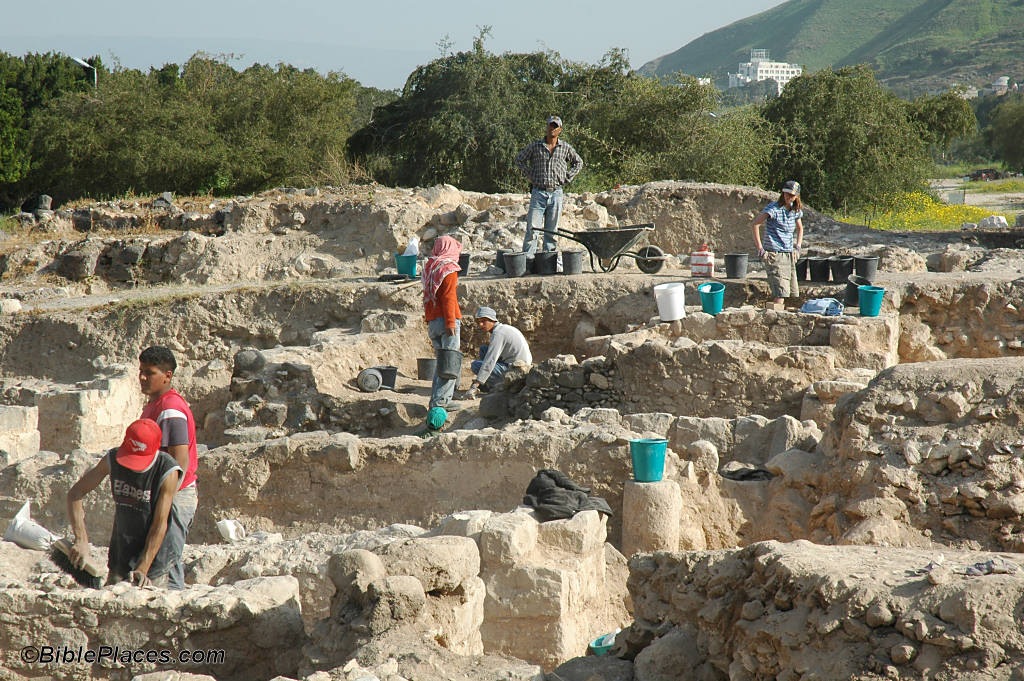
Recent excavations in Tiberias
Share:

This story in The Times looks very interesting.  It’s another one of those occasions when the discovery is made long after the excavators leave the field.

The British Museum yesterday hailed a discovery within a modest clay tablet in its collection as a breakthrough for biblical archaeology – dramatic proof of the accuracy of the Old Testament.
The cuneiform inscription in a tablet dating from 595BC has been deciphered for the first time – revealing a reference to an official at the court of Nebuchadnezzar, king of Babylon, that proves the historical existence of a figure mentioned in the Book of Jeremiah.
This is rare evidence in a nonbiblical source of a real person, other than kings, featured in the Bible.
The tablet names a Babylonian officer called Nebo-Sarsekim, who according to Jeremiah xxxix was present in 587BC when Nebuchadnezzar “marched against Jerusalem with his whole army and laid siege to it”.

The rest of the story is here.  I’ve been working for some years on a list of extrabiblical references to biblical people.  I’m not ready to share it, but I can tell you that it is long.

The stupid quote of the story goes to renowned scholar Geza Vermes, who said, according to the reporter, “the Biblical story is not altogether invented.”  My response: there is not a fraction of evidence that it is invented at all.  Many scholars have many theories, but these are possible only because of the lack of evidence.  The more evidence, the less room for scholarly ideas about the invention of the Bible.  This observation is not based upon the above story, but upon years of study in the land of Israel.  The liberal case gets weaker the more I know.

Share:

Arutz-7 appears to be the first with a detailed report from the press conference.  The Jerusalem Post and Haaretz are still reporting only the basics.

The approach to the burial site was via a monumental flight of stairs 6.5 meters wide, leading to the hillside; the stairs were especially constructed for the funeral procession. Herod died in Jericho, but left instructions to be buried in the area known as the Herodium.
The mausoleum itself was almost totally dismantled in ancient times, but part of its well-built podium remains. Spread among the ruins are pieces of a large, unique coffin, nearly 2.5 meters (over 8 feet) made of a Jerusalemite reddish limestone, decorated by rosettes. The sarcophagus (coffin) had a triangular cover, which was decorated on its sides. Only very few similar sarcophagi are known in the country, and can be found only in elaborate tombs such as the famous one at the King’s Tomb on Salah a-Din Street in eastern Jerusalem.

The tomb was found on the slope of the hill, and not in the complex that Herod had prepared for his burial.  Some possibilities: 1) Herod ordered the location change in order to thwart tomb robbers (if so, he failed).  2) Herod’s subjects buried him here, defying the wishes of the king (as did Herod’s sister in ordering the leading men of the kingdom released before Herod’s order to kill them could be carried out).  3) Herod’s body was moved at a later time.  4) This isn’t Herod’s tomb.

On the last point, I would simply note that the basis for this “definite” identification is “a combination of the location, type of work at the tomb, the decorations, and pieces of the coffin.”  In other words, there is no inscription.  In order to make a convincing case, the workmanship of the tomb and coffin are going to have to be of the highest quality.  It is interesting that “location” is factored into the identification, as it seems that the location, not in the prepared burial place, would argue against the identification.  But of course, it is at the Herodium, and presumably, not just any wealthy citizen could be buried there.

I look forward to seeing photographs of the discoveries, and hope that soon the tomb area will be open to visitors.


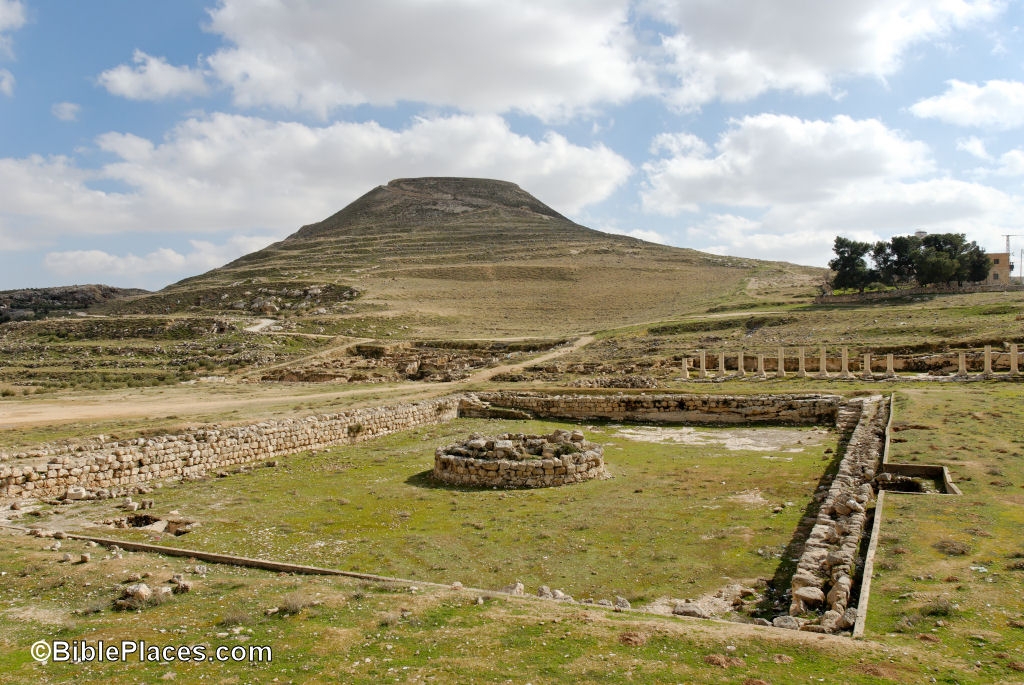
Herodium with swimming pool and lower city in foreground
Update: Yahoo has the AP story with a nice slideshow showing the area of the excavation.
Share: