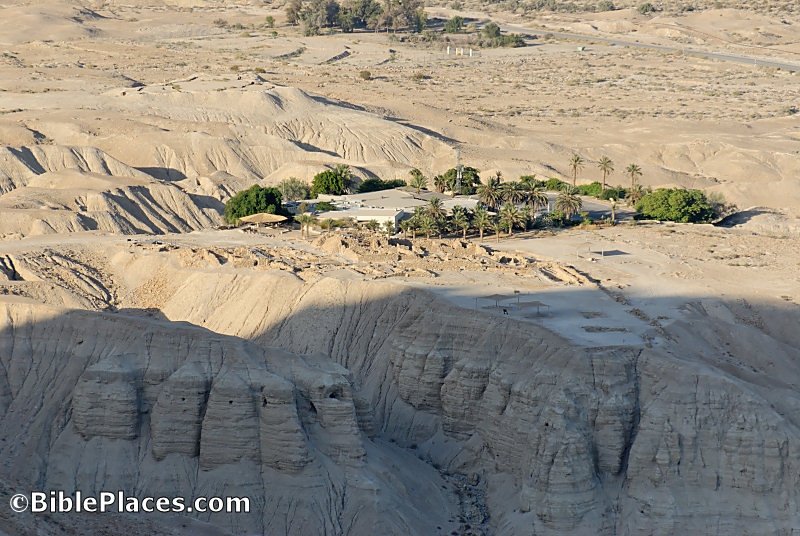
Scholars have long debated the identity of those who lived at Qumran.  Most believe that the site was inhabited by Essenes, an ascetic group that separated themselves from the corruption of Jerusalem and the Temple.  There at Qumran they eked out an existence and copied scrolls by night.  Even in recent months the consensus theory has been challenged by those who believe that Qumran was a place of pottery manufacture.

Results from a recent study of the soil around Qumran strengthens the majority view.  Israeli paleopathologist Joe Zias found remains of human excrement about 500 meters north of the site.  The intestinal parasites in the remains prove that the remains were of human origin, and the burial of the feces indicates that they aren’t from Bedouins, as the latter do not bury their excrement.  It seems unlikely at best to suggest that pottery makers or inhabitants of a Roman villa would travel such a distance to relieve themselves, and thus this discovery supports the Essene hypothesis.

The results of the article will be published in Revue de Qumran, but the Jerusalem Post has the best synopsis online.  The story is quite fascinating and it would have been a perfect article for Biblical Archaeology Review, but the poor relationship between Shanks and Zias precludes such a possibility.

Zias goes further in the study to suggest that the short life expectancy of the Qumranites (as evidenced in a study of the cemeteries) was the result of their sanitary practices.  The Qumranites would pick up parasites as they walked through the defecating field which would then be passed on to everyone through the daily immersions in the ritual baths.

The article in Nature ends with this non-sequitur from Zias:

If his theory is correct, it might therefore carry a lesson about religious fundamentalism, Zias adds. “It shows what happens when people take biblical things too fundamentally or literally, as they do in many parts of the world, and what the ultimate consequences are.”


Qumran from southwest
Share:

The ancient “church” at Megiddo is slated to be opened to tourists next spring, reports Haaretz. Within 4 years the prison itself should be entirely relocated so that the site can become a “tourist center.” I think they might be over-estimating the site’s importance with plans such as these:

The building in which it is located, which dates back to the British Mandate, will be turned into a center for tourists interested in ancient Christianity and the nearby airfield will be expanded to allow for pilgrim flights.

Do they really think that pilgrims are going to fly in just because they found an old “church”? 


Wouldn’t Christians find slightly more interesting things places like, oh, the synagogue at Capernaum, the well of Jacob near Sychar, or the Mount of Olives?

Of greater interest is some new information on the “church” itself, and its date:

The oldest known Christian prayer sites date back to the middle of the fourth century, but experts who have visited the Megiddo site believe it goes back to the start of that century.


The date is based on shards and coins found at the site, as well as three Greek inscriptions on the mosaic floor of the church.


The Antiquities Authority describes the site not as a church but as a “prayer house” since it was apparently located inside a Roman officer’s private home, according to one of the inscriptions. Christianity became a legal religion in the Roman empire in the year 313.


Other findings that are indicative of early Christian rites are the central symbol of the fish, found in the mosaic, (later changed to a cross) and the fact that in one of the inscriptions, Jesus is referred to as “the lord Christos,” a term which later disappeared.

So it’s no longer a “church” but a Christian home. That sounds like sufficient reason to expand the airport.

Share:

For some years, Americans and other foreigners were afraid to come to Israel. Now that the calm has returned (ha, ha), they have come back. Among the projects, the Philistine city of Gath is being currently being excavated primarily by Israelis, and the Israelite city of Gezer was excavated in June primarily by Americans.

The Gath team has done something extraordinary in maintaining an excavation blog. You should follow along with them if you want to know the latest. If you haven’t checked in a few days, then you don’t know that they found an ostraca (inscribed potsherd) on their first day of digging!

The first season of the Gezer excavations concluded successfully and director Steven Ortiz is interviewed about the results by the Book and the Spade radio program. Among other things, he discusses his discovery of thick destruction layer that may be dated to the destruction of Siamun (1 Kings 9:16). That interview may only be online for a few days, so don’t wait if you are interested.

Back to the “calm situation,” the reality in Israel is that it is always on the edge of some turmoil. That is life here. When you live in the midst of Arab enemies (and yes, even those who have made peace with Israel still hate her), times of stability are brief. Should that affect one coming to tour Israel or to participate in a dig? Absolutely not. Tour operators and excavation directors know where it is safe and they won’t take their people to dangerous areas. CNN makes you think that all of Israel is in upheaval, and that is one of the ways that the media lies.

Share:

This amazing find near Ramle was announced by Hebrew University researchers this week.

Israeli scientists said on Wednesday they had discovered a prehistoric ecosystem dating back millions of years containing eight previously unknown species of crustaceans and invertebrates similar to scorpions.

In a press conference held Wednesday morning at Hebrew University in Jerusalem, the researchers said the discovery came about when a small opening was found, leading to a cave extending to a depth of 100 meters beneath the surface of a quarry in the vicinity of Ramle. The quarry is operated by cement manufacturer Nesher Industries.

“Until now eight species of animals were found in the cave, all of them unknown to science,” said Dr. Hanan Dimantman, a biologist at the Hebrew University of Jerusalem.

Haaretz has the full story and a photo.

Share:

The Gath blog has been mentioned here before, but it’s worth mentioning again because they are doing a great job of keeping it updated, and with things that you don’t always see. Last summer the so-called “Goliath inscription” was in the news and they have a very nice high-resolution photo of it. 

The “bottom line” of the post shows the significance of the discovery:

1) the inscription demonstrates that ca. the 10th/9th cent. BCE, names very similar to Goliath were in use at Philistine Gath. This does provide some cultural background for the David/Goliath story; 2) that already early in Iron IIA, the Philistines adopted the Semitic writing systems.

The recent posts have a good variety of helpful, large photos of an archaeological excavation. Good for teaching, especially if you haven’t been on a dig to take the photos yourself!

Share: