No one is claiming that this tomb will be as amazing as that of its neighbor, King Tut, but the fact that another intact tomb has been discovered is newsworthy in itself. The tomb dates to the late 18th dynasty, approximately the same time as King Tut, but the identity of the tomb is not yet known and probably does not belong to a pharaoh. Perhaps it was the tomb of a queen, noble or other court official. Or maybe the gardener, one archaeologist joked. CNN has the story with two photos. Yahoo has about half a dozen.
 An ancient cemetery was uncovered in the southern Shephelah recently. The tombs are “6,000 years old” which makes it from the Chalcolithic period (though the article doesn’t specifically say). It does say that “The find yielded a treasure trove of ancient artifacts, including pottery, statues and jewelry all in mint-condition….He added that the find was the biggest of its kind and was invaluable for historians to deepen their understanding of the period.” I call the Chalcolithic age one of “surprising sophistication,” and this hoard could be good. The article is very brief but for the rest, see Haaretz. The photo is of an ossuary (burial box) from the Chalcolithic period, discovered elsewhere.
Note: despite the name similarity, Kiriath Gath is not near ancient Gath; the name was given to it early in the 20th century when the location of Gath was believed to be further south. Kiriath Gath is closer to biblical Lachish.
 Reports are just now surfacing that last month police found pieces of a mosaic floor from an ancient synagogue in an Arab car. The mosaic includes a menorah, palm branch (lulav), and an inscription which says “Peace on Israel.” The mosiac measures 2 x 3 feet and is believed to be from a 7th century A.D. synagogue in the area of Ramallah (vicinity of ancient Bethel). The thieves were arrested and so far have not divulged the location of the find. More information about the discovery is at Arutz-7, Jerusalem Newswire (but Ramallah is not ancient Ramah), and the AP. The graphic at right is from Arutz-7.
In one of those “I wish this were me” stories, the Jerusalem Post is reporting that three boys, aged 11-13, found an intact burial cave from the Second Temple Period (probably 1st century A.D.) near Beth Shemesh. The cave includes skeletons, ossuaries, and probably some other interesting goodies. The Antiquities Authority sealed the cave, presumably until they have the manpower to properly excavate it.
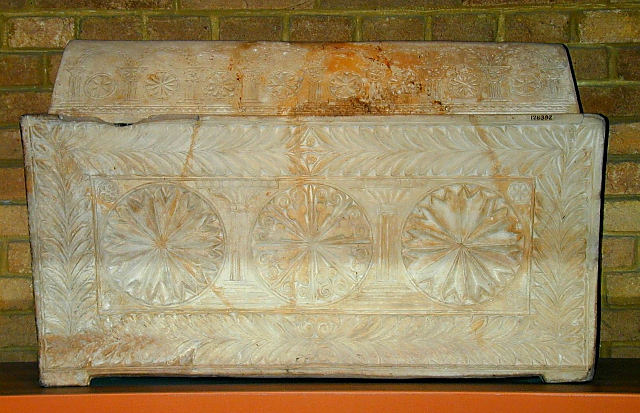 The above photo is of an ossuary from the 1st century, but not one that was recently discovered.
Paleojudaica points to a new article in Haaretz on the Pool of Siloam. It’s basically an update of things since the last big reporting in August. There are a few new things of note, which I may or may not have mentioned here before. This includes:
- The discovery of the 1st century street near the pool. For those of you who know, they found this street in the excavations underneath the road/path that runs between the old pool and the garden which covers the new pool. The archaeologist told me that he would like to reveal the entire length of the road from the Pool of Siloam to the Temple Mount. I told him he was crazy. Unless he is thinking of digging a tunnel underneath all of those houses. Then he’s still crazy :-).
- The recovery of “cylinder seals.” This is clarified in a post to the ANE list that the Hebrew original has “seals and bullae.” (Bullae are seal impressions.) The archaeologist told me that these date to the 9th century and do not contain personal names (as do most of the bullae found in Area G, dating to the early 6th century B.C.). The importance of these seals, if they date to anything before the mid-8th century, is that they will give evidence of an administrative center in Jerusalem at that time. Many scholars reject the biblical evidence for that, and there’s not much else evidence for it outside the Bible. The article doesn’t say, but I can tell you that these seals were found around buildings which were constructed inside the Middle Bronze pool, which is just to the north of the Gihon Spring and protected by the Pool Tower. That’s the area shown in this photo.

Boy, here’s a line that I can’t believe. At least it wasn’t true a few weeks ago. “Garbage is being collected on a regular basis.” Or maybe they’re collecting the garbage, but they just can’t get the residents to understand that they have to put it in those large containers.
UPDATE: The Hebrew version of the article has a photo montage which shows some of the seals.