“Researchers have revealed a hidden manuscript on a recycled piece of parchment, believed to have been written by the Greek mathematician, astronomer and geographer from the ancient Roman Empire: Claudius Ptolemy.”

“Archaeologists in Egypt have discovered broken statues of ancient royalty at a sun temple in Heliopolis.”

Gorgeous zodiac paintings decorating the roof and walls of the 2,200-year-old Temple of Esna in southern Egypt have been revealed during a restoration project that’s clearing away two millennia’s worth of grime, soot and bird poop.”

“The American Research Center in Egypt (ARCE) has launched the Valley of the Queens and the Western Wadis on the Theban Mapping Project website.”

Mattias Karlsson attempts to explain why a king of Moab was called “the Egyptian,” if indeed he was.

Jason Borges provides a first-person account of the destruction in Antakya (biblical Antioch on the Orontes).

Turkish authorities have begun to “strengthen” historic buildings in Istanbul with “Khorasan mortar,” an ancient method that provides buildings with elasticity during an earthquake.

The Vatican gave to Greece three marble statue heads that once adorned the Parthenon.

The Greek mafia is beating up archaeologists on the island of Mykonos.

“A growing number of researchers now want to reconstruct ancient aromas and use them to learn more about how we used to live.”

Archaeologists are using AI to protect ancient sites, improve dating methods, and analyze old rock art.

The Pergamon Museum in Berlin will be completely closed beginning in October for three and a half years, with the southern wing not reopening until 2037 (!).

Bryan Windle reports on the top three stories in biblical archaeology in the month of March.

HT: Agade, Arne Halbakken, Alexander Schick, Explorator

“A 6,000-year-old copper fishing hook, possibly used for catching sharks or other large fish, has been discovered during an Israel Antiquities Authority excavation in Ashkelon.”

Andy Cook posts a short video he just filmed in the drainage channel underneath the City of David.

Sussita National Park is now open to the public. The site, also known as Hippos, overlooks the Sea of Galilee on its eastern side.

Bible History Daily addresses the question of who lived in the ancient city of Hazor: commoners, elites, or a mix of the two. This issue is explored further in an article by Shlomit Bechar in the latest issue of Biblical Archaeology Review.

Several dozen articles on the topic of “The Ancient Written Wor(l)d” have been published in the latest issue of ‘Atiqot (open access). One of the articles challenges the identification of the signet ring of Pilate.

“Jerusalem was named one of TIME magazine’s 50 most extraordinary travel destinations, as part of the publication’s third annual list of the World’s Greatest Places.”

“Caesarea was given awarded the ACTA Archeological and Cultural Award for the best foreign archeological site by GIST, Italy’s foremost tourism press agency.”

Chandler Collins will now be posting information about excavations and publications about Jerusalem on Facebook, Twitter, and Instagram.

As Emily Master steps down after five years as Executive Director of the Friends of the Israel Antiquities Authority, she identifies three milestone projects completed in this time: a renovated Davidson Center, the Shelby White and Leon Levy Lod Mosaic Archaeological Center, and the Jay and Jeanie Schottenstein National Campus for the Archaeology of Israel.

Aren Maeir’s latest publication is in a volume dedicated to Indiana Jones. (Despite the date of its posting, the book appears legitimate.)

New release: In the Shadow of the Wall: The Life and Death of Jerusalem’s Maghrebi Quarter, 1187–1967, by Vincent Lemire (Stanford University Press, $32; Amazon).

ASOR webinar on April 13: “New Perspectives on Jerusalem’s 7th Century BCE Elite,” by Yuval Gadot

Online lecture on April 27: “The Archaeology of Mount Zion in Jerusalem – Past, Present, and Future,” by Shimon Gibson. Registration is free and required.

On YouTube: “The Jewishness of the New Testament: An Interview with R. Steven Notley” (17 min)

Israeli authorities are forecasting severe heat waves this summer, with temperatures possibly reaching 120 degrees F (49 C).

The Infusion Bible Conference digital download of all 42 videos of “The Last Days of Jesus” is now on sale for $30 off. Purchase includes the pdf notebook with 170 pages of notes, resources, and recommendations.

Focus on the Family is celebrating Passion Week with a series of devotionals by Will Varner, illustrated with photos from BiblePlaces.com.

HT: Agade, Arne Halbakken, Alexander Schick, Explorator

Archaeologists working in the temple of Dendera discovered a Sphinx-like statue that may depict Emperor Claudius.

“Egyptian officials have released photos of an ancient scroll, the 52-foot-long (16 meters) Book of the Dead papyrus recently discovered in Saqqara. The 10 images show ancient illustrations of gods and scenes from the afterlife, as well as text on the document, which is more than 2,000 years old.” The released photos were first posted on the government’s Facebook page.

The British Museum’s Curator’s Corner provides a lesson in how to read ancient Egyptian hieroglyphs (27 min).

New release: Ancient Egypt, New Technology: The Present and Future of Computer Visualization, Virtual Reality and Other Digital Humanities in Egyptology, edited by Rita Lucarelli, Joshua A. Roberson, and Steve Vinson. (Brill, $174; free download)

The first-ever detailed study of the theater at Pergamum reveals that it is larger than the theaters at Smyrna, Ephesus, Miletus, or Aspendos. An aerial photo shows the locations of the theater, stadium, and amphitheater in relation to the acropolis.

Turkish Archaeological News has a roundup of major stories for the month of February. They also provide a damage assessment of cultural properties one month after the earthquake.

“The revamped archaeological museum of Argos in the Peloponnese and its upgraded display collection will soon reopen to the public.”

Archaeologists have discovered for the first time wooden stakes described by Julius Caesar and used as a kind of ancient barbed wire.

New research suggests that humans may have first begun riding horses around 3000 BC.

New exhibition at the San Antonio Museum of Art: “Roman Landscapes: Visions of Nature and Myth from Rome and Pompeii”

The Global Smyrna Meeting on the Seven Churches of Revelation will be held June 4 to 10, featuring many scholars in the field including Mark Wilson, Mark Fairchild, James Hoffmeier, David deSilva, and Ben Witherington.

HT: Agade, Arne Halbakken, Ted Weis, Mark Hoffman, Explorator

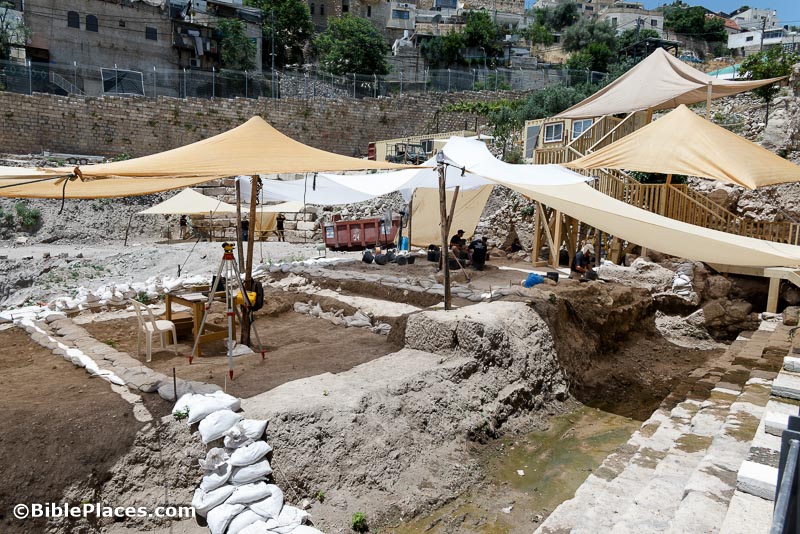
Pool of Siloam excavations in late February. Photo courtesy of John DeLancey.

Graduate students on a field trip discovered a statue of a lioness near a synagogue in the Golan Heights.

Several editorials reflect on the Darius Ostracon fiasco, including Nathan Steinmeyer at BAS, Ruth Schuster at Haaretz, and The Jerusalem Post.

“The Davidson Center in Israel’s Jerusalem Archaeological Park will reopen to the public next week after being closed for three years for renovations. The center will have updated exhibits featuring first-ever publicly displayed archaeological finds, innovative technology, and interactive galleries.”

Nixza Gonzalez writes about 11 beautiful national parks in Israel, most of which are not on the itineraries of most groups.

Chandler Collins evaluates the evidence that identifies Herod’s tower near Jaffa Gate (“the tower of David”) as either Hippicus or Phasael, concluding that the popular view today is wrong.

Piotr Bienkowski disputes the recent proposal that Edom was related to the copper mining at Faynan in the 10th and 9th centuries BC.

New release: A Handbook of the Aramaic Scrolls from the Qumran Caves: Manuscripts, Language, and Scribal Practices, by Daniel Machiela (Brill, $192; free download)

In the latest Digging for Truth episode, Bryan Windle recounts his top 10 list of discoveries in biblical archaeology in 2022.

Excavations of the Pool of Siloam in late February. Photo courtesy of Simeon Western

HT: Agade, Arne Halbakken, Ted Weis, Mark Hoffman, Explorator

A scan of the north side of the Great Pyramid of Giza detected a corridor measuring 30 feet by 6 feet.

“The Egyptian Ministry of Tourism and Antiquities announced on Friday the discovery of a group of tombs from the Persian, Roman and Coptic eras in the Al-Bhansa [Oxyrhychus] region.”

“Archaeologists excavating at the ruins of Old Dongola in Sudan have discovered ancient Egyptian hieroglyphics inscribed on sandstone blocks.”

Iran and China are collaborating to conduct underwater archaeological surveys in the Persian Gulf.

A curator at Manchester Museum describes the significance of the touring exhibition, “Golden Mummies of Egypt.”

The Art Newspaper reports on the full scale of earthquake damage to heritage sites in Turkey and Syria.

Hybrid lecture on March 9: “Iron in the Sky: Meteorites in Ancient Egypt,” by Victoria Almansa-Villatoro. Register here.

“Daniel—The Top Ten Archaeological Discoveries” is the latest episode on Digging for Truth.

Expedition Bible’s latest video is on the “Search for the Tower of Babel.”

New release: Esarhaddon, King of Assyria, by Josette Elayi

Bryan Windle highlights the top three reports in biblical archaeology in the month of February.

HT: Agade, Arne Halbakken, Gordon Dickson, Ted Weis, Explorator

The most interesting story of the week is that of the “Darius ostracon,” but I need more space for that, so see below.

There are currently 80 archaeologists working on 14 active excavations in Jerusalem. This story is focused on the Pilgrimage Road excavation.

Moshe Gilad visits the Bar’am synagogue and notes that a very “complicated and significant restoration” is underway. The story is illustrated with some beautiful photos of the site.

Aren Maeir provides a translation of a public statement made by the Israel Archaeological Association about the effect of governmental changes upon archaeological sites and research.

Ilan Sharon, longtime co-director of the excavations at Tel Dor, died recently.

A trailer is out for “Quest for the Throne of God,” a movie that follows the tabernacle and the ark of the covenant, featuring Craig Evans and Scott Stripling, produced by Gesher Media.

Season 3 of “The Holy Land: Connecting the Land with Its Stories,” hosted by John Beck, has been released.

Now to the story of the week. On Wednesday, the Israel Antiquities Authority made a dramatic announcement: a visitor walking around Tel Lachish in December picked up a potsherd reading “Year 24 of Darius,” a reference to the Persian king who ruled over the land of Israel from 522 to 486 BC. It seemed incredible that an inscription would just be laying on the surface, never before noticed, so the archaeologists worked very carefully to confirm its authenticity.

After several months of investigation by the leading researchers of the IAA, press releases were crafted, a video was created, and the discovery was announced. There was no doubt, the experts concluded, that the inscription was genuine. According to The Jerusalem Post:

A few weeks later, [Eylon] Levy received a phone call from the authority’s Saar Ganor. He said he was “on his way from the Dead Sea Scrolls labs. We’ve put it through three scanners. This is authentic. No modern hand could do it, and it’s from two and a half thousand years ago, from before the story of Purim.”

Ganor analyzed Levy’s discovery with Dr. Haggai Misgav of the Hebrew University of Jerusalem and they both confirmed that the artifact dated to the Persian royal administration at Lachish in the Achaemenid period, at the turn of the fifth century BCE.

Haaretz has this:

How confident are they in their interpretation? “Very,” Ganor answers, adding that the writing is so clear that Misgav could read it on the spot. Even so, the ostracon was of course handed over for restoration, during which process its authenticity was confirmed. The inscribed potsherd will be published in the Israel Antiquities Authority journal ‘Atiqot, vol. 110.

But on Friday someone reading about the discovery contacted the IAA to let them know that she had inscribed the potsherd in a demonstration to students. The piece was then tossed aside at the site, to be picked up several months later.

The IAA took full responsibility:

In terms of ethical and scientific practices, we see this as a very severe occurrence. Leaving the newly inscribed sherd on the site was careless.

Yes, indeed. And they are going to do something about it, working to “refresh proper procedures and policies with all foreign expeditions working in the country,” so that no one else dares leave a modern inscription at any archaeological site.

For my part, I will continue to put my full trust in the archaeological experts and their three scanners as long as we know the truth from other sources. As James Davila observes, “What are all those scans and laboratory tests worth if they can’t even identify a modern pedagogical showpiece that wasn’t intended to fool anyone?”

HT: Agade, Arne Halbakken, Gordon Dickson, Ted Weis, Explorator