A “lost city” from the time of Amenhotep III has been discovered near Luxor. “After seven months of excavations, several neighborhoods have been uncovered, including a bakery complete with ovens and storage pottery, as well as administrative and residential districts.” The excavating team is hailing it as the “second most important archeological discovery since the tomb of Tutankhamun.”

The National Museum of Egyptian Civilization in Cairo opened on April 3, and Luxor Times has posted a 30-minute walking tour.

NPR has posted a number of photos of the spectacle dubbed “The Pharaohs’ Golden Parade.”

Hikers in the northwestern Negev discovered a rare Egyptian scarab amulet dating to the 9th–8th centuries BC.

500 caves have been excavated in the Judean wilderness in recent years, and it is estimated that it will take 2-3 years to finish what remains.

William A. Ross looks at what the recent Dead Sea Scrolls discovery means for Septuagint studies.

A bronze tablet from Yemen dating to the 1st century BC mentions a temple dedicated to a previously unknown god.

Visitors can now take a virtual tour of Baalbek that shows the site as it looks today as well as at its height in the Roman period.

Carl Rasmussen shares several photos of a well-preserved but seldom-visited portion of the Diolkos near Corinth.

April 13, 8:30 pm (Eastern): Steve Austin will be giving a special session on “Climate Change, Dead Sea Mud & Bible Chronology.” Registration is required, and the session will not be recorded.

April 14, 8:00 pm (Eastern): Lawrence Schiffman will be speaking about the newly discovered Dead Sea Scrolls.

April 14, 8:00 pm (Eastern): Beth Alpert Nakhai will be speaking on “The Real Lives of Women in Biblical Times.” Registration costs $7.

Thomas E. Levy provides a summary of William G. Dever’s life as recounted in his recently published autobiography.

Brunilde Ridgway’s review of John Boardman’s A Classical Archaeologist’s Life: The Story So Far: An Autobiography provides a good summary of an extraordinarily productive life.

“During the next three years, RINBE will create a complete and authoritative modern presentation of the entire corpus of the royal inscriptions of the six kings of the Neo-Babylonian Empire in print and in a fully annotated (linguistically tagged), open-access digital format.” Some is already available, including a pdf of The Royal Inscriptions of Amēl-Marduk (561–560 BC), Neriglissar (559–556 BC), and Nabonidus (555–539 BC), Kings of Babylon (Royal Inscriptions of the Neo-Babylonian Empire 2), by Frauke Weiershäuser and Jamie Novotny (and for sale here).

HT: Agade, Keith Keyser, Arne Halbakken, Ted Weis
Archaeologists have discovered dramatic evidence of the conflagration that destroyed Azekah circa 1130 BC, leading them to dub the site as a “small Pompeii.”

According to news reports, a rare Tyrian shekel was discovered during a renovation project at the Tower of David Museum. This is true, except that the coin is not a shekel and not rare. It is a silver tetradrachm of Demetrios II Nikator from Tyre with a date of SE 184 = 129/8 BC.

While undergoing conservation work, a large structural crack was discovered in Herod’s tower in the Citadel of David.

Justin Kelley’s BAR article on “The Holy Sepulchre in History, Archaeology, and Tradition” is summarized in Bible History Daily, where a detailed plan of the Church of the Holy Sepulcher is also provided.

Scholars are using high-tech imaging to understand thousands of hand-engraved crosses on the Church of the Holy Sepulcher.

A new “Emmaus Trail” allows walkers to travel the 11 miles (18 km) from Abu Ghosh to Nicopolis/Latrun. Leen Ritmeyer takes the occasion to propose that Emmaus should be identified with Bethel in the Old Testament.

David Moster has posted a new video that explains how to “make sense of the new Dead Sea Scrolls,” including a discussion of how important these discoveries are to biblical studies.

Randall Price is on The Book and the Spade discussing the new Dead Sea Scrolls discoveries.

The latest teaching video from John DeLancey is “The Life of Jesus – His Redemptive Purpose.”

New book: Jesus of Nazareth: Archaeologists Retracing the Footsteps of Christ, by Michael Hesemann. The author’s background and motivations are reported here.

Bryan Windle lists the top 10 discoveries related to Jesus.

Robert E. Cooley died on Thursday. During his career, he excavated Tel Dothan and helped to found the Near East Archaeological Society.

HT: Agade, Charles Savelle, Ted Weis, Arne Halbakken

Bryan Windle reviews the top three reports in biblical archaeology in the month of March.

In a seven-minute video, Aren Maeir gives a quick overview of the archaeological process from start to finish.

Hannah Brown explains why spending a day or more at Timna Park in southern Israel is worthwhile.

Wayne Stiles is hosting a free webinar for the Passion Week, with an engaging look at Jesus’s final week, day by day.

An extract from the new CSB Holy Land Illustrated Bible identifies five incidents and three patterns in Pilate’s life that set the context for the trial of Jesus.

BibleTimeLines.com has an extensive collection of timelines, graphics, and videos, including a timeline for the Passion Week.

Jordan J. Ryan considers how Constantine’s Church of the Holy Sepulcher celebrated more than Jesus’s resurrection.

The Infusion Bible Conference is a 3-day event focusing on the context of the biblical world. I’ll be back again this year. Early registration ends soon. Church leaders can take advantage of the IBC Press Kit to share with their congregations. (The conference has a virtual option this year.)

Not the millennium: “Jerusalem’s Biblical Zoo is attempting damage control after kids saw a lion eat a bunny.”

HT: Agade, Ted Weis, Charles Savelle, Explorator, Arne Halbakken

IMG-20210322-WA0008

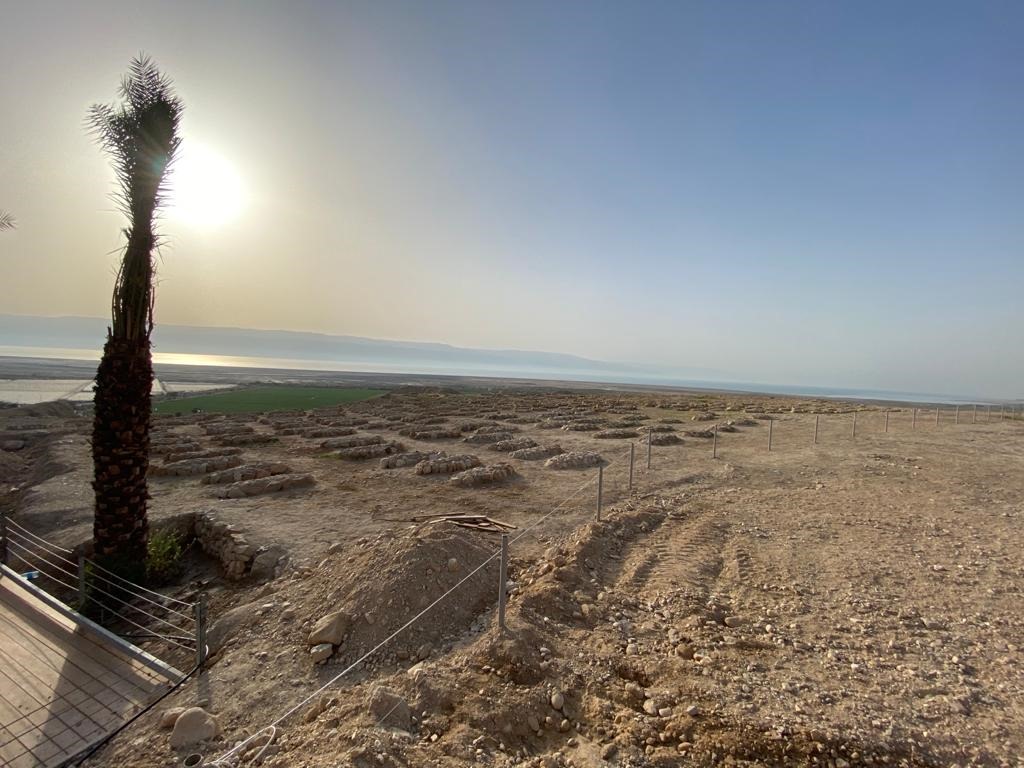
The cemetery at Qumran has recently been “reconstructed.” Photo courtesy of Michael Schneider in Jerusalem.

Archaeologists working in Egypt’s Western Desert have discovered a monastery complex dating to the 4th to 8th centuries.

Twenty-two royal Egyptian mummies are set to be transferred to the National Museum of Egyptian Civilisation (NMEC) in a much-awaited parade in the streets of Cairo on 3 April.”

King Tut’s war shield has been restored so that it may be displayed to the public for the first time.

A small bronze bull was discovered after a rainfall near the temple of Zeus in Olympia.

Dimitris Tsalkanis describes his goals in creating “Ancient Athens 3D,” a collection of hundreds of digital models from seven historical periods from 1200 BC to AD 1833.

Some people are not happy with the proposal to loosen governmental control over five major museums in Greece.

There are a number of similarities between the chariot recently discovered chariot near Pompeii and five chariots discovered in Greece in 2002.

A beautiful, long-lost mosaic that once adorned a ship belonging to Caligula has found its way into an Italian museum.

A collection of 24 studies by Cyrus H. Gordon, published in a variety of books and journals between 1933 and 1982, have been compiled in pdf format by Robert Bedrosian.

In response to Peter J. Parr, Aren Maeir explains why preliminary reports and prompt publication of excavation results are essential.

HT: Agade, Arne Halbakken, Ted Weis, Alexander Schick, Explorator, Steven Anderson

The Jerusalem Post has more about the very old, very well-preserved woven basket that was announced at the same time as the Dead Sea Scrolls discovery.

The Israel Antiquities Authority has identified 20 caves in the Judean desert “with the potential for good artifacts” that will be excavated in the future.

Herb Keinon reflects on the possible significance of the Dead Sea Scrolls announcement that also mentioned the non-Jewish items of the woven basket and the mummified skeleton.

The city of Jerusalem has publicly acknowledged that the existence of a 150-meter tunnel that connects the Dormition Abbey to another church known as the “house of Joseph.” I suspect that there is much more to this story than is reported here.

Carl Rasmussen shares photos from a very interesting building in Jerusalem that dates to the Hasmonean or Herodian eras.

The Jerusalem Municipality archives, containing materials over 400 years old and more than 600,000 photos, will be digitized.

Jonathan Klawans argues that the Shapira scrolls should be regarded as forgeries because they “are suspiciously aligned with [Shapira’s] own curious mix of backgrounds and commitments.”

Jim Davila at Paleojudaica has some updates on the Shapira Scroll discussion.

Now online, incomplete but free: A Digital Corpus of Early Christian Churches and Monasteries in the Holy Land. This six-year project was carried out on behalf of the Hebrew University and the Institute of Archaeology.

One of my favorite books, Reading the Bible with Rabbi Jesus, is only $1.59 on Kindle right now. If you prefer paperback, you can support the author by buying it here.

HT: Agade, Arne Halbakken, Ted Weis, Alexander Schick, Explorator, Steven Anderson

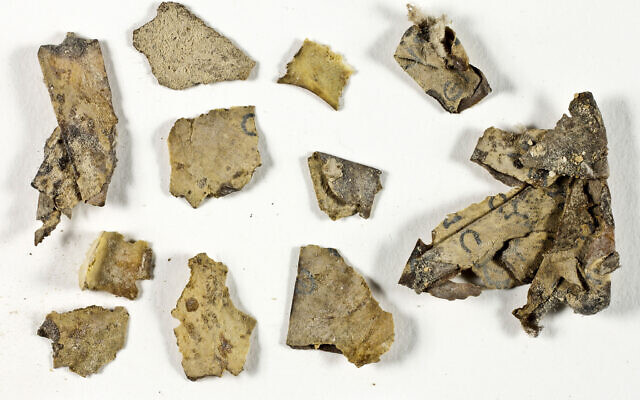
Archaeologists working in a cave in Nahal Hever near the Dead Sea have discovered two dozen scroll fragments. Most are Greek translations of portions of Zechariah and Nahum. Also announced was the discovery of “the world’s oldest woven basket” and the mummified skeleton of a child.

The announcement this morning reported the results of an operation begun in 2017, and the archaeologists are seeking more governmental support to continue the hunt for ancient artifacts in the Judean desert. The Times of Israel reports:

The latest identified finds, two dozen 2,000-year-old biblical scroll fragments from the books of Zechariah and Nahum, were discovered in clumps and rolled up in the Cave of Horror. The conservation and study of the fragments was conducted by the IAA’s Dead Sea Scrolls Unit under Tanya Bitler, Dr. Oren Ableman and Beatriz Riestra.

The team has so far reconstructed 11 lines of Greek text that was translated from Zechariah 8:16–17, as well as verses from Nahum 1:5–6. They join nine, much more extant fragments that were discovered by Yochanan Aharoni, who first surveyed the Cave of Horrors in 1953.

On the new fragments, as well as in the Greek translation scroll discovered by Aharoni, only the name of God appears in Hebrew. It is written in the Paleo-Hebrew script used during the First Temple period, as well as by some adherents of the Bar Kochba revolt (132–136 CE), including on coinage, and in the Qumran community.

For the full story, photos, and a video, see The Times of Israel, The Jerusalem Post, The New York Times, and other major news outlets.

Fragments of the newly discovered Dead Sea Scrolls. Photo by Shai Halevi, Israel Antiquities Authority