Archaeologists working in a cave in Nahal Hever near the Dead Sea have discovered two dozen scroll fragments. Most are Greek translations of portions of Zechariah and Nahum. Also announced was the discovery of “the world’s oldest woven basket” and the mummified skeleton of a child.

The announcement this morning reported the results of an operation begun in 2017, and the archaeologists are seeking more governmental support to continue the hunt for ancient artifacts in the Judean desert. The Times of Israel reports:

The latest identified finds, two dozen 2,000-year-old biblical scroll fragments from the books of Zechariah and Nahum, were discovered in clumps and rolled up in the Cave of Horror. The conservation and study of the fragments was conducted by the IAA’s Dead Sea Scrolls Unit under Tanya Bitler, Dr. Oren Ableman and Beatriz Riestra.

The team has so far reconstructed 11 lines of Greek text that was translated from Zechariah 8:16–17, as well as verses from Nahum 1:5–6. They join nine, much more extant fragments that were discovered by Yochanan Aharoni, who first surveyed the Cave of Horrors in 1953.

On the new fragments, as well as in the Greek translation scroll discovered by Aharoni, only the name of God appears in Hebrew. It is written in the Paleo-Hebrew script used during the First Temple period, as well as by some adherents of the Bar Kochba revolt (132–136 CE), including on coinage, and in the Qumran community.

For the full story, photos, and a video, see The Times of Israel, The Jerusalem Post, The New York Times, and other major news outlets.
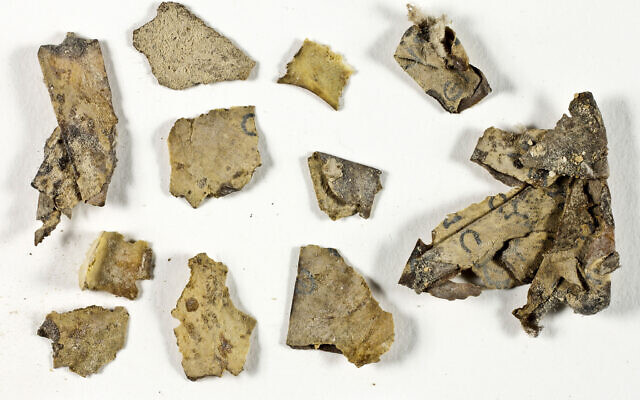
Fragments of the newly discovered Dead Sea Scrolls. Photo by Shai Halevi, Israel Antiquities Authority

Share:

An 11-year-old on a family hike in the Negev discovered a rare fertility figurine dating to about 500 BC.

Haaretz (premium) has a story about the debate over whether the Lachish gate shrine was a shrine, and if so, if it was desecrated by a toilet.

A new book by Idan Dershowitz argues that the scrolls of Moses Shapira, long believed to be forgeries, are actually the earliest Dead Sea Scrolls and were a “pre-canonical antecedent” of Deuteronomy. The book is available on Academia. Christopher Rollston argues that the scrolls are forgeries. Drew Longacre concurs.

A notice from the Hazor Excavations team indicates that foreigners will be permitted to volunteer in Israel this summer with proof of vaccination. The Gath registration webpage confirms this.

My new reflection on the Garden of Gethsemane is now available to members of Jerusalem Perspective.

The New York Times runs an obituary for Hershel Shanks.

Jerusalem University College has announced its newest program: The Christian Movement in the Mediterranean, with a two-week voyage tracing Paul’s voyages in the Mediterranean.

New: Ancient Israel’s Neighbors, by Brian R. Doak (Book 1 in Oxford’s Essentials of Biblical Studies series).

The early-bird discount for the Infusion Bible Conference ends on April 9. The topic is “Paul and His Roman World,” and the new location is Nashville.

HT: Agade, Ted Weis, Arne Halbakken, Keith Keyser, Explorator

Share:

Archaeologists discovered a massive gateway near Persepolis that was built by Cyrus in honor of the conquest of Babylon.

A large-scale production brewery was found in Abydos, Egypt.

“The discovery of a rare ‘mud mummy’ from ancient Egypt has surprised archaeologists, who weren’t expecting to find the deceased encased in a hardened mud shell.

A CT study indicates that Pharaoh Seqenenre Taa II (558-1553 BC) died on the battlefield.

A researcher studied tomb reliefs and conducted dozens of experiments in order to discover how the ancient Egyptians baked bread.

A UNESCO jobs program is helping to restore Byzantine sites in Jordan.

Carl Rasmussen shares photos of Aizanoi in Turkey, where one of the best-preserved temples of the ancient world is located.

Greece Is lists the top 10 archaeological finds in Greece in 2020.

The Paphos Archaeological Museum in Cyprus has reopened after four years of renovations and delays.

Smithsonian Magazine: Iraq’s Cultural Museum in Mosul is on the road to recovery.

“The Encyclopædia Iranica Online is now freely accessible at Brill’s Reference Works Platform.”

5,000 photographs of Arabia taken by Sir Wilfred Thesiger between 1945 and 1950 have been digitized by the Pitt Rivers Museum.

“Excavating the History of the Bible: What Archeology Can Teach us About the Biblical World”—hosted by Dr. Andrew Mark Henry has launched on YouTube. The first episode provides an intro to biblical archaeology. The second is on the Canaanites.

A rare snowstorm covered Athens and its acropolis with several inches of snow.

HT: Agade, Ted Weis, Arne Halbakken, Keith Keyser, Explorator

Share:

Archaeologists in western Turkey have found a hoard of 651 silver coins dating to the 1st century BC.

“Turkish archaeologists studying the ruins of the ancient town of Myra have found more than 50 terracotta figurines depicting humans, gods and animals.”

Carl Rasmussen shares photos of Adada, a city that Paul and Barnabas probably passed through on their first journey.

“Syrian authorities believe they have found the body of a top archaeologist who was killed by the Islamic State (IS) group in 2015 while he tried to protect the ancient city of Palmyra.”

Why were ostrich eggs so coveted by elites in the ancient Near East?

The builders of the Giza pyramids were locals who were paid for their work and who ate well.

Egypt is planning to open four museums this year, including the Grand Egyptian Museum in June.

Online lecture on Feb 22: “Presenting the Heritage of Jordan at The Jordan and The Petra Museums,” by Khairieh Amr

Edd Hodsdon: “Darius the Great: 9 Facts About The King Of Kings”

New from Eisenbrauns: A Handbook of Gods and Goddesses of the Ancient Near East Three Thousand Deities of Anatolia, Syria, Israel, Sumer, Babylonia, Assyria, and Elam, by Douglas R. Frayne and Johanna H. Stuckey, with illustrations by Stéphane D. Beaulieu. Save 30% with code NR21.

HT: Agade, Alexander Schick, Arne Halbakken, Keith Keyser, Ted Weis, Explorator

Share:

An Israeli soldier discovered a rare coin dating to AD 158 from the ancient city of Geva Phillip near Megiddo.

Israeli archaeologists recently re-discovered a dolmen in northern Galilee in a search inspired by the memoirs of Prince Albert and Prince George (later King George V). The underlying journal article is here.

A portion of the “altar site” on Mount Ebal has been destroyed by road construction work. Israel’s President has asked the Ministry of Defense to investigate.

King Manasseh’s reign is illuminated by archaeological discoveries, as Bryan Windle shows in his latest archaeological biography.

Barry Beitzel is interviewed about his background in biblical geography and his recent work on the Lexham Geographic Commentary series.

Tributes to Hershel Shanks have been shared by Suzanne Singer, Daniel Silliman, Aren Maeir, and the Washington Post. The full Shanks commemorative issue of BAR (from 2018) is now open to all, including kind words from Christopher Rollston and others.

Albright Virtual Workshop on Feb 22: “‘The loss of a minute is just so much loss of life’: Edward Robinson and Eli Smith in the Holy Land,” by Haim Goren.

Jonathan Robker gives some tips for finding and using digital resources related to biblical studies and material culture.

Registration is now open for Infusion Bible Conference (formerly The Institute of Biblical Context Conference), June 14-16, in Franklin, Tennessee.

HT: Agade, Alexander Schick, Arne Halbakken, Keith Keyser, Ted Weis, Explorator

Share:

Sixteen rock hewn burial tombs were found at Taposiris Magnain, Egypt, with one mummy having a golden tongue.

Some Egyptian scholars are arguing over whether it is acceptable to excavate and display ancient mummies.

Bones allegedly of St. James the Younger housed in the Santi Apostoli church in Rome are not old enough to have belonged to the apostle.

“New burials discovered inside the Roman necropolis of Santa Rosa, standing under what is now Vatican City, have shed light on burials that housed the servants and slaves of the Roman Caesars.”

Excavations are resuming at Herculaneum after 40 years, with work focused on the ancient beach.

After working hard to get Babylon chosen as a World Heritage Site, Iraqi officials have stopped working to protect the site.

The Getty Research Institute is presenting an online exhibition on the ancient Roman city of Palmyra, including more than 100 rare images.

“An anonymous philanthropist gave more than £11 million ($15m) to University College London to support the teaching and research of the heritage, history and languages of ancient Mesopotamia.”

Now online: Jewish Studies, an Internet Journal 19 (2020) —  Special Josephus Issue

Now on YouTube: Gilgamesh Lament for Enkidu (with subtitles)

David Moster has just released a new video on “Coups in the Bible.”

Online lecture on Feb 10: “House Hunters: Babylon, 1300 BCE,” by Susanne Paulus

The new Digital Atlas of the Roman Empire (DARE) is available for broad use, including in web applications.

The German Archaeological Institute has created a digital map of Pergamum that represents all known archaeological remains.

New podcast on This Week in the Ancient Near East: “The Other Kind of Throne, or, What’s the Deal with Toilets in the Iron Age?”

Hershel Shanks, founder of Biblical Archaeology Review, died of Covid on February 5 at the age of 90.

HT: Agade, Joseph Lauer, Arne Halbakken, Charles Savelle, Keith Keyser, Ted Weis, Alexander Schick

Share: