A team excavating Khirbet a-Ra‘i (the alleged Ziklag) in January and February discovered “a rare ‘smiting god’ figurine, a bronze calf figurine, two seals and decorated Canaanite and Philistine pottery from the 12th Century BCE.”

With everyone home, antiquities thieves are having a field day in Judea and Samaria.

With the Israel Museum closed, the Dead Sea Scrolls are now safely stored “behind five locked doors in a humidity and temperature-controlled vault at the Shrine of the Book.”

Owen Jairus reports on discoveries made in the Nazareth Archaeological Project, as recently published by its director Ken Dark.

The summer season at Tell es-Safi/Gath has been cancelled. Other excavations have apparently cancelled as well, though I haven’t yet seen those notices.

The Temple Mount Sifting Project has unveiled a new virtual exhibition.

The Palestine Open Maps project has just launched, and it is based on the 1940s survey maps from the British Mandate.

On Kindle for $2.99: Jesus and the Eyewitnesses: The Gospels as Eyewitness Testimony, by Richard Bauckham.

Hisham’s Delights is a new digital cookbook from the kitchen of the Albright Institute.

HT: Agade, Ted Weis, Joseph Lauer

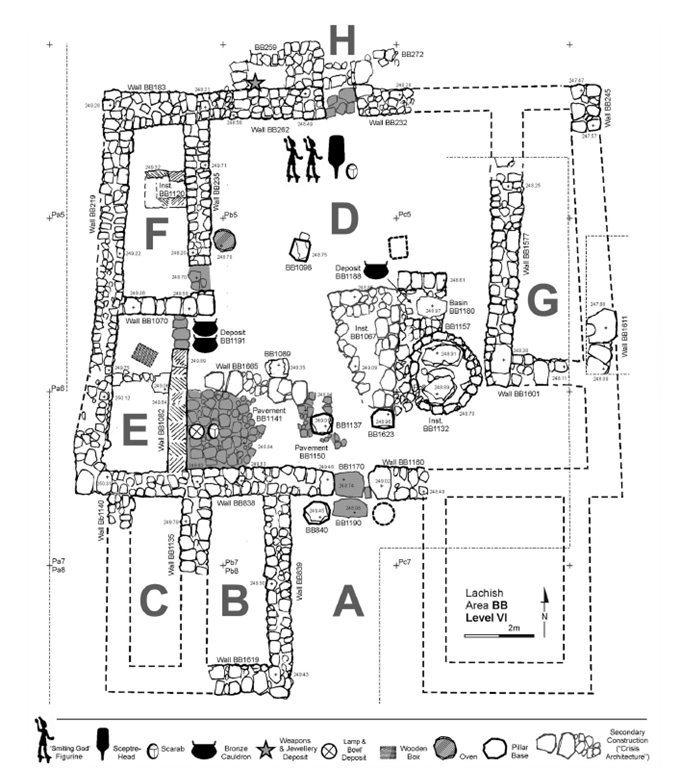
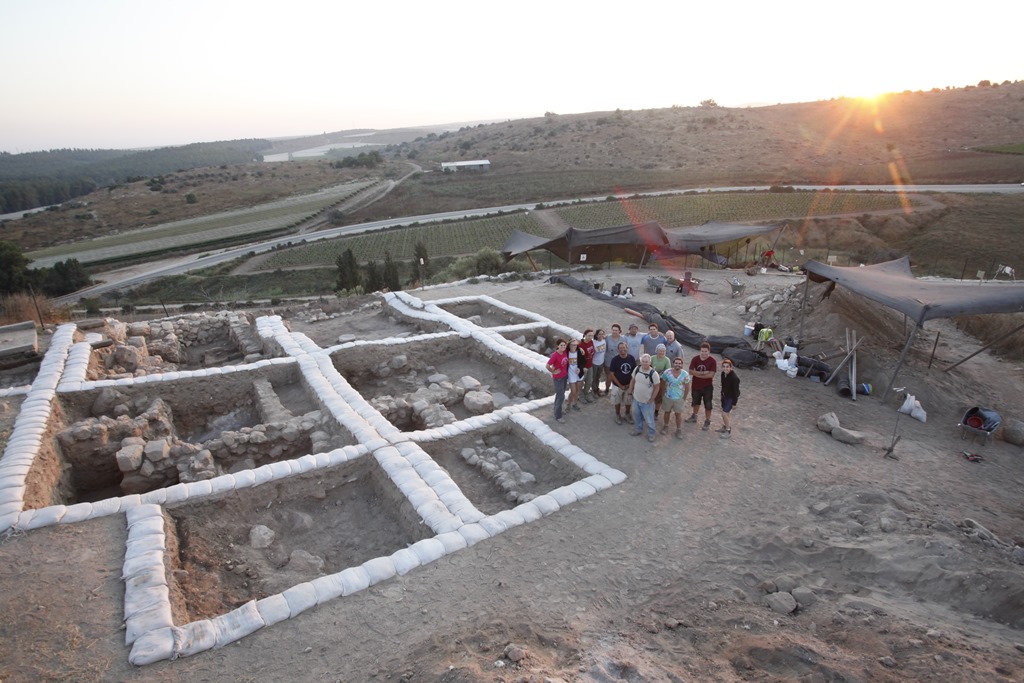
Archaeologists from Hebrew University excavating at Lachish have uncovered a temple from the Canaanite period. The full study is published in Levant, and the university has issued a press release, portions of which are excerpted here.

In a study published last month in Levant, [Yosef] Garfinkel and his co-authors revealed, for the first time ever, extensive ruins of a Canaanite temple dating to the 12th century BCE that they uncovered in National Park Tel Lachish, a large Bronze Age-era settlement near the present-day Israeli city of Kiryat Gat…

The layout of the temple is similar to other Canaanite temples in northern Israel, among them Nablus, Megiddo and Hazor.  The front of the compound is marked by two columns and two towers leading to a large hall.  The inner sanctum has four supporting columns and several unhewn “standing stones” that may have served as representations of temple gods.  The Lachish temple is more square in shape and has several side rooms, typical of later temples including Solomon’s Temple.

In addition to these archaeological ruins, the team unearthed a trove of artifacts including, bronze cauldrons, Hathor-inspired jewellery, daggers and axe-heads adorned with bird images, scarabs, and a gold-plated bottle inscribed with the name Ramses II, one of Egypt’s most powerful pharaohs.  Near the temple’s holy of holies, the team found two bronze figurines.  Unlike the winged cherubs in Solomon’s Temple, the Lachish figurines were armed “smiting gods”.

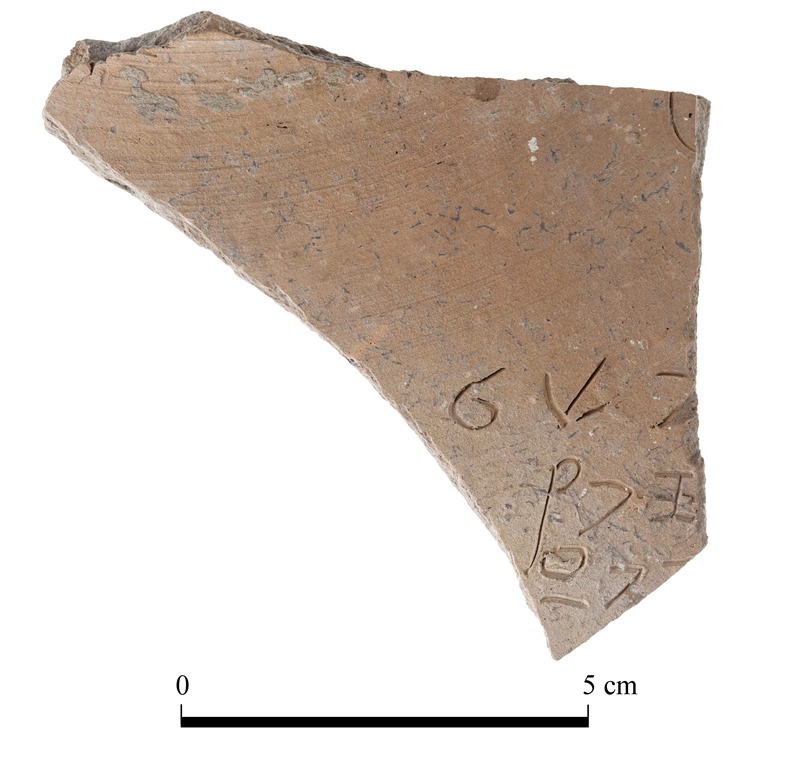
Of particular interest was a pottery sherd engraved with ancient Canaanite script.  There, the letter “samek” appears, marked by an elongated vertical line crossed by three perpendicular shorter lines.  This makes it the oldest known example of the letter and a unique specimen for the study of ancient alphabets.

The story is currently being reported by Jewish Press and Arutz-7, with more surely to follow.

HT: Joseph Lauer

Temple at Tel Lachish_Courtesy of the Fourth Expedition to LachishJPG

Temple at Tel Lachish, courtesy of the Fourth Expedition to Lachish

Plan of the North-East Temple_Credit J. Rosenberg.

Plan of the North-East Temple, by J. Rosenberg

Letter samek, 2nd row on right, inscribed on storage jar_Credit T. Rogovski

Letter samek, 2nd row on right, inscribed on storage jar; photo by T. Rogovski

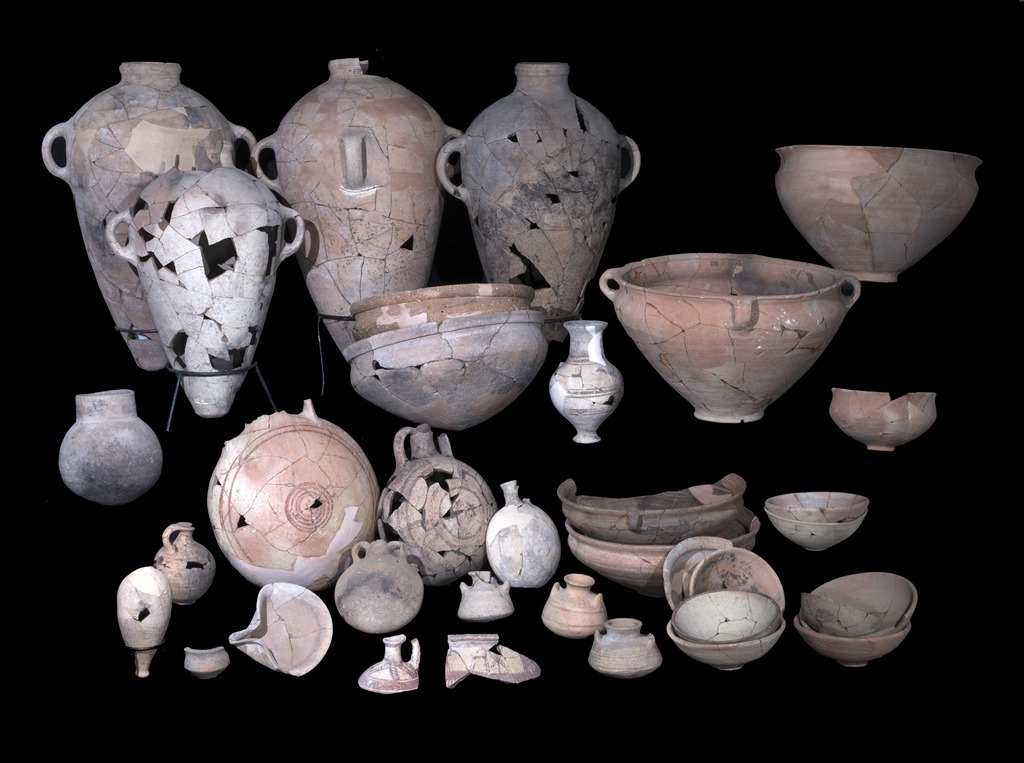
Pottery uncovered in Temple_Credit C. Amit_IAA

Pottery uncovered in temple, photo by C. Amit, IAA

Archaeologists believe that a well-preserved complex at Horvat Tevet, near Afula in the Jezreel Valley, served as a royal estate for Israel’s kings.

Archaeologists working at Tell Damiyah (biblical Adam) are uncovering a religious complex that dates to 700 BC.

Ann Killebrew shares about her experience and discoveries made in the last decade of excavating Tel Akko.

16 tombs from the 26th dynasty have been found at Al-Ghoreifa in Egypt.

New research of the mummified remains of Takabuti, held at the Ulster Museum, reveals the Egyptian had genetic roots to Europe and was likely stabbed to death.

Ueli Bellward explains the complex water collection system of Petra, including how its flash flood system enabled the city to survive.

Archaeologists are concerned about the increasing popularity of Gobekli Tepe.

A story in Discover magazine explains how archaeologists know where to dig.

Archaeologists believe that they have found a second example of crucifixion, discovered near Venice.

The AP has a number of photos of a massive locust invasion in eastern Africa.

Caesarea’s ancient theater stage is undergoing a major renovation.

John DeLancey has just wrapped up another tour of Israel, blogging about each day.

Holly Beers is on The Book and the Spade discussing her new book, A Week in the Life of a Greco-Roman Woman.

Bryan Windle identifies the top three reports in biblical archaeology in the month of January.

BiblePlaces.com celebrated its 20th anniversary this week, and we are thankful for many encouraging words, including reflections from Mark Hoffman, Ferrell Jenkins, Leon Mauldin, and Charles Savelle.

HT: Agade, Ted Weis, Cam von Wahlde, Joseph Lauer

A stone measuring table and several dozen stone weights were discovered in a plaza along the first-century AD street from the Pool of Siloam to the Temple Mount. Archaeologists believe that the area it was found served as the Jerusalem’s central market. The Times of Israel article includes a video and many photos.

It’s not quite a copy of the Tel Dan Inscription, but a pottery restorer discovered a faint ink inscription of a single Hebrew word on a storejar excavated at Abel Beth Maacah (Haaretz premium).

“Egypt’s recent decision to transport ancient Pharaonic artifacts to a traffic circle in the congested heart of Cairo has fueled fresh controversy over the government’s handling of its archaeological heritage.”

Rainfall this week led to flooding in the Judean wilderness. The video at the bottom of this page shows waterfalls in Nahal Qumran. Aren Maeir shares videos and photos of a river running through the Elah Valley.

The Biblical Archaeology Society is offering dig scholarships for excavations this coming year.

The most recent maps posted on the Bible Mapper Blog are of Southern Greece, the Judean Wilderness, and Philistia.

The photographs of Nancy Lapp, taken during excavations around the Middle East from the 1950s to the 1990s are the subject of an interesting photo essay by Rachael McGlensey. More than 2,000 images from Jordan have been digitized in the Paul and Nancy Lapp Collection at ACOR.

Bob Rognlien’s new book is out: Recovering the Way. The book trailer will introduce you to it. Here’s my endorsement:

Recovering the Way is an enjoyable and fascinating read, combining historical insights from the time of Jesus with practical encouragement for our lives today. All that Bob has learned and experienced in three decades of leading pilgrims through the land of Israel provide the reader with a rich treasure of biblical instruction, wise application, and captivating stories. All of this benefits from dozens of beautiful illustrations which help the reader to see the world where Jesus ministered.

HT: Agade, Joseph Lauer, Ted Weis

We live in remarkable days, archaeologically speaking. More excavations at more sites are uncovering a tremendous amount of all kinds of information about ancient civilizations. Much of what is learned doesn’t make for a sensational news story, but is perhaps more important than the headline discovery.

The end of the year is a good time to look back over the stories, and attempting to identify highlights, and even to rank them, provides a good opportunity to determine what we consider important and why. My list here is decidedly subjective, and with my own undeniable biases towards discoveries from the biblical periods made in the land of Israel. The value isn’t in the accuracy of the list but in the opportunity to reflect on what we’ve gained and what may lie ahead. Here, then, is my list of the top 10 discoveries in biblical archaeology in 2019:

1. A seal impression belonging to “Nathan-Melech, servant of the king” discovered in Jerusalem’s City of David. Why is this in my top 10? Scholars believe this is likely the same individual who served Josiah, king of Judah (2 Kgs 23:11). If so, this is an archaeological artifact created by someone named in the Bible.

2. A statue likely depicting an Ammonite king in the 9th or 8th centuries BC discovered in Amman. Why is this in my top 10? Depictions of ancient kings are quite rare from Israel or their neighbors in Ammon, Moab, Edom, Philistia, Phoenicia, or Aram.

3. A destruction layer from the Babylonian conquest of Jerusalem in 586 BC discovered on the Western Hill of Jerusalem. Why is this in my top 10? The Babylonian conquest is well-documented in the Bible, but archaeologists have found less trace of it in excavations than you might expect.

4. Massive fortifications exposed at Gath. Why is this in my top 10? This provides further insight into the nature of this Philistine city at the time when Goliath went out to battle and never came home.

5. A 7th-century BC seal impression “belonging to Adonijah, the royal steward” discovered in the City of David. Why is this in my top 10? Though this is not the famous Adonijah, son of David, it gives us an ancient example of the same name, in the city where he lived. In addition, this Adonijah was “chief of staff” to one of the kings of Judah, possibly Manasseh and Josiah.

6. The possible discovery of the “Church of the Apostles” at el-Araj (Bethsaida?). Why is this in my top 10? Anything that furthers the discussion about the correct identification of Bethsaida is valuable.

7. A mosaic depicting the Israelites’ encampment at Elim as well as two of the four beasts of Daniel 7 discovered in the ancient synagogue of Huqoq. Why is this in my top 10? Before there were photographs illustrating the biblical record, there were mosaics. But most synagogue mosaics depict Zodiacs and other non-biblical subjects.

8. A mosaic floor in a church at Hippos apparently depicts Jesus’s multiplication of the fish and loaves (Haaretz premium). Why is this in my top 10? This may well be an ancient depiction of a miracle near the place where it happened.

9. An Byzantine Church near Beth Shemesh with an inscription mentioning a “glorious martyr.” Why is this in my top 10? This church is well-preserved, and its mosaics are beautiful.

10. A new DNA study indicating that Philistines living in Ashkelon in the late 12th century BC originated from Greece, Crete, or Sardinia. Why is this in my top 10? The origins of the Philistines has long been debated, and this provides some definitive scientific evidence of their Aegean origin.


Fake News:

Khirbet a-Ra‘i is Ziklag.

Kiriath Jearim is Emmaus.

Temple that housed the Ark of the Covenant discovered at Beth Shemesh.


Top Stories Related to Tourism:

The Ketef Hinnom Archaeological Garden opened, no longer requiring passage through the Begin Center to visit the First Temple period tombs.

The Temple Mount Sifting Project was relaunched at a new location.

A $6 million, 9-year project has made much of Jerusalem’s Old City accessible to wheelchairs.

The outer courtyard of the Tomb of the Kings was reopened to tourists.

$55 million will be invested to renovate several sites in the Jewish Quarter of Jerusalem’s Old City, including the Burnt House, the Wohl Archaeological Museum, and the Tiferet Yisrael Synagogue.

With restorations complete, Bethlehem’s Church of the Nativity was removed from UNESCO’s list of endangered world heritage sites.

A new sound-and-light show, used advanced technologies, was unveiled at Masada.

A new visitor’s center opened at Caesarea in four reconstructed vaults underneath Herod’s temple.

A new archaeological visitor center opened at Jokneam, at the base of Mount Carmel not far from Megiddo.

The new Petra Museum was inaugurated.

Egypt opened a 105-mile hiking trail called the “Red Sea Mountain Trail” that is west of Hurghada.

Greek authorities granted permission for the restoration of the interior of the Parthenon in Athens.

The palace of Nero, with virtual reality features, opened to visitors.

Saudi Arabia is now giving visas to foreign tourists.

Losses This Year:

Tim Bulkeley

George Giacumakis

Doug Greenwold

Philip J. King

Amos Kloner

William B. Tolar


Other Compilations:

The two I would recommend first are those by Gordon Govier and Bryan Windle. Others are a bit broader in scope or have different criteria, including those by Owen Jarus, Stephanie Pappas, and Aaron Earls. Israel HaYom suggests the top 5 of the decade, and Haaretz (premium) offers their top discoveries of the decade.

I compiled my lists before reading any others, and I see there’s quite a bit of difference between them. One reason: I excluded discoveries made or announced in previous years. But it can be tricky knowing when a discovery was “made,” as sometimes a lengthy analysis delays the announcement. Of course, in some cases, the announcement is necessarily made before the analysis!


Previous Years:
You can revisit the top stories of previous years with these links:
Few people will get excited about a “large stone found at Beth Shemesh,” but if you claim that the ark of the covenant sat there, that’s another matter. The archaeologist helpfully notes that the stone is located in the wrong place, and I’ll add that the temple dates to the wrong century and the stone looks to be much too small to qualify as a “large stone” in Israel.

An ancient seawall near Haifa allegedly was built to prevent flooding caused by climate change in the Neolithic period. The journal article on which these stories are based is here.

“A small 1st century factory that produced fermented fish sauce — arguably the most desirable foodstuff of the Roman era — was recently uncovered during excavations near the southern coastal Israeli city of Ashkelon.”

A Bronze Age painting of an Asian monkey on a Greek island suggests that trade and cultural contacts were more far-reaching than previously known.

“Two large tombs have been discovered and excavated at the site of the ancient city of Pylos in southern Greece, suggesting that Pylos played a surprisingly prominent role in early Mycenaean civilization.”

Archaeologists have found physical evidence of the mysterious pointy “head cones” found in Egyptian art.

“Egypt’s Ministry of Antiquities witnessed a fortuitous weekend, discovering rare red granite Ramses II statue and seizing 135 relics in a Kidney dialysis centre.”

The homes of ancient Egyptians, Mesopotamians, and “Israelis” are presented in this collection of 40 photographs.

Shawn Zelig Aster has written a short but interesting article explaining how Assyria treated ambassadors from Israel, Judah, and other nations in order to turn them into emissaries for Assyrian ideology.

Bryan Windle pulls together all of the evidence, and a number of photographed inscriptions, in his archaeological biography of Quirinius.

Carl Rasmussen shares a few photos from his visit to the new museum at Caesarea Maritima.

The final Stars Wars movie is the latest Hollywood production to be filmed in Jordan’s Wadi Rum.

Phillip J. Long is quite positive in his review of the new Lexham Geographic Commentary on Acts through Revelation.

Don McNeeley provides a summary of the presentations given at the 2019 meeting of the Near East Archaeological Society.

Pac McCarthy (seetheholyland.net) has written a hymn with a Holy Land theme. A video recording is now on YouTube.

HT: Agade, Ted Weis, Keith Keyser, Joseph Lauer, Mark Hoffman