A winepress from the Byzantine period was discovered at Chorazin by a team doing conservation work.

The recent discovery of a depiction of the Egyptian god Bes in the City of David Givati parking lot excavation is the first of its kind ever found in Jerusalem.

The Times of Israel features a well-illustrated story on the Beth Shemesh excavations including the controversy and the museum exhibit.

A new sound-and-light show, used advanced technologies, has been unveiled at Masada.

A shipwreck discovered in Heracleion matches the description of a Nile River boat described by Herodotus.

Excavation work at Macherus is complete after 11 years, but conservation work will continue.

Over a million people are expected between March-September to attend the Louvre exhibition of the  Egyptian pharaoh Tutankhamun. The show features the largest number of Tut items ever displayed together. As construction nears completion for the new Grand Egyptian Museum in Giza, the Egyptian Ministry for Antiquities states that after the six city world tour is completed, key pieces related to Tut will never again leave Egypt.

The Basrah Museum in southern Iraq has added three new galleries, totaling 2,000 pieces, focused on Sumer, Assyrian, and Babylonian objects.

Erin Darby will be lecturing on “The Archaeology of Women in Ancient Israel” in Oak Ridge, Tennessee, on April 2.

The History Channel has a photo essay of ten biblical sites.

Wayne Stiles recently visited the Royal Mummies Hall in the Cairo Museum.

Bible History Daily features a profile on Julia Berenice, the companion of King Agrippa II in Acts 26.

New from the Oriental Institute of the University of Chicago: The Great Hypostyle Hall in the Temple of Amun at Karnak, by Peter J. Brand, Rosa Erika Feleg, and William J. Murnane. For purchase in hardback or a free download.

“The Setting of the Assassination of King Joash of Judah: Biblical and Archaeological Evidence for Identifying the House of Millo,” by Chris McKinny, Aharon Tavger, Nahshon Szanton, and Joe Uziel, is a paper read and illustrated by Chris McKinny.

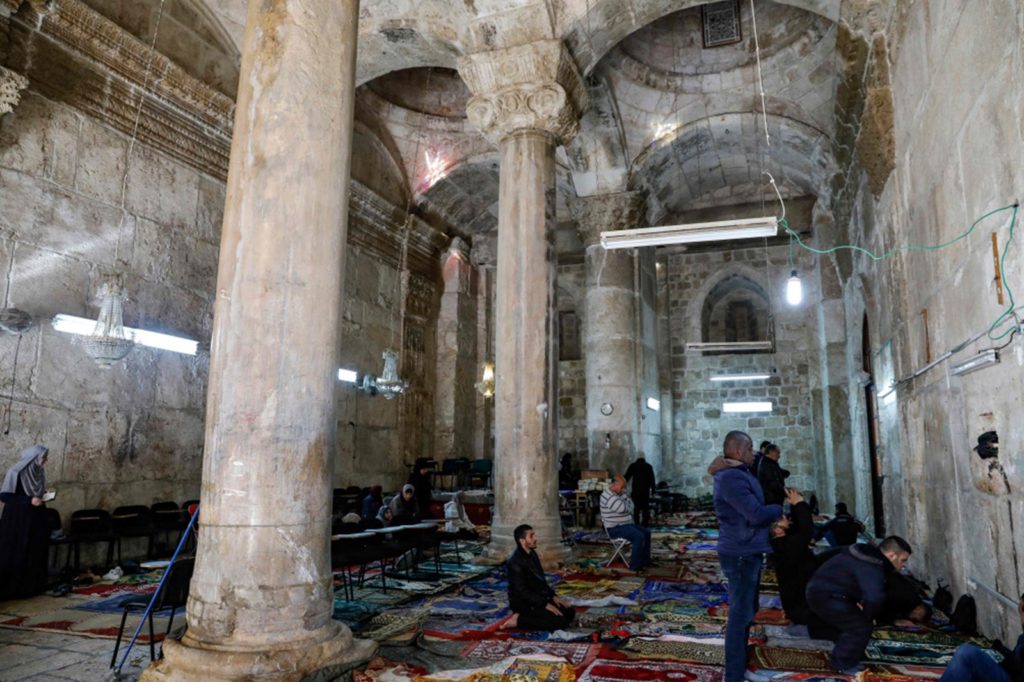
The photo below, from DerStandard, shows the interior of the Golden Gate in recent times.
HT: Ted Weis, Agade, Charles Savelle, Alexander Schick, Paleojudaica

Interior of the Golden Gate
Photo from DerStandard

An attempt to smuggle into Britain an ancient Babylonian kudurru as a “carved stone for home decoration” with a value of “300” failed.

“Music was ubiquitous in Ancient Greece. Now we can hear how it actually sounded.”

Israel has become the first country to list all cemetery tombstones online.

The February 2019 issue of the Newsletter of the Egyptian Ministry of Antiquities includes the latest discoveries, repatriations, and news.

A Greek archaeologist has been working in Alexandria for 15 years in an effort to find the tomb of Alexander the Great.

A 3-minute video shows an animation of what the hanging gardens of Babylon may have looked like.

The Museum of the Bible is hosting a two-session lecture series on “Jerusalem and Rome: Cultures in Context in the First Century CE,” featuring Eric Meyers, Mary Boatwright, Lawrence Schiffman, and Steven Notley.

Eric Meyers will be lecturing on March 28 in Chapel Hill, North Carolina, on “Holy Land Archaeology: Where the Past Meets the Present.”

Six speakers will address the subject of “Egypt and Ancient Israel: Merneptah’s Canaanite Campaign—History of Propaganda?” in a conference at Southwestern Baptist Theological Seminary on March
26.

Chris McKinny’s recent lecture on “Tel Burna—After a Decade of Investigation” is now online. The video includes all of his visuals.

This is fascinating: Predators in the Thickets: A Film Interview with Two Botanists and a Zoologist in Israel. You’ll learn more about lions, bears, forests, thickets, the Zor, and the Ghor. The film is intended an introduction to the newly launched Dictionary of Nature Imagery of the Bible.

Amos Kloner died yesterday.

HT: Agade, Chris McKinny, Joseph Lauer

Egypt has preserved a unique Greco-Roman catacomb in Alexandria through a groundwater-lowering project.

The Egyptian site of Heliopolis is “a black hole in our knowledge of ancient Egypt.”

A ram-headed sphinx carved from sandstone more than 3,000 years ago has been found in Egypt.”

The new exhibit “Ancient Egypt: From Discovery to Display” at the University of Pennsylvania Museum walks the visitor through the archaeological process.

John DeLancey shares photos he recently took inside the pharaohs’ tombs in the Valley of the Kings.

The top archaeological finds from Greece in 2018 include the oldest known excerpt from Homer’s Odyssey and the most intact ancient Greek vessel ever found.

Carl Rasmussen goes to Rome in search of an answer to the question, “Where did the Jerusalem Temple treasure go?” (Part 1, Part 2)

This year’s Friends of ABR Fundraising Banquet will honor Bryant Wood.

HT: Explorator, Ted Weis, Agade, Paleojudaica

New clues to the lost tomb of Alexander the Great are being unearthed in Egypt (National Geographic).

Sinai’s 500 plus photographic entries from mid 19th to mid 20th centuries . . . are now published online with detailed geography and history description . . . based on the 19-year field survey and maps of Sinai Peninsula Research (SPR).”

Erin Blakemore recounts the tale of how a modern attempt to play King Tut’s trumpets went awry.

Somehow John DeLancey is able to post summaries every day for his tours, including their recent days in Egypt.

Iraq is seeking World Heritage List status for the ancient city of Babylon.

Tourists are apparently returning to the ancient city of Ur in southern Iraq.

Esagil, Treasure Hunt in Babylon, is a a board game with a real-scale map of ancient Babylon.

The opening of a spectacular ancient Jewish catacomb in Rome continues to be delayed.

What is “biblical archaeology”? Owen Jarus provides some definitions and an introduction to some of the controversy surrounding its use.


Smithsonian Magazine profiles Wendell Phillips, sometimes known as America’s “Lawrence of Arabia.”

The majority, or perhaps even all, of the 75 new “Dead Sea Scrolls” fragments that have appeared on the market since 2002 are modern forgeries, according to Årstein Justnes and Josephine Munch Rasmussen. UPDATE: I am told by someone I trust that this article has many errors, including in its basic assertions.

ASOR has begun its March Fellowship Madness 2019 to raise funds to help students and scholars.

Ferrell Jenkins explains why he is fond of an “unattractive” photo taken at the Corinth Museum.

Two new videos with Aaron Brody: Introduction to the Bade Museum and Repatriating Antiquities.

HT: Ted Weis, Agade, G. M. Grena

IMG_20190301_134514_thumb[1]
Destroyed baptismal site on the Jordan River after recent flooding
(Photo by Alexander Schick)

A well-preserved Greek inscription from the 5th century recording a blessing for one ‘Master Adios’” was discovered in central Israel.

Plans to convert the Golden Gate of the Temple Mount into a Muslim place of prayer are being resisted by Israeli police.

Two crews of antiquities thieves working in eastern Samaria were arrested in recent weeks. One of them was looting Alexandrium-Sartaba.

A short trailer has been released promoting this season’s excavations at Tel Shimron.

There is still time to sign up for this summer’s season at Tel Burna. Shiloh has some openings as well.

Heavy rains this week caused flooding in the Jerusalem area.

The Times of Israel shares a photo essay of wildflowers of the Dead Sea.

Israel’s Good Name recounts his recent university trip to Wadi Dalia and Sartaba in eastern Samaria.

Leon Mauldin reflects on Proverbs’ view of sluggards and ants, and he shares a photo of ants at Neot Kedumim.

The BBC visits the recently opened Terra Sancta Museum in Jerusalem.

New book: Exploring the Holy Land: 150 Years of the Palestine Exploration Fund, edited by David Gurevich and Anat Kidron. (Amazon)

I am on the Diligent Pastors podcast this week with Scot Chadwick, talking about the land of the Bible, photo collections, and preparing for a trip to Israel. Pastors especially may want to check out other episodes in this new podcast.

HT: Ted Weis, Agade, G. M. Grena

“A Ptolemaic workshop for boat construction and repair has been uncovered in the Sinai Peninsula.”

Six Old Kingdom mastaba tombs, two Old Kingdom shaft tombs and one rock-cut tomb with multiple burials that were previously unknown were discovered last month by the Qubbet El-Hawa Research Project (QHRP) in Aswan.”

Archaeologists working in Pompeii on Valentine’s Day found a fresco of Narcissus.

Construction work on the new subway in Rome has led to discoveries of military barracks and an ancient home.

An Israeli tour guide discovered a rare Bar Kochba coin while hiking near Lachish.

Haaretz premium: “A recent article by Dr. Milka Levy-Rubin . . . says the Dome of the Rock was built in order to restore Jerusalem’s place on the regional map of holy sites, not vis a vis Mecca, but rather as a rival to Constantinople, the Byzantine capital.”

The January 2019 issue of the Newsletter of the Egyptian Ministry of Antiquities is now online.

Federica Spagnoli provides a history of the pomegranate in the ancient Near East.

“The Schloss Karlsruhe Museum [in Karlsruhe, Germany] is hosting the largest exhibition ever held on Mycenaean Greece’s cultural history.”

James Hoffmeier: What was Atenism and why did it fail?

The Washington Post shares some of Kevin Bubriski’s photographs taken in Syria before the civil war broke out.

John DeLancey has announced an Israel tour that includes a sign-language interpreter. He also recently posted a 5-minute video on Life Lessons from the Elah Valley that includes some drone footage.

Shmuel Browns shares some photos he took at the Dead Sea at sunrise.

Ferrell’s favorite photos this week are of the Garden of Gethsemane and Jerusalem from the Mount of Olives.

HT: Agade, Joseph Lauer, Charles Savelle