The discovery of a Neolithic model of a clay silo from Tel Tsaf is leading scholars to rethink the history of food storage.

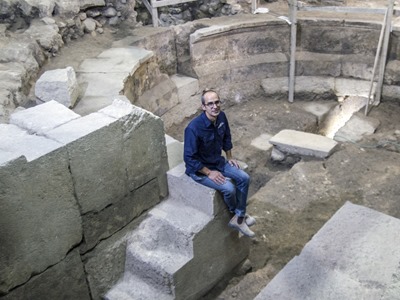
Gabriel Barkay recently gave a tour of the Temple Mount to members of the US Congress.

John DeLancey is blogging about his Israel tour, and on Wednesday he took his group to el-Araj, a candidate for New Testament Bethsaida.

Students from Oakland University involved in the Lachish expedition this summer gained knowledge and experience.

Shmuel Browns shares some photos of sinkholes at the Dead Sea.

The Anglo-Israel Archaeological Society has posted its schedule of fall lectures.

If you’re not familiar with Solomon’s failure in establishing his 12 administrative districts, take a look at Wayne Stiles’s post and map.

I’ve been waiting for Craig Keener’s four-volume commentary on Acts to be available in digital format, and Accordance has it first, and at a great introductory sale price.

Accordance also has a sale on the NICOT and NICNT bundle at about half of what I paid for it on Logos.

Phillip J. Long has written the first full-length review of the Photo Companion to the Bible.

Two of my favorite Bible teachers, both born in 1928, died this week: Stanley Toussaint (DTS) and Robert Thomas (TMS).

HT: Joseph Lauer, Agade

Several dozen seal impressions have been discovered in excavations in the City of David. These bullae date to the period after the fall of the northern kingdom in 722 BC and the archaeologists suggest that the names on them may belong to refugees who immigrated to Jerusalem at that time.

The IAA press release is here, and the story is reported in a number of news sources. The Times of Israel incorporates many photographs and one video into its story.

The dozens of clay imprints were used on letters and documents which were bound by string and sealed by wet clay pressed with the sender’s mark or name. The impressive trove was discovered at recent digs uncovering three Late Iron Age buildings frozen in time by the destruction caused by the 586 BCE Babylonian siege. The discovery was made by a team of Israel Antiquity Authority archaeologists led by co-directors Dr. Joe Uziel and Ortal Chalaf.
Among the dozens of bullae is a rare find of an intact sealing, bearing the name “Ahiav ben (son of) Menahem,” referring to two kings of Israel but found in the capital of the Kingdom of Judah, Jerusalem.
[…]
According to co-director Ortal Chalaf, these Israelite names and other findings point to the possibility that after the destruction of Israel, refugees fled the Kingdom of Israel for the Kingdom of Judah, and settled in Jerusalem. After settling, the use of their names on official correspondence shows that these Israelites gained important roles in the Judaean administration, said Uziel.
“These names are part of the evidence that after the exile of the Tribes of Israel, refugees arrived in Jerusalem from the northern kingdom, and found their way into senior positions in Jerusalem’s administration,” according to the two co-directors.

The full story is here.

A 6th-century mosaic discovered near the Damascus Gate in Jerusalem has a Greek inscription mentioning Emperor Justinian. A 1.5-minute video is here.

At Neve Tzuf, an 8-year-old girl discovered a coin from the Jewish Revolt inscribed “Holy Jerusalem.” (But I’ve heard doubts that the coin is genuine.)

Haaretz: “The discovery of masks and more cultic vessels has bolstered confidence that ritual activity was taking place 3,200 years ago at Libnah, a Canaanite city that would become Judahite in the biblical era.”

Ahramonline: “An Egyptian archaeological mission from the Ministry of Antiquities has uncovered five Roman tombs during excavation works carried out in Beir Al-Shaghala site in Dakhla Oasis in Egypt’s Western Desert.”

The pottery restorer of the Gath excavations shows how to restore an ancient pot in in a 1.5-minute video (but you might want to turn the sound off first).

Authorities have frozen plans to build a new neighborhood over the abandoned Arab village of Lifta.

Those who know the history here may get a kick out of Rami Arav’s declaration that “Archaeologists should be led by the evidence, and not force the evidence into their theories.” His new piece entitled “Bethsaida Controversy” is a frontal attack on the recent el-Araj claims.

Check out the latest www.HolyLandPhotos.org Newsletter from Carl Rasmussen here.

If you like this blog and you use Facebook, you might consider joining the “Nerdy Bible Backgrounds and Bible Geography Majors” group.

“Ancient Babylonians living almost 4,000 years ago could have predicted Monday’s total solar eclipse.” Here’s how.

Two of my partners on the new Photo Companion to the Bible witnessed the eclipse in different parts of the United States. Steven Anderson shares his experience here, and the photo below was taken by A.D. Riddle.

HT: Joseph Lauer, Mike Harney, Ted Weis, Agade

Total solar eclipse, totality, from center line in Makanda IL, adr1708215777
Total solar eclipse on August 21, 2017
Photo by A.D. Riddle

The suggestion that el-Araj could be New Testament Bethsaida received lots of media attention, not all accurate. I’d recommend this report by Jeffrey Garcia and Steven Notley at the CSAJCO website.

An on-site interview with archaeologist Mordechai Aviam is posted at CBN’s Facebook page. The Today show sent a correspondent to the site. National Geographic sets some of the record straight. The Times of Israel looks at the two sites laying claim to the name of Bethsaida.

Jonathan Adler guides a video tour of a 2,000-year-old stone quarry that he excavated in Galilee. The Jerusalem Post provides a written report on the excavations.

The Abel Beth Maacah team shares a photo album from the 2017 season.

Nadav Na’aman argues that Khirbet Qeiyafa was not a Judahite city in a recent article in the Journal of Hebrew Scriptures.

Authorities are planning to stop the flow of sewage down the Kidron Valley.


The Wall Street Journal (subscription req’d) traces the path in which ISIS looted artifacts make their way out of the Middle East.

“Researchers have unearthed a 1,800-year-old writing tool, or stylus, at the Assos archeological site in northwestern Turkey.”

Excavations at Carchemish have uncovered 250 Hittite bullae this year.

Excavators at Tell Tayinat found fragments of a large female statue at the citadel gate complex.

Now online: Egypt’s Ministry of Antiquities’ Newsletter for July 2017.

Wayne Stiles considers the strategic value of the International Highway (aka Via Maris).

Ferrell Jenkins shares a couple of beautiful photos of ibex at En Gedi and Ein Avdat.

Leon Mauldin explains the location and importance of Akeldama, the Field of Blood.

Cynthia Shafer-Elliott is on the Book and the Spade discussing “Canaanite DNA” and her excavation work at Tel Halif.

We will be making a big announcement in the BiblePlaces Newsletter on Monday. You can sign up for a free subscription here.

HT: A.D. Riddle, Lois Tverberg, Chris McKinny, Charles Savelle, Agade, Ted Weis, Joseph Lauer

For years, some scholars have doubted the claim of excavators working at et-Tell that they had discovered Bethsaida (see my explanation here). But as the years went by, and archaeologists continued to come up empty (of significant remains from the right time period), they doubled down and their voices became more shrill in their defense. Succeeding excavation reports were titled Bethsaida I, Bethsaida II, Bethsaida III, Bethsaida IV, etc.
Bethsaida aerial from northeast, ws053016297
  The site of et-Tell, proposed by excavators to be Bethsaida, with el-Araj and the Sea of Galilee in the distance

But they had this in their favor: there was not a better alternative. That may be changing, as another archaeological team has begun work at a site closer to the shore of the Sea of Galilee. Early word out from the el-Araj team this summer was that they had discovered Roman-period remains. That’s a big step forward. Today’s Haaretz carries a report of the latest finds. Here are a couple of important sections:

Archaeologists think they may have found the lost Roman city of Julias, the home of three apostles of Jesus: Peter, Andrew and Philip (John 1:44; 12:21). A multi-layered site discovered on the northern shore of the Sea of Galilee, in the Bethsaida Valley Nature Reserve, is the spot, the team believes.
The key discovery is of an advanced Roman-style bathhouse. That in and of itself indicates that there had been a city there, not just a fishing village, Dr. Mordechai Aviam of Kinneret College told Haaretz.

[…]

What the archaeologists found at el-Araj is an older layer dating from the late Roman period, the 1st to 3rd centuries C.E., two meters below the Byzantine level. That Roman layer contained pottery sherds from the 1st to the 3rd centuries B.C.E. [sic; should be C.E.], a mosaic, and the remains of the bathhouse. Two coins were found, a bronze coin from the late 2nd century and a silver denarius featuring the Emperor Nero from the year 65-66 C.E. 
And has a major missing church been found too? The excavators found walls with gilded glass tesserae for a mosaic, an indication of a wealthy and important church. Willibald, the bishop of Eichstätt in Bavaria, visited the Holy Land in 725 C.E., and in his itinerary, he describes his visit to a church at Bethsaida that was built over the house of Peter and Andrew. It may well be that the current excavations have unearthed evidence for that church, say the archaeologists.

The article continues to discuss significant evidence that indicates the level of the Sea of Galilee was 6 feet (2 m) lower than previously believed.

El-Araj, Jordan River, and Sea of Galilee aerial from north, ws040617534
The site of el-Araj, located in the area of the trees near the shore of the Sea of Galilee

Personally I think it’s best to continue to be cautious. There’s no sense (for those not writing headlines or raising funds) in making the same mistake again in the identification of Bethsaida. But it’s certainly fair to say that the geographical and archaeological stars seem to be in alignment.

UPDATE: The story is also reported in the Jerusalem Post and Ynet (Hebrew).

HT: Jared Clark, David Bivin

A large 4th-century AD winepress has been discovered and excavated in the Ramat Negev region.

The IAA has posted a 1-minute video in Hebrew.

A new study argues that everything we knew about the origin of the Philistines is wrong.


The Times of Israel reviews discoveries made in excavations at Magdala, with an eye on priestly inhabitants.

A new DNA study indicates that the modern-day Lebanese people are descended from people who
lived in the area 4,000 years ago.

Wayne Stiles reflects on a lesson Jesus taught when he walked on the Sea of Galilee.

The Tempe Mount Sifting Project has begun a video series that tours the Temple Mount, beginning with Solomon’s Stables, including footage of the destruction in 1999.

Steven Ortiz is on The Book and the Spade discussing the 10th season of excavations at Gezer.

On the 75th anniversary of his death, Sir Flinders Petrie is profiled in The National, with the focus on his support of eugenics.

The inaugural issue of Archaeology and Text is now online.

The Tell es-Safi (Gath) team got real creative for their season-end group photo.

HT: Joseph Lauer, Agade, Charles Savelle