Archaeologists excavating in the Timna Valley near Eilat have discovered fabric that was dyed red and blue. This is the first time that such a colored clothing has been discovered from this ancient period. The Times of Israel provides a summary of a journal article and includes some photographs and a video.

Since 2013, Dr. Erez Ben-Yosef of Tel Aviv University has directed excavations in the Timna Valley where his team has found textiles dating back to the Iron Age (11-10 centuries BCE). On some of the fragments, there is a decorative pattern of red and blue bands.
In an article published Wednesday in the scientific journal PLOS ONE, the researchers hypothesize that the metalworkers, considered fine craftsmen, “were probably entitled to wear colorful clothing as a mark of their high status.”
According to Ben-Yosef and the IAA’s Dr. Naama Sukenik, the findings indicate that the society at Timna, identified with the Kingdom of Edom, was hierarchical and included an upper class that had access to colorful, prestigious textiles.
The concept of highly prized, skilled laborers flies in the face of conventional wisdom, which had supposed that slaves had largely manned the isolated copper mines.

Personally I think the speculation about the identification of the workers is unwarranted, given that we have essentially nothing to compare this with given the lack of preservation of perishable materials in the rest of Israel. And if the dating to the 10th century is correct, then this area was likely under the control of Israel, not Edom (2 Sam 8:14; 1 Kgs 9:26; 2 Chr 8:17). But one can certainly conclude that the workers here had access to a good shopping mall.

The official press release is posted here. The AFTAU has issued a press release here. Some high-res photos are available here.

HT: Joseph Lauer
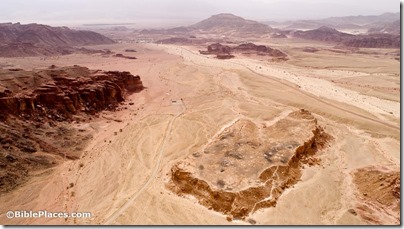
Timna Valley Slaves Hill aerial from north, ws032317820
“Slaves’ Hill” in Timna Valley;
“Solomon’s Pillars” is located on the left
Share:

A 3,700-year-old Egyptian burial chamber containing the remains of a ‘Pharaoh’s daughter’ was found south of Cairo at Dahshur’s royal necropolis.

Archaeologists have discovered “a cachette of non-royal mummies of men, women and children buried in catacombs eight metres below ground level in the desert neighbouring the bird and animal necropolis at the Tuna Al-Gabal archaeological site” in Egypt.

Two Egyptian men illegally digging for antiquities were killed when their house collapsed. And the
Egyptian government has increased the penalty for antiquities theft for a maximum of a life sentence.

An international team of experts met in Cairo to determine how best to transport King Tut’s artifacts to the new museum.

Egypt has begun to register its Jewish sites and antiquities.

An exhibit of recently discovered artifacts is now on display at the Luxor Museum.

Turkey is planning to restore and open the stadium of Perga.

Carl Rasmussen recently visited a new archaeology display in a station for the metro tunnel that connects Europe and Asia.

The city of Rome has begun restoration works on the Mausoleum of Augustus with the plan to open it to tourists by 2019.

John DeLancey shares a new video of a recent performance of “Jerusalem of Gold” by the Portney
Brothers and he explains the song’s significance.

The diet of Jerusalemites in the first century AD was primarily sheep and goats, followed at a distance by cows and chickens.

“Methuselah,” the date palm tree sprouted from a 2,000-year-old seed, is now 12 years old.

I’m traveling much of the month of June and will post as I am able. Roundups will probably resume in July.

HT: Joseph Lauer, Ted Weis, Charles Savelle, Agade, Explorator, Paleojudaica

Share:

A new study suggests that the Philistines brought their pigs with them when they sailed to the coast of Israel.

The second issue of the Tel Aviv University Archaeology Newsletter has reports on projects at
Masada, Kiriath Jearim, Timna Valley, City of David, and more.

David Hendin reports on the most significant numismatic discoveries in Israel in recent years.

Wayne Stiles looks at lessons to be learned from sieges in the Bible.

Charlie Trimm explains how soldiers relieved themselves while in battle.

Lexham Geographic Commentary: The Gospels is now available as a standalone purchase in Logos.

The Acts through Revelation volume is in pre-order status.

A new database identifies 20,000 archaeological sites at severe risk of destruction.

Access the Collections is a new feature of the Oriental Institute website to encourage visitors to explore their photographic and document archives.

Recently released:

Hazor VII: The 1990–2012 Excavations: The Bronze Age, edited by Amnon Ben-Tor et al.

Socoh of the Judean Shephelah: The 2010 Survey, by Michael G. Hasel, Yosef Garfinkel, and Shifra
Weiss (Eisenbrauns)

Khirbet Qeiyafa in the Shephelah, edited by Silvia Schroer and Stefan Münger (Academic Press Fribourg)

The Twice-Told Tale: Parallels in the Bible, collated by Abba Bendavid (Carta)

  • A collation of parallel Bible texts showing the duplications, differences, and silences

We’ll have more stories in part 3 of the roundup tomorrow.

HT: Joseph Lauer, Ted Weis, Charles Savelle, Agade

Share:

The big story of the week is the discoveries made in excavations at Caesarea, including the altar of Herod’s temple, an inscribed menorah, and a statue of Asclepius. You can read the press release here or download high-res photos here. Haaretz has the best illustrated story. The Times of Israel emphasizes the discovery of an inscribed menorah. The Jerusalem Post focuses on the $27 million project. Art Daily provides another brief summary.This 3-minute video includes English subtitles.

A colossus of Ramses II has been re-erected in front of Luxor Temple’s first pylon.

Ten nations have created an “Ancient Civilizations Forum” to work together to protect ancient heritage from Islamic extremism.

Israeli police arrested a man in Hawara and confiscated hundreds of antiquities they discovered in his house.

A petition is now circulating to save the Yale Babylonian Collection.

A first-century AD bust of Drusus Minor will be returned to Italy by the Cleveland Museum of Art.

Should Egypt sell some of its artifacts to raise money?
BBC: “Madain Saleh isn’t as well-known as Petra, but the Nabateans’ second-largest city played a
crucial role in their mysterious empire.”

Simon Gathercole looks at the historical evidence for Jesus’s life and death.
BAS has published online a web-exclusive chart of 53 biblical people who have been confirmed in inscriptions.

Wayne Stiles’s recent post on Mount Carmel includes photos of its beauty and its burning.

Leon Mauldin visited Bethphage yesterday.

What happened to the cross that Jesus died on?

Mark Hoffman suggests that you may want to download Google Earth before it’s gone.


The Corinth Excavations Archaeological Manual has been published and a pdf has been made available for free. The post includes a link to previously published archaeology manuals.

The four-volume Dictionary of Daily Life in Biblical and Post-Biblical Antiquity is available on
Logos at a pre-pub price of $51. I recommend it.

I’ll be traveling much of May and June, so I probably will not be able to do many roundups.

HT: Joseph Lauer, Agade, Ted Weis, Charles Savelle

Share:

“An Egyptian archaeological mission in Luxor has announced the discovery of a major tomb in the city’s west bank area dating back to the 18th Dynasty and containing priceless artefacts.”

Israeli archaeologists have begun to study an ancient Jewish pyramid near Khirbet Midras in the Shephelah.

Archaeologists have discovered an estate of Emperor Marcus Aurelius in the mountains of southwestern Turkey.

Symbols found on the the Vulture Stone at Gobekli Tepe in Turkey has led researchers to propose the earth was struck by a devastating comet around 11,000 BC.

Shots were fired near St. Catherine’s Monastery at Mount Sinai, but there are different explanations of what happened.

The Qumran and Bible Exhibition is now online with an audioguide and with a video introduction.

The latest edition of The Holy Land Magazine is online and includes tourist articles on Nazareth Village, Yad VaShem, Neot Kedumim, and more.

Tom Powers considers David Bivin’s recent post on the deteriorating road to Emmaus and adds some observations of his own.

Elizabeth Sloane, writing in Haaretz, asks, “Did the Egyptian goddess Hathor originate with Semitic miners from Canaan?”

The Temple Mount Sifting Project must meet its fundraising goal or it will receive none of the pledged funds.

The Amarna Letters are the topic of the week on The Book and the Spade with guest Alice Mandell.

The Khirbet el-Maqatir exhibit in Pikeville, Kentucky is drawing visitors.

Eisenbrauns is offering the Victor Avigdor Hurowitz memorial volume at a savings of 40% for a few more days: Marbeh Ḥokmah: Studies in the Bible and the Ancient Near East (2 vols). List $139.50; sale: $83.70.

HT: Charles Savelle, Ted Weis, Joseph Lauer, Agade

Share:

Gabriel Barkay believes that they have discovered one of the capitals from Solomon’s Colonnade on the eastern side of the Temple Mount. Leen Ritmeyer seems inclined to agree, but he clarifies an issue with a measurement.

An excavation last month of Qumran Cave 11 resulted in the discovery of an upper chamber, linen textiles, medicinal plants, and leather and wooden artifacts. An international workshop on Cave 11 will be held later this month.

An underground tunnel network from the Bar Kochba period has been discovered in the Hebron hills.

The dating of donkey dung supports a Solomonic-date for a mining camp at Timna Valley in southern Israel.

Construction has begun on the “Sanhedrin Trail,” running from Beth Shearim to Tiberias. It will be a “smart” trail that “will communicate with the hikers using an innovative, augmented reality-based application.” The project also includes the building of a visitor’s center in Tiberias.

After the Temple Mount Sifting Project sent out an urgent plea for funds, the Prime Minister of Israel stepped in to restore the lost funding. Or did he?

The Egyptian Antiquities Ministry announced the discovery of a 13th dynasty pyramid, currently being excavated in Dahshur’s royal necropolis.

A Roman bath complex has been inaugurated in Alexandria.

Magnetometers and ground-penetrating radar has been used to discover the concession stands, taverns, and souvenir shops that surrounded a Roman amphitheater in Austria. (If you substitute “NFL” for “gladiator,” it will all make perfect sense.)

“Colorising the Arch of Titus: The Spoils of Jerusalem” is a new 4-minute video that reveals the results of a recent study led by Steven Fine of the original design and colors of the famous panel.

Ferrell Jenkins shares a couple of photos of the view from Mount Nebo.

Joel Pless suggests a biblical connection in his recent interview on Pompeii and Herculaneum on The Book and the Spade.

Israel’s Good Name recently visited Solomon’s Quarries, the Jerusalem Archaeological Park, and more.

Later this month, New College of the University of Edinburgh will be hosting a conference entitled “Coins and the Bible: Understanding Ancient Coinage.”

This month, Logos is offering Jesus Through Middle Eastern Eyes: Cultural Studies in the Gospels, by Kenneth E. Bailey for only $1.99.

Winged Bull Press released several new titles on April 1. And their new shipping service is a hoot!

HT: Agade, Joseph Lauer, Mike Harney, Ted Weis, Charles Savelle, Alexander Schick

Share: