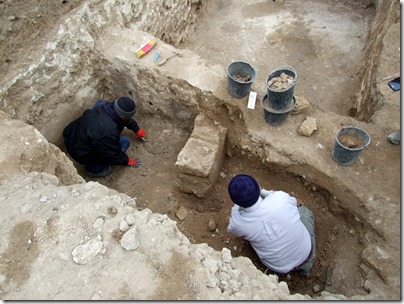
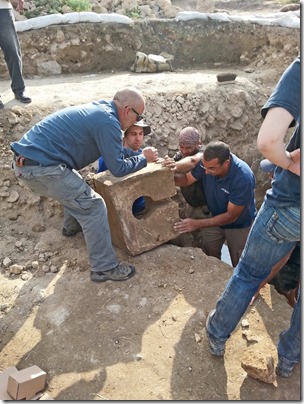
In excavations on Mount Zion this summer, archaeologists discovered a gold coin with the image of Nero. UNC Charlotte’s press release gives more details:

The discovery of a rare gold coin bearing the image of the Roman Emperor Nero at UNC Charlotte’s archaeological excavations on Mount Zion in Jerusalem has been announced by the archaeologists in charge of the project Shimon Gibson, James Tabor and Rafael Lewis.
“The coin is exceptional, because this is the first time that a coin of this kind has turned up in Jerusalem in a scientific dig. Coins of this type are usually only found in private collections, where we don’t have clear evidence as to place of origin,” said Gibson, an adjunct professor of religious studies at UNC Charlotte.
The gold coin (aureus) bears the bare-headed portrait of the young Nero as Caesar. The lettering around the edge of the coin reads “NERO CAESAR AVG IMP.” On the reverse of the coin is a depiction of an oak wreath containing the letters “EX S C,” with the surrounding inscription “PONTIF MAX TR P III.” Importantly, these inscriptions help to work out the date when the coin was struck as 56/57 AD. Identification of the coin was made by the historian and numismatist David Jacobson from London.
The coin dates to a little more than a decade before the destruction of Jerusalem by the Romans in 70 A.D. and was found in rubble material outside the ruins of the first century Jewish villas the team has been excavating. The team has hypothesized that the large houses may have belonged to wealthy members of the priestly caste, and it may have come from one of their stores of wealth.

The press release includes more information and a photo of the coin. A high-res image of the coin’s obverse is here.

HT: Joseph Lauer

A New York Times photo essay reveals how a Turkish dam project will submerge thousands of years of history.

Turkey is punishing Austria by cancelling their excavations at Ephesus, Limyra, Myra, and Antalya.

Ferrell Jenkins begins a new series on Visiting Iznik (Nicea, Nicaea), Turkey with a summary of the numerous trips he has made to the country over the last 50 years. Part 2 considers the testimony of history regarding church government, part 3 looks at the first ecumenical council, and part 4 visits the site of the seventh ecumenical council.


The New York Times reports on several digital archives of Middle Eastern archaeological artifacts, with a special focus on the Ur Online database.

A newly discovered beam from Khufu’s second boat may be the oars holder.

On the ASOR Blog, Reg Clark answers the question, “How and why did the [ancient] Egyptians
protect their tombs?”

Volume 4 of The Context of Scripture is available from Brill for pre-order.

HT: Joseph Lauer, Charles Savelle, Agade, A.D. Riddle, Steven D. Anderson

A stone seal discovered this summer at Abel Beth Maacah suggests Israelite presence at the site in the 9th century.

Luke Chandler has collected a number of photos of floor tiles from Herod’s Temple Mount that have been restored by the Temple Mounting Sifting Project. The Jerusalem Post has more details. There are more photos here. A 20-minute video of the press conference is online, with English starting at about 3 minutes.

Archaeologists have uncovered a Byzantine-era stable at Avdat in southern Israel. High school students joined in the sifting of hundreds of buckets of organic material left behind by donkeys, sheep, and goats. Five high-resolution photos are available.

There’s now an island in the Sea of Galilee. It’s near the southern shore and is the result of the low water level. Artillery shells from WWI have also been discovered nearby.

A mosaic from the Huqoq synagogue may depict Alexander the Great meeting the high priest of Jerusalem. Another interpretation is that it shows the battle between Antiochus VII and John Hyrcanus I. The National Geographic article has photos.

Israel’s ancient capital of Samaria has been vandalized. A video in Hebrew shows some of the damage.

Exploring Bible Lands continues its series on “Walking like Jesus” with a photo of a Roman road in Galilee.

Wayne Stiles explores why Kiriath Jearim is ignored, and why it shouldn’t be.

Thursday’s Archaeological Conference in the City of David entitled “Digging for Truth — Jerusalem,
Archaeology & UNESCO” may be watched online. Parts are in Hebrew and other parts in English, with the whole lasting 4.5 hours. The program may be viewed here. The Jerusalem Post reports on the talk by Dore Gold.

Olive pits discovered at Khirbet Qeiyafa receive special attention at a new exhibit at the Bible Lands
Museum Jerusalem.

HT: Joseph Lauer, Charles Savelle, Agade, Ted Weis

The discovery of hundreds of olive pits in the Beth Shean Valley dated to 5000 BC are prompting a reevaluation of ancient irrigation practices.

Some antiquities have been discovered in the garden of the American Consulate in Alexandria.

The majority of smuggled artifacts seized in Syria and Lebanon are fakes.

Nir Hasson provides a fascinating review of the legal and cultural challenges of excavating bones, skeletons, and cemeteries in Israel (Haaretz premium).

The Bible Lands Museum Jerusalem is opening a new exhibit next week entitled “In the Valley of 
David and Goliath.” The Haaretz (premium) article has more details.

Carl Rasmussen shares an interesting photo from Pompeii that sheds light on the Acts 19 riot in
Ephesus.

The W.F. Albright Institute of Archaeological Research is accepting applications for a number of funded fellowships.

The Bornblum Eretz Israel Synagogues Website continues to be updated with descriptions, plans, photos, and bibliographic references.

Gordon Govier and Clyde Billington report on some of the latest discoveries in biblical archaeology on The Book and the Spade.

Aren Maeir notes a forthcoming volume on Iron Age archaeology in the Shephelah.

Ferrell Jenkins shares photos this week of the Pamphylian coast and the lilies of the field.

Logos and Accordance both have a 60%-off sale on Carl Rasmussen’s Zondervan Atlas of the Bible (revised edition), now for $12.99. (That’s a great deal on a great resource!)

HT: Charles Savelle, Joseph Lauer, Agade

Philippe Bohstrom reports in Haaretz on the discovery of a large royal structure immediately adjacent to the Solomonic city gate.

A palatial building dating to the era of King Solomon 3000 years ago has been discovered in the royal city of Gezer, though there is no evidence which of the Israelite kings lived there, if any.
The monumental building dates to the 10th century BCE, the era associated with King Solomon, who is famed for bringing wealth and stability to the newly-united kingdom of Israel and Judah. The American archaeological team also found a layer featuring Philistine pottery, lending credence to the biblical account of them living in the city until being vanquished by King David.
The complex features a large central courtyard, like contemporary palace-like buildings found throughout the southern Levant, including at Hatzor and Megiddo. Though there’s no telling who ruled from there, if anybody did, the edifice is significantly larger than the size of ordinary houses of the time, excavation co-director Prof. Steve Ortiz, representing the Tandy Museum of Southwestern Baptist Theological Seminary of Fort Worth, Texas, told Haaretz. Among the features not found in usual domestic structures is ashlar masonry – large rectangular-shaped monolithic hewn stones – in the corners of rooms, Ortiz said.
[…]
The main feature is two parallel long rooms, or courtyards, surrounded on all sides by various rooms, numbering at least 15. The palace has two entrances from the east and west. The entrance from the west also connects this building to the monumental six-chambered gate associated by most scholars with Solomon. This entrance is more robustly built than the rest of the building: The walls are constructed with two to three rows of stones wide, built of roughly dressed field stones somewhat smaller in size than those used in the rest of the building.

The article contains photos and more background about the historical importance of Gezer along with a little bit of the reasoning for dating this stratum to the 10th, and not 9th, century.

HT: Joseph Lauer

Gezer aerial from west, ws073114058b
Gezer from the west, showing area of palace excavations
Photo by Bill Schlegel

A high school student found a ballista ball from the Bar Kochba Revolt during recent excavations of Beitar.

Excavators working at Abel Beth Maacah discovered one of the earliest silver hoards ever found.

There’s more information about the excavation of the chariot race mosaic in Cyprus.

To make the looting of Syrian artifacts more difficult, the US State Department announced emergency import restrictions.

“Oxford University researchers say that trees which grew during intense radiation bursts in the past have ‘time-markers’ in their tree-rings that could help archaeologists date events from thousands of years ago.”

Wayne Stiles explains how the Herodium testifies to God’s sovereignty.


The New York Times is no fan of the Ben-Hur remake.

The Associates for Biblical Research are beginning to recruit for their first season of excavations at Shiloh next summer.

Leon Mauldin posts on the end of wicked Queen Athaliah and shares a photo of a model of Jerusalem at the Bible Lands Museum.

If you wanted to know a little more about Enoch’s journey through the world (referenced in
Thursday’s survey results), Paleojudaica explains.

The new NIV Cultural Backgrounds Study Bible is being released on Tuesday. It looks impressive, and you can flip through the entire books of Genesis and Matthew online to see for yourself.

Hundreds of photos, maps, and charts accompany study notes edited by John Walton (OT) and Craig
Keener (NT). The promotional website also includes videos and infographics.

HT: Agade, Ted Weis, Joseph Lauer

Old City aerial at night from southwest, ws052016101
Our most re-tweeted photo of the week was this aerial photo taken by Bill Schlegel of Jerusalem from the southwest. The Citadel of David is in the foreground and the Mount of Olives is in the distance.