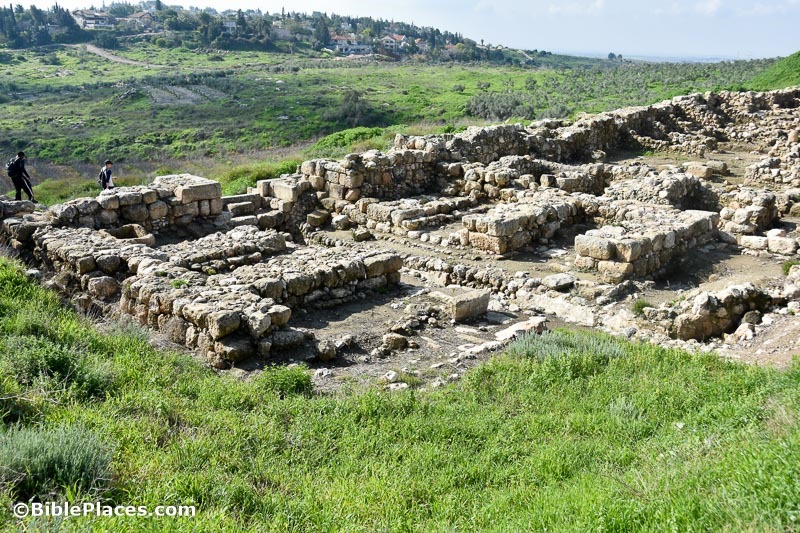
A Times of Israel article discusses the newly deciphered Moabite inscription found an an altar from Ataroth.

With international tourism to Lebanon on the rise, there is a new interest in preserving the country’s cultural heritage.

Claudine Dauphin has been trying to figure out how Umm ar-Rasas, in the semi-arid steppe of central Jordan, was able to survive, including in the Byzantine period when it included 16 Byzantine churches.

The July issue of the Newsletter of the Egyptian Ministry of Antiquities is now available.

Bryan Windle selects the top three reports in biblical archaeology for the month of August.

The Anglo-Israel Archaeological Society has posted an archaeological report for August 2019. Future lectures are also listed.

Jimmy Hardin is interviewed on The Book and the Spade on the controversial topic of state formation in the 10th century.

On the 250th anniversary of Napoleon’s birth, the Jerusalem Post looks at the French general’s visit to the Holy Land.

Alex Joffe wonders what the ancient Near East would look like without the year 1919.

Appian Media is close to meeting two fundraising goals for developing new video resources, but the deadline is today.

Two of John Beck’s geography books have just been released as audiobooks: Land without Borders and Along the Road.

John DeLancey is offering a free online course called “Biblical Israel – Learning the ‘Playing Board’ of the Bible.” You can watch the preview here or see a replay of the first session here.

Carl Rasmussen shares photos of Domus Galilaeae, a Catholic retreat center near the Sea of Galilee that is normally not open to visitors.

Ferrell Jenkins posts a nice color photo of winnowing grain at Shechem.

New: Atlas of the Biblical World, by Mark Vitalis Hoffman and Robert A. Mullins. Mark shares the details on his excellent blog.

HT: Agade, Joseph Lauer

Share:

Excavations under a house in northern Israel have revealed what may be the largest wine factory from the Crusader era.

Archaeologists have discovered an arrowhead from the Roman siege of Jotapata in AD 67.

A i24News video shows the “pilgrim road” leading from the Pool of Siloam to the Temple Mount of Jerusalem.

“Archaeologists working in the buried Roman city of Pompeii say they have uncovered a ‘sorcerer’s treasure trove’ of artefacts, including good-luck charms, mirrors and glass beads.”

A new exhibit about a 4th-century synagogue mosaic floor has opened in the Archaeological Museum of Aegina. Aegina is a Greek island not far from Athens.

“Anchors Aweigh: Seaports of the Holy Land” is a new exhibit opening on Tuesday at the Bible Lands Museum in Jerusalem.

Preliminary images of seven (alleged) Dead Sea Scroll fragments owned by the Southwestern Baptist Theological Seminary are now online. (The link looks unusual, but it works.)

Lubna Omar provides a personal perspective as a Syrian archaeologist unable to protect her country’s heritage.

A guy passionate about ancient Egypt and baking used ancient yeast to bake a loaf of bread.

Egyptian authorities transferred a 90-ton obelisk of Ramses II from Zamalek to El Alamein.

The Oriental Institute is celebrating its 100th anniversary.

Carl Rasmussen shares photos of the largest altar in the world.

I always like the photos that Wayne Stiles includes with his posts, and this week is no different with his reflections on Abraham’s faith.

Matti Friedman writes a helpful review of Jodi Magness’s new book on Masada.

Did you know there are four long distance hiking trails in Israel? They range in length from 37 miles to 637 miles.

HT: Agade, Joseph Lauer, Alexander Schick, Ted Weis

Share:

A Greco-Roman building uncovered in northern Sinai was used as a seat for the ancient Senate.

King Tut’s gilded coffin has been transferred from Luxor to the new Grand Egyptian Museum where it will be restored before being put on display. New images have been released before the restoration begins.

Sara Ahmed reports on the Egyptian Collection at Leiden’s Rijksmuseum.

A salvage project in Cyprus has uncovered a large Hellenistic-era sanctuary.

The new archaeological museum at Troy has opened, and Carl Rasmussen has photos.

A statue of Alexander the Great, long lost in a museum storage room, has recently been re-discovered.

Gordon Franz has posted a new article: The apostle Paul and Dr. Luke on the Island of Cost: Sin, Sickness, and Death.

Sarah Parcak’s new book, Archaeology from Space, looks at the use of technology in archaeology.

Bryan Windle’s latest in the Footsteps series is “Three Things in Babylon Daniel Likely Saw.”

HT: Ted Weis, Agade

Share:

New excavations in Perga have revealed the well-preserved(!) foundation of the Tomb of Plancia Magna. And Carl Rasmussen also has photos of new reconstruction work at Thyatira.

Pat McCarthy’s newest page at Seetheholyland.net is about the Sisters of Nazareth excavation, including a church possibly built over Jesus’s childhood home.

Aaron Demsky explains how the Samaria Ostraca shed light on the names of Zelophehad’s daughters and Israel’s settlement in Manasseh.

Mark Barnes draws out some lessons from Shechem, including how conflict, covenant, and choice defined its history.

In a new podcast, Clint Burnett discusses the background of the Nazareth Inscription as well as assessing whether it provides evidence of Jesus’s empty tomb (Apple).

Peter grew up in Bethsaida and ended up in Rome. Wayne Stiles explains how he got there by a series of “hard left turns.”

Shemesh Online reports on the compromise reached that will allow for the construction of the highway over the tell, the reduction of the width of that road, as well as the building of a pedestrian overpass to connect the two sides.

Kristina Killgrove gives five reasons why you shouldn’t buy that ancient artifact.

Cathie Spieser looks at the theology of birth and rebirth in ancient Egypt.

Chapter 8 of The Gospel of Mark in the LUMO Project has been dubbed in Koine Greek.

On The Book and the Spade, Clyde Billington and Gordon Govier discuss some recent stories, including Macherus, Melchizedek, and the Philistines.

In his ongoing Footsteps series, Bryan Windle identifies three things Paul likely saw in Corinth.

Ferrell’s Favorite Foto #24 is of Gibeon.

HT: Agade, Jared Clark, Joseph Lauer

Share:

Excavations in Alexandria have revealed a well-preserved mosaic floor from the Roman period.

An artificial reef and underwater museum is being created in the Red Sea waters of Aqaba from old military vehicles.

The Tetrapylon avenue at Aphrodisias will open soon, following the completion of excavations.

Egypt’s Ministry of Antiquities June 2019 Newsletter provides the latest updates.

Four ancient Babylonian tablets at the British Museum were apparently used to calculate the motion of Jupiter.

An exhibition of looted archaeological artifacts is now on display at the Capitoline Museums.

A man who made more than half a million dollars by selling to a museum an “ancient Egyptian figurine” he made in his garden shed is sorry.

Mastic, from the island of Chios (cf. Acts 20:15), is getting a fresh look as a possible super-drug.

In an excerpt from her new book, Sarah Parcak asks, “Will the future of archaeology not require moving dirt?”

Jimmy Hardin discusses the latest discoveries at Macherus on The Book and the Spade.

In the final post in his series on Paul’s shipwreck on Malta, Carl Rasmussen shares photos of a more likely place than the traditional bay.

HT: Joseph Lauer, Agade, Charles Savelle, Mark Hoffman, Steven Anderson, Explorator

Share:

Archaeologists working at el-Araj (Bethsaida?) are claiming that a Byzantine church they are excavating is the “Church of the Apostles.” The story is reported in Haaretz (premium); the excavation website has lots of photos.

The excavation season at Gath is over. Among this week’s posts is this one with their end-of-season photo shoot.

“A rare, very early rural mosque was unearthed during recent archaeological excavations in the southern Israel Bedouin city of Rahat.”

Excavations on Mount Zion have revealed a moat from the Crusader siege of Jerusalem in 1099.

“An unprecedentedly vast Neolithic settlement — the largest ever discovered in Israel and the Levant, say archaeologists — is currently being excavated ahead of highway construction five kilometers from Jerusalem

The University of Basel announced its possession of the oldest autograph of a Christian letter.

Researchers are studying the harbor technologies of Portus, the maritime harbor of Rome in the first centuries AD.

For the first time in decades, Egypt has opened the Bent and Red Pyramids of Dahshur to tourists.

Wayne Stiles draws spiritual lessons about closed doors from Paul’s second missionary journey.

New from Eerdmans: Scribes and Scrolls at Qumran, by Sidnie White Crawford

Now at the top of my wish list (but more difficult to acquire outside of Israel): Ancient Jerusalem Revealed: Archaeological Discoveries, 1998–2018, edited by Hillel Geva.

HT: Joseph Lauer, Ted Weis, Charles Savelle, Agade

Share: