Researchers are trying to understand the significance of triangles incised on the inside rims of basalt bowls from the Chalcolithic period.

A student on a school trip found a coin in Nahal Shiloh with the words “Agrippa King” inscribed on it.

The Washington Post reports on the excavations and controversy related to the first-century road that runs from the Pool of Siloam to the Temple Mount.

Egyptian archaeologists have discovered tombs from the Second Intermediate Period in the Nile Delta.

Writing in The Ancient History Bulletin, Katherine Hall proposes that Alexander the Great died from Guillain-Barré syndrome.

Nir Hasson explains the background of the Shivta exhibit at the Hecht Museum (Haaretz premium).

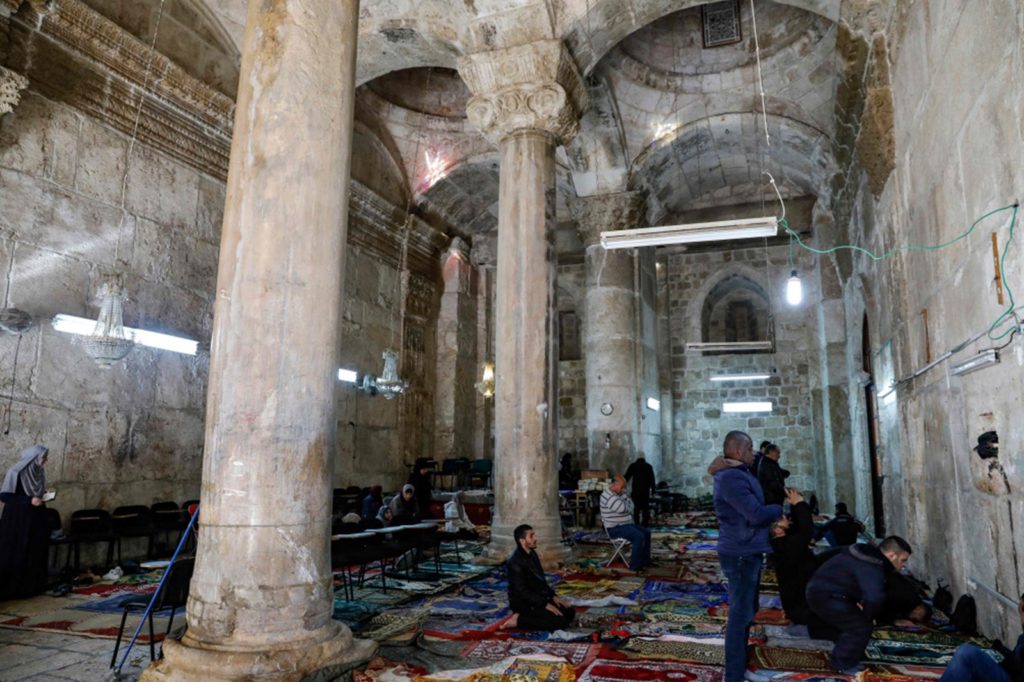
Meet the priest who has taken care of the Church of Jacob’s Well in Nablus for the last 60 years.

Israel’s Good Name writes about his field trip to Nahal Rash’ash in eastern Samaria.

There are 28 days in February and 28 chapters in Acts, so we’ve decided to do a month-long tour of the book. Join us on Facebook, Twitter, or Instagram.

HT: Agade, Ted Weis, Charles Savelle

Share:

The restoration of the Roman aqueduct of Gadara has been completed, and the tunnel is now open to the public.

Researchers have discovered Iron Age II pottery at Sela in Jordan.

The goal of the SCHEP project is to encourage people in Jordan to protect the ancient sites in their communities.

Britain has returned to Egypt a stolen ornamental tablet of Pharaoh Amenhotep I.

“The Ministry of Antiquities began the work of the second phase of the project of documenting the rock inscriptions in the ancient area of South of Sinai.”

Egypt’s Ministry of Antiquities has posted an annual newsletter for 2018.

Saudi Arabia now wants tourists to come visit its archaeological sites.

“Trade Routes in Arabia – Masterpieces of the Monuments of Saudi Arabia through the Ages” is a new exhibit at the Louvre in Abu Dhabi.

In a third post on Assos, Carl Rasmussen describes the theater and the ancient harbor.

The British Museum celebrated its 260th birthday this week. A birthday blogpost provides some numbers, including the number of objects in the collection: 8 million!

The BBC attempts to explain why ancient people drilled holes in their heads.

Near Eastern Archaeology is soliciting articles for publication.

Wayne Stiles is leading a tour of Greece and Turkey in September.

HT: Agade, Joseph Lauer, Ted Weis

Share:

A woman taking a stroll near Tel Beth Shean discovered that winter rains had exposed two Roman statues.

New technology now makes declassified US spy photos from the 1960s more useful for research in the Middle East. LiveScience tells the story, and you can explore the amazing Corona Atlas yourself.

A team of archaeologists and climbers scaled the cliffs of Sela in order to study a relief made by the Babylonian king Nabonidus.

Ruth Schuster surveys the archaeological evidence for the earthquake in the days of Uzziah mentioned by Amos and Zechariah (Haaretz premium).

Kyle Harper attempts to trace the origins of the Nazareth Inscription.

‘Serve the Gods of Egypt’ is an exhibition focusing on the Third Intermediate Period (1069-664 BC), now showing at the Museum of Grenoble, located in southeast France. 

Now online: Maps, drawings, and photographs from the American Research Center in Egypt (ARCE) Sphinx Project, 1979-1983.

The Fall 2018 issue of DigSight includes stories on the seal impression of Isaiah, new publications, recent finds, and upcoming events.

The Oriental Institute 2017–18 Annual Report is now available.

On the ASOR Blog, Claudio Ottoni asks, “Where do cats come from?”

Carl Rasmussen provides illustrations for Paul’s boxing metaphor.

Wayne Stiles explains why Peter’s trip to Caesarea was apparently inefficient and yet perfectly necessary.

A 4-minute video from the Today Show explains how NASA technology is being used to decipher Dead Sea Scrolls. The video includes footage inside Cave 1.

Owen Jarus suggests five archaeological discoveries to watch for in 2019.

The editors of The Bible and Interpretation have chosen their five best articles for 2018.

In a full article posted from Biblical Archaeology Review, Robert Cargill explains what a day on a dig looks like.

Jerusalem is one of the fastest growing tourist destinations in the world. Jordan’s tourism in 2018 was its second highest ever.

William B. Tolar of Fort Worth, Texas, a longtime professor of biblical backgrounds and archaeology [at Southwestern Baptist Theological Seminary], died Dec. 29.” He apparently led 80 trips to Israel.

There will be no roundup next weekend.

HT: Ted Weis, Agade, Mark Hoffman, Chris McKinny, Joseph Lauer, Paleojudaica, Bryan Windle

Share:

A 2,000-year-old bronze ring with a solitaire gemstone was uncovered in the City of David National Park in Jerusalem.

Ceramic jars and cooking pots suggest the Persian Empire used Tel Keisan, near the city of Akko in
Northern Israel, as a base camp in their effort to conquer Egypt (Haaretz premium).

Police caught antiquities thieves in the act of excavating Huqoq for ancient coins.

The petrified remains of a harnessed horse has been uncovered in Pompeii.

Emma Maayan-Fanar writes about her recent study at Shivta which revealed a painting of Jesus.

Longer, hotter summers and drier winters are a threat to the remaining cedar trees in Lebanon.

The NY Times reports on the only tourist boat operation on the Dead Sea.

”By analysing the architecture and historical documentation, it is possible to reconstruct a detailed history of the Karak Castle during the Crusader period.”

Several people are dead and a dozen injured after a bomb blast struck a tourist bus near the Egyptian pyramids in Giza.

“Finds Gone Astray” is a new exhibit opening on Monday at the Bible Lands Museum. The Times of Israel provides some of the background for these artifacts that have been recovered from thieves and smugglers in the West Bank since 1967.

Carl Rasmussen asks: Herod or Jesus: Which “King” Has Had the Most Lasting Influence?

What is the Samaritan Torah? David Moster has created a 10-minute video to answer that question.
National Geographic has produced a 4-minute animated video on The History of the Bible.

Gary Knoppers died last week.

HT: Ted Weis, Agade, Joseph Lauer, Charles Savelle

Share:

The Ultra-Orthodox are upset that the French government won’t allow entrance into the Tomb of the Kings in Jerusalem. The French claim that they have renovated the site and with the right assurances, they will open it to the public.

A long tunnel has been covertly dug underneath the “Tomb of David” on Mount Zion and now some people are mad.

The large number of tourists visiting the Church of the Nativity in Bethlehem has led to the development of an app that will handle reservations.

“The inauguration ceremony of Egypt’s new Greco-Roman Museum [in Alexandria] will be held by the end of 2019.”

Three ancient cities in Crete are the focus of an exhibit at the Museum of Cycladic Art in Athens, Greece.

Harvey Mudd College is giving its Cypriot artifacts to the University of Cyprus.

Don McNeeley shares a report on the 2018 annual meeting of the Near East Archaeological Society.
You can join the society here.

The video is now online for the 2018 Plenary Address for the ASOR Annual Meeting: “Between Looters, Private Collectors, and Warlords: Does Archaeology Stand a Chance?” by Hélène Sader, Professor of Archaeology, American University of Beirut.

Tali Erickson-Gini is on The Book and the Spade talking about the Timna Park excavations and the opportunity for the public to volunteer.

Wayne Stiles compares Peter’s boast in the Upper Room to his failure in the Garden of Gethsemane to find application today.

That “ark of the covenant” in the church in Ethiopia—it’s a replica.

Rick Lanser believes he has evidence that supports the birth of Jesus on Nisan 1, 6 BC.

Ferrell Jenkins’s favorite photos this week include Hasankef, the Roman road near Saglikli, and Riblah.

Justin Taylor interviews the filmmaker who has created “The Chosen,” the first-ever multi-season drama about the life of Christ.

HT: Joseph Lauer, Agade, Ted Weis

Share:

Archaeologists have discovered a 5th-Dynasty tomb in Saqqara, Egypt, that has never been looted.

Excavations begin today. The photos are impressive.

A 4,500-year-old marble pillar that sat in the basement of the British Museum for 150 years has been revealed as the first recorded account of a conflict over a disputed border — and the earliest known instance of word play. The pillar is featured in an exhibit entitled, “No Man’s Land,” that runs through January.

The use of machine translation may open the door to deciphering more than half a million cuneiform tablets from Mesopotamia.

The Syrian Director General of Museums and Antiquities claims that the US is looting ancient tombs in northern Syria.

The November issue of the Newsletter of the Egyptian Ministry of Antiquities features stories on the latest archaeological discoveries, the transfer of antiquities to the new Grand Egyptian Museum, and cultural events.

All past issues of the “Archaeology in Jordan” Newsletter are now available online. The 2018 issue is also available here.

The new issue of Biblical Archaeology Review includes stories on the destruction of Azekah, an artificial tell in Arkansas, and excavation opportunities in 2019.

Students from all over the world, including Arab countries, have joined Aren Maeir’s MOOC on biblical archaeology.

The Institute of Biblical Culture will be offering two classes in January: Biblical Geography I and Early Biblical Interpreters I. They are also running a buy two, get one free special.

David Moster shares his experience at this year’s SBL conference with a 10-minute video.

The first in Ferrell’s Favorite Fotos series is of Babylon, taken in 1970.

HT: Agade, Ted Weis, Joseph Lauer, Chris McKinny, Keith Keyser

Share: