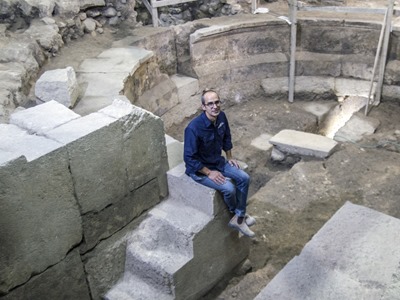
Robert Mullins has written an update on the major discoveries at Abel Beth Maacah after 5 years of excavation.

A head of an Akhenaten statue has been discovered in excavations at Tel el-Amarna.

Some medieval artifacts were seized in Turkey, including a gold seal attributed to Solomon. James Davila provides some commentary.

The Jerusalem Post profiles the Temple Mount Sifting Project.

Mordechai Aviam and R. Steven Notley make a case that el-Araj should now be considered the leading candidate for the site of Bethsaida-Julias.

Appian Media has released a “sneak peek” from an upcoming upside in the “Following the Messiah” series with an acoustical experiment at the Cove of the Sower.

With the water level of the Sea of Galilee nearly at an all-time low, Ferrell Jenkins illustrates the dramatic difference with several photos of Heptapegon.

David Moster will be lecturing on “The Jordan River and the Two Half-Tribes of Manasseh” in NYC on Nov 14. (We noted some of David’s work on the Jordan River here last year.)

Ben Witherington is on The Book and the Spade talking about his newest book, A Week in the Fall of Jerusalem.

HT: Paleojudaica, Joseph Lauer, Agade

Archaeologists have discovered a Jewish settlement under an abandoned military base near the town of Beit El.

Excavation of a tomb near Jerusalem’s Biblical Zoo uncovered an “afterlife snack pack of nine decapitated toads.”

A lost city of Alexander the Great has been identified at Qalatga Darband, six miles from Iraqi Kurdistan.

The Yeshiva University Museum recently opened a new exhibition, “The Arch of Titus – from Jerusalem to Rome, and Back.”

The Brooklyn Museum has just opened “Soulful Creatures: Animal Mummies in Ancient Egypt.”

The Arab World Institute Museum in Paris is hosting through January 2018 the exhibition, “Oriental Christians: 2,000 Years of History,” featuring artifacts never before displayed in Europe.

BYU has constructed a full-size tabernacle replica.

“The Center for Ancient Middle Eastern Landscapes (CAMEL) at the Oriental Institute of the University of Chicago is pleased to present the Anatolian Atlas, an online resource for geographical data related to the archaeology of Anatolia (ancient Turkey).”

The IWC at Tel Aviv University has announced its lecture schedule for the fall all centered around the theme “Jerusalem.”

Malka Z. Simkovich tries to explain why Christian monks copied Jewish manuscripts.

Bill Schlegel has created a new video showing sites in Benjamin from the air.

Wayne Stiles explains the value of using maps in your Bible study.

In light of his recent visit to el-Araj, John DeLancey discusses the two proposed locations for Bethsaida.

Ferrell Jenkins has written a well-illustrated post on Barclay’s Gate in the Western Wall. I suspect that most visitors don’t even know that it exists.

New release: Qedem 57: The Temple Mount Excavations in Jerusalem 1968-1978, Directed by Benjamin Mazar. Final Reports Volume V. Herodian Architectural Decoration and King Herod’s Portico.

Eisenbrauns is selling all available volumes of Excavations and Surveys in Israel for $5 each (with a few restrictions).

The population of Israel is now 8.7 million, including 6.5 million Jews and 1.8 million Arabs.

HT: Ted Weis, Charles Savelle, Joseph Lauer, Agade

The biblical Feast of Trumpets, usually observed now as the Jewish New Year, was celebrated on Thursday. Ferrell Jenkins shares some photos of the ram’s horn.

With the ending of year 5777, the Temple Mount Sifting Project identifies the “top 10 topics” over the past year.

Ferrell Jenkins explains how Dr. James Turner Barclay is honored in the Cathedral of St. George in Jerusalem.

Israel’s Good Name describes his experience on the Horvat Midras excavation.

The re-dating of the Gihon Spring fortifications is the topic on this week’s edition of The Book and the Spade.

The latest issue of Tel Aviv includes an article on the “Monumentality of Iron Age Jerusalem Prior to the 8th Century BCE.”

There have been a number of wolf attacks in the Judean wilderness in recent months. The article includes a video of a wolf chasing a young ibex.

“Dr. Scott Stripling and Dr. Craig Evans headline the upcoming Text and Trowel symposium on archaeology and the Bible at the University of Pikeville on Oct. 20-21, 2017.”

HT: Agade

Archaeologists have learned a lot in the first season of a renewed expedition to Masada, but they’re not saying much yet.

The tomb of an 18th-Dynasty goldsmith has been discovered on Luxor’s West Bank.

“Excavations at an ancient mound in the central Anatolian province of Kayseri shed light on writing from around 2,000 B.C.

The Plutonium of Hierapolis is being restored so that it can be opened to tourists next year.

The ancient stadium of Laodicea is being restored.

Scholars are using new technology to read palimpsests at St. Catherine’s Monastery.

Israel’s Good Name describes two recent field trips to the Sorek Stalactite Caves and to Tel Burna.

After years of delay, the Louvre Abu Dhabi will open two months from today.

HT: Explorator, Agade

Several dozen seal impressions have been discovered in excavations in the City of David. These bullae date to the period after the fall of the northern kingdom in 722 BC and the archaeologists suggest that the names on them may belong to refugees who immigrated to Jerusalem at that time.

The IAA press release is here, and the story is reported in a number of news sources. The Times of Israel incorporates many photographs and one video into its story.

The dozens of clay imprints were used on letters and documents which were bound by string and sealed by wet clay pressed with the sender’s mark or name. The impressive trove was discovered at recent digs uncovering three Late Iron Age buildings frozen in time by the destruction caused by the 586 BCE Babylonian siege. The discovery was made by a team of Israel Antiquity Authority archaeologists led by co-directors Dr. Joe Uziel and Ortal Chalaf.
Among the dozens of bullae is a rare find of an intact sealing, bearing the name “Ahiav ben (son of) Menahem,” referring to two kings of Israel but found in the capital of the Kingdom of Judah, Jerusalem.
[…]
According to co-director Ortal Chalaf, these Israelite names and other findings point to the possibility that after the destruction of Israel, refugees fled the Kingdom of Israel for the Kingdom of Judah, and settled in Jerusalem. After settling, the use of their names on official correspondence shows that these Israelites gained important roles in the Judaean administration, said Uziel.
“These names are part of the evidence that after the exile of the Tribes of Israel, refugees arrived in Jerusalem from the northern kingdom, and found their way into senior positions in Jerusalem’s administration,” according to the two co-directors.

The full story is here.

As excavations get underway at Kiriath Jearim, Haaretz (premium) reports on a 9-foot-wall discovered there and Finkelstein’s belief that the site held a temple that competed with Jerusalem.

The “ancient coin” the 9-year-old girl found last week is in fact a modern souvenir.

The bones of people killed at Khirbet el-Maqatir during the First Jewish Revolt were recently reburied in Ofra. Leen Ritmeyer posts more information and images.

Leen Ritmeyer shares a photo of a Temple Mount model made of Legos.

Wayne Stiles explains the significance of the Gezer boundary stones.

John DeLancey explains Hezekiah’s Tunnel, with help from a couple of videos including one narrated by Ronnie Reich.

Bill Schlegel has created a 5-minute video about Bethsaida in which he uses aerial footage to explain the two candidates and identify which site is most likely Bethsaida.

Lois Tverberg shares her experience and photos from the el-Araj dig this summer.

G. M. Grena has created a video tutorial on how to identify a LMLK seal impression. (Is his computer running Windows 95?)

R. T. France identifies seven differences between Galilee and Judea in the time of Jesus.

Israel’s Good Name describes his experience as a square supervisor at the Gath excavations.

Accordance has a big sale that includes a couple of collections from Carta, including the Carta Super Combo and the Carta Select Combo.

HT: Mike Harney, Agade