From the Jerusalem Post:

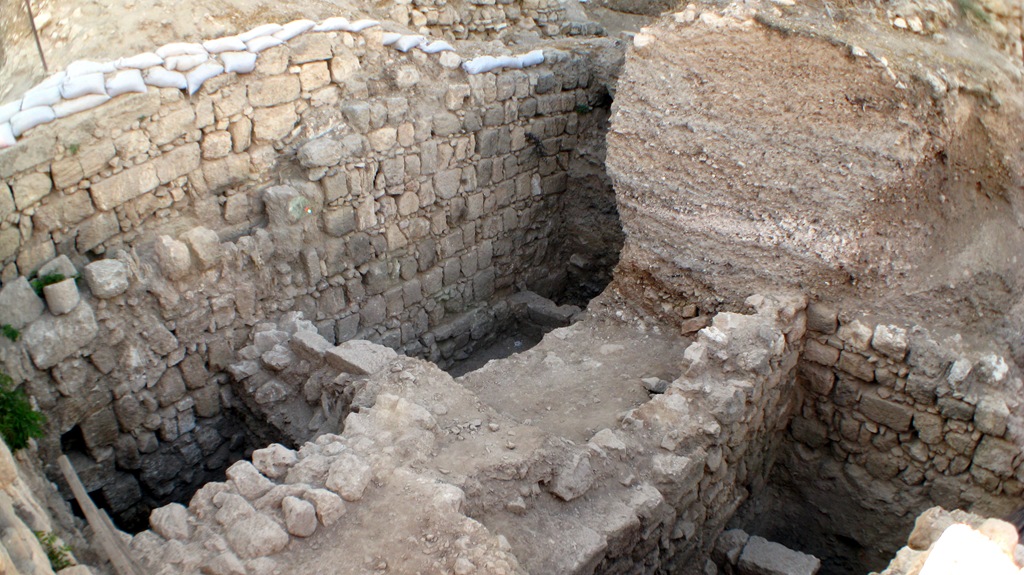
An ancient quarry covering approximately one dunam and dating back to the end of the Second Temple period was uncovered during excavations on Shmuel Hanavi Street in Jerusalem ahead of the construction of residential buildings, Israel Antiquities Authority said on Monday.
According to Dr. Ofer Sion of the Authority, who directed the dig along with Yehuda Rapuano, the 2,300 year-old site was probably the source of the stones used to build the Second Temple walls.
“The immense size of the stones indicates it was highly likely that the large stones that were quarried at the site were destined for use in the construction of [legendary builder of ancient Jerusalem King] Herod’s magnificent projects in Jerusalem, including the Temple walls,” Sion said.

The article continues here.

The article gives conflicting dates for the quarry.  It is dated to the “end of the Second Temple period,” which is the years before A.D. 70.  But it was used for Herod’s projects, and he ruled in Jerusalem from 37-4 B.C.  But the site is 2,300 years old.  Given the monumental construction of Herod’s rule, I would guess that it dates from this period.

The location of the site is Shmuel Hanavi Street, which is a major thoroughfare about one mile north-northwest of Damascus Gate, running between Sanhedria and Mea Shearim.

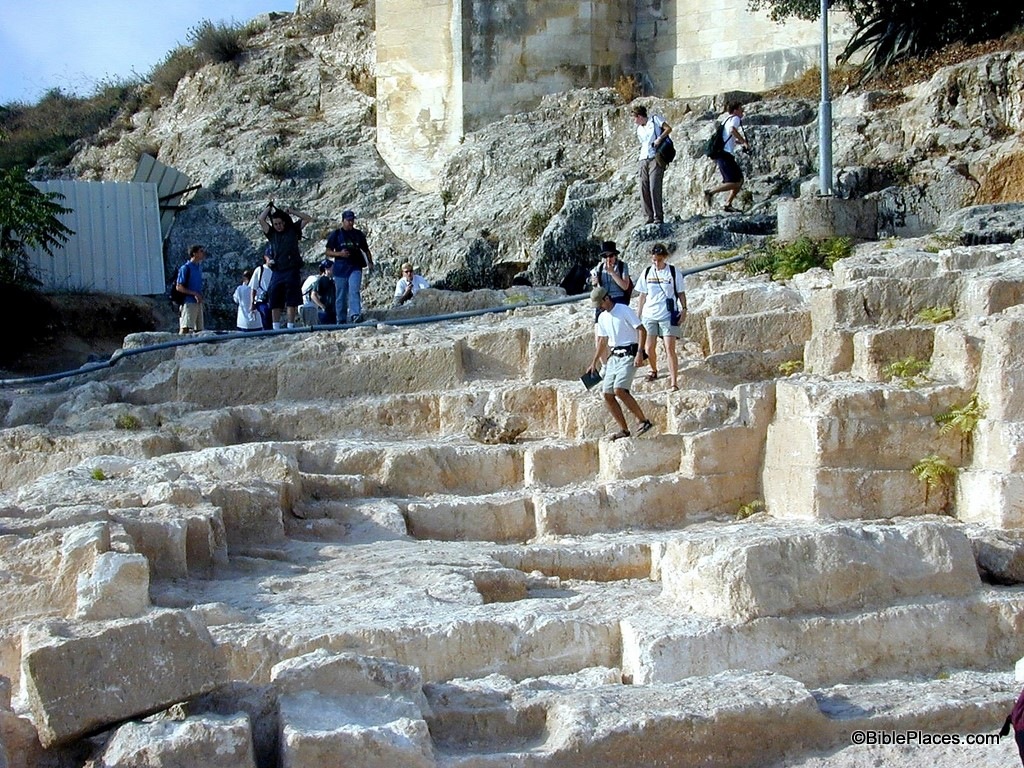
Other major quarries from roughly the same time period have been discovered in Ramat Shlomo (location, photos), Sanhedria, and “Solomon’s Quarries” near Damascus Gate.  The quarry at Ketef Hinnom (now covered by the Menahem Begin Heritage Center) may date to the same period.

Ketef Hinnom new excavations, tb090299803

Ketef Hinnom quarry, September 1999

UPDATE: Joe Lauer notes that a couple of high-resolution images are available from the Israel Antiquities Authority here (zip).  The press release is posted here, and Arutz-7 also has an article.

According to the Vatican, the traditional “tomb of Paul” has been authenticated.  Pope Benedict XVI announced that “tiny fragments of bone . . . belong to someone who lived in the first or second century.”  “This seems to confirm the unanimous and undisputed tradition that these are the mortal remains of the Apostle St. Paul.” 

The skeptical would note that a lot of people lived in the first and second centuries.  However, these bones were within a tomb traditionally identified with Paul.  I wouldn’t call that proof, but it seems to point in the direction of authenticity.  At least, it is unlikely that somebody in the Middle Ages set this all up.  CNN has a report.

Additionally, what is believed to be the earliest portrait of Paul was unveiled.  The painting dates to the 4th century and shows the apostle with a thin face and a dark pointy beard.  You can see for yourself here.

Previous coverage of the excavation of Paul’s tomb was mentioned here and here.

Expedition Bible has just released a new DVD entitled “Jericho Unearthed.”  Filmed on location, the video features interviews with archaeologists who argue for and against the site’s destruction by the Israelites as described in the book of Joshua.  From the website:jericho_unearthed

The battle of Jericho is one of the most enduring biblical stories.  The description of the “walls falling down” is among its most well-known accounts.   Yet, the most famous excavation of this ancient site, carried out in the 1950’s under the direction of Kathleen Kenyon, claims that there wasn’t even a city at Jericho—much less city walls—at the time when Joshua supposedly conquered it.  What are the implications of the battle of Jericho being disproven?  Wouldn’t the Bible be demonstrated untrustworthy? Couldn’t it be argued that the Jewish people have no more right to the land of Israel than anyone else? The implications really are staggering! For more than fifty years scholars have built a wall of doubt against the historical accuracy of the Bible using Jericho as one of its cornerstones. It’s time to face those challenges head on!  It’s time to determine whether or not the conclusions of modern scholarship stand in light of the evidence or if those arguments don’t in fact collapse like Jericho’s walls. 

You can view the trailer here, or order the DVD from Amazon for $7.  I haven’t seen the video itself, but based upon the previous work of Expedition Bible, I would expect that this is the best resource available on the subject.

Does the newly discovered Roman quarry mark biblical Gilgal?  The excavator thinks this is possible.  From Haaretz:

Zertal says their working theory is that the site is Galgala, biblical Gilgal, mentioned on the sixth-century Madaba mosaic map. The cave, buried 10 meters underground, is about 100 meters long, 40 meters wide and 4 meters high, is the largest artificial cave so far discovered in Israel.
Potsherds found in the cave and the carvings on the columns led Zertal to date the first quarrying of the cave to around the beginning of the Common Era. It was used mainly as a quarry for 400 to 500 years,” but other finds give the impression it was used for other purposes, perhaps a monastery or even a hiding place,” Zertal said.
Zertal said scholars wondered why people would dig a quarry underground considering the effort needed to just to pull the stones out of the ground.
A possible answer may be in the famous Madaba Map of ancient Palestine, found in Jordan. In it, a place named Galgala is marked and an accompanying Greek word meaning “12 stones.” The map also depicts a church near the site. Archaeologists say they have found two ancient churches near the cave.
According to Zertal, scholars had always assumed that “12 stones” refered to the biblical story of the 12 stones the Israelites set up at Gilgal after they crossed the Jordan.
However, the discovery of the quarried cave may mean the reference was to a quarry established where the Byzantines identified Gilgal. Zertal explains that in antiquity sanctuaries were built out of stones from sacred places.

The rest of the article is here

I would note that there is sometimes a big difference between a biblical site and what Byzantines thought was a biblical site.  In any case, the quarry’s location, 3 miles north of Jericho, is approximately where biblical scholars have supposed ancient Gilgal may have been located.  What has always been lacking is any archaeological evidence for a site from the time of Joshua.  A Roman quarry does not provide that evidence, but it may be a step in the right direction.

References to Gilgal in the Bible include Josh 4:19-20, Josh 10:6-7, 1 Sam 11:14-15, 1 Sam 13:4-15, 2 Sam 19:15; 2 Kings 2:1, Hos 4:15, and Amos 4:4.

HT: Joe Lauer

UPDATE (6/22): Thanks to Joe Lauer for sending along links to articles with photos.  The University of Haifa has issued a press release which includes four high-resolution photos.  Ynet includes a slideshow with six images, including one of the cave’s entrance.

UPDATE (6/25): National Geographic has an article about the discovery, including some quotations from Jodi Magness.

Medeba map Jericho and Gilgal area, tb053108977Jericho and Gilgal on the Medeba Map
Outlined in red is “Gilgal, also the Twelve Stones”
Below and to the right is the city of “Jericho,” surrounded by palm trees
The Jordan River is at the top, with the fish on the right swimming away from the Dead Sea

For more about the Medeba Map, see this BiblePlaces page.

The largest manmade cave in Israel was found 3 miles north of Jericho, and may have been used as a monastery in later years.  From the Jerusalem Post:

An artificial underground cave, the largest of its kind in Israel, was discovered in the Jordan Valley during excavations by the Haifa University’s Department of Archaeology. Prof. Adam Zertal, who headed the dig, assessed that the cave was used as a quarry in the Roman era. Various carvings were found on the cave’s walls, including some of crosses, leading to the notion that the cave might have also hosted an ancient monastery. The cave, sprawling over four dunams [1 acre] ten meters [32 feet] under the face of earth, is located some four kilometers [2.5 miles] north of Jericho. It was discovered at the end of March 2009 as part of a Haifa University dig which began in 1978, and is the largest man-made cave ever uncovered in Israel. The cave’s main hall is supported by 22 pillars, on which are engraved 31 crosses, a zodiac-like symbol, roman numerals and a Roman legion’s pennant. Judging by the findings, Prof. Zertal dated the cavern to around 1 CE. "Initially, the place was utilized as a quarry, which was active for 400-500 years. But the other findings definitely give the impression that the cave was used for other purposes, such as a monastery, and perhaps even a hideaway," said Zertal.

The story is also covered by Haaretz and Reuters.

Gordon Franz has just posted three transcribed interviews with staff members of the Hazor excavations, including Amnon Ben-Tor, Sharon Zuckerman, and Orna Cohen.  

“Hazor is Number One…”: An interview with Amnon Ben-Tor

“Where is the Archive at Hazor?”: An interview with Sharon Zuckerman

“It is the Best Job in the World”: An interview with Orna Cohen

Cohen is a conservator, and she comments on the controversy of the James Ossuary.  She believes that the second half of the inscription is original, but the first part is forged.

I had the pleasure of looking at and checking the James Ossuary and I gave my comments on it.  I think the ossuary is authentic and a real one, but the inscription on it, I am convinced there are two hands that wrote the inscription.  To my opinion, part of the inscription is faked, part is original.  Of course, there are things that go on in trial now.  They are still trying to figure out what is faked and by whom it was made.  To my opinion, the name Joshua [on the ossuary] is real.  The inscription reads: “Ya’acov bar Yosef achi Yehoshua.”  [Translation: Jacob, or James, the son of Joseph, the brother of Jesus].  So the first part, I think is added.  My professional opinion is almost against all the others that think the last name [on the inscription]; “bother of Jesus” (Joshua) is a fake.  So my opinion was against the others [at the trial].  I checked and it’s according to the patina in the letters.  There was a fake patina of just dirt that was put in these letters on purpose so I cleaned part of it and underneath there was the original, yellowish patina that based on my experience, was the original one.  It was not on the first part of the inscription but it was on the last part of the inscription.  That is what I gave as my opinion.