Haaretz is reporting on the discovery of a hoard of coins at a site three miles south of ancient Jerusalem.

A few days ago, archaeologists made a most surprising find at the bottom of such a columbarium, at a site at Kibbutz Ramat Rachel near Jerusalem – a hoard of coins from the time of the destruction of the Second Temple (70 C.E.).
Late in July, archaeologists from Tel Aviv University identified, beneath the floor of the columbarium, a ceramic cooking pot from the 1st century C.E. that held 15 large gold coins. “It’s very special to find a hoard like this, and it’s very exciting,” related the director of the excavations at the site, Dr. Oded Lipschits, of TAU. “We discovered the hoard with a metal detector, and then we went down into the niche and found this small cooking pot inside it.”
What was a pot holding coins doing at the bottom of a cave used for raising pigeons? According to Lipschits, the pot was covered up in a way that indicates that it had been concealed in a hurry. “We know that coins like these were brought to the Temple,” he says. “Possibly after the Temple was destroyed there was no place to bring the coins, and since the columbarium was no longer in use, they buried the coins here. This arouses sad thoughts as we approach Tisha B’Av,” he added, referring to the Hebrew date (the ninth of Av) that traditionally marks the destruction of both the First and Second Temples.

For photos, see the Hebrew version of the article. (HT: Joe Lauer).

Unrelated to the coin discovery is discussion of the function of the building that has previously been identified as a palace of the Judean kings (something akin to Camp David in the U.S.). 

Lipschits says that one of the aims of the current dig is to clarify the purpose of this structure. “The accepted claim is that it is a palace of the kings of Judea, but I’m dubious of that. The palace lacks any Judean characteristics, and there is no reason that a royal palace would have been built here, when the City of David is not far away.”
Lipschits believes that the palace was built during the period of the Assyrian subjugation. “This entire complex is, in my opinion, an administrative center for the occupying regime, a place where agricultural produce was collected, for delivery as a tax to the Assyrians.”
During the period of the return to Zion (beginning 539 B.C.E.), the Assyrian regime was replaced by a Persian one, but the administrative center continued to operate. Many seal impressions from this period have been found, bearing the name “Pahwat Yahud,” the name of the country under this regime. The Ramat Rachel excavation is is the main accumulation in the country of impressions of this sort, and Lipschits sees this as further proof that the site was an administrative center.

There’s some confusion about this elsewhere, but I think the journalist has it correct.  What Lipschits is suggesting, contrary to his predecessors (Aharoni, Yadin, and Barkay) is that the palace was an Assyrian center, following the time of the Assyrian subjugation of Judah under Hezekiah.  While most would agree that Assyria maintained some sort of control over Judah for about 50 years after Sennacherib’s failed attempt to conquer Jerusalem, Lipschits goes farther in claiming that Ramat Rahel was an on-site command post for Assyria.  Here’s a brief summary of archaeologists’ conclusions about this important and beautiful building:

  • Yohanan Aharoni: Palace of Judean king Jehoiakim (cf. Jeremiah 22); ca. 600 B.C.
  • Yigael Yadin (never missing an opportunity to disagree with YA):  Palace of Judean queen Athaliah; ca. 840 B.C.
  • Gabriel Barkay: Palace of Judean king Hezekiah; ca. 700 B.C. (possibly built, destroyed, and rebuilt during his reign)
  • Nadav Na’aman and Oded Lipschits: Assyrian headquarters in Judah; ca. 700 B.C.

If you’re interested in more, you can start with the article by Barkay in Biblical Archaeology Review, Sept/Oct 2006, pp. 34-44.
The season at Philistine Gath (Tell es-Safi) is concluded and archaeologist Aren Maeir has a great wrap-up of the season for all who couldn’t be there. Gath is proving to be one of the most important excavations of recent times and Maeir’s helpful reviews to the public should be a model for all excavations (and we get it straight from the horse’s mouth and not garbled through a journalist!). 

Some highlights (from my perspective):

  • They excavated material from Early Bronze, Middle Bronze, Late Bronze, Iron I, Iron II, and Crusader.
  • Gath appears to have been a large, significant site in Early Bronze, before the arrival of the Philistines.
  • Remains were found related to the earliest arrival of the Philistines at the site, including locally made Mycenean IIIC ware.
  • Important discovery from the time of David/Solomon: “a well-dated fragment of a seal impression (of the late 21st Dynasty in Egypt, ca. mid-10th cent BCE), and several nice clusters of carbonized grape pips. This latter find should be able to provide nice 14C datings for this phase. One cannot overemphasize the importance of the finds in this level, since it may provide the first concrete, well-dated (from several perspectives) context from the early Iron Age IIA in Philistia.”
  • Gath was a large site in the time of the first kings of Judah: “As such, it appears to mirror the role that Gath is portrayed as playing in the biblical text in the early monarchy, that of the major Philistine city, primus inter pares among the five Philistine cities.”
  • More evidence was revealed of Hazael’s destruction of the site in about 800 B.C.
  • Gath may have been destroyed twice by the Assyrians – first by Sargon II (712 B.C.?) and then by Sennacherib (701 B.C.).

Maeir concludes: “All told, the season was great, the team was fantastic and the find were extraordinary!”

Read the whole thing here.

The excavations at Ramat Rahel have recently begun and they have their own blogToday they found a bomb!  Other excavations in Israel with blogs include Gath (regular and professional), Megiddo (regular), and Dan (they had good intentions).  I don’t know of any blogs for the current excavations at Hazor (where is that archive?), Gezer (is this another Macalister dump?), or Ashkelon.

There’s a few more days if you want to join in excavations on a site that used to be called Khirbet Qeiyafa, but is now dubbed the much more appealing “Elah Fortress.”  There’s some info here on what to bring.  Here’s the season brochure (front, back). You can also watch a YouTube video on the site.

Next year Bryant Wood is headed back to Khirbet el-Maqatir after a hiatus since Palestinian terrorism restarted in 2000.  Excavations of the candidate for biblical Ai are scheduled for May 20 – June 6, 2009. 

The Jerusalem Report has a lengthy article (published online, but poorly formatted, by the JPost) about the state of Dead Sea Scroll and Qumran research, including various theories of who lived at Qumran and who were responsible for the scrolls. The article also discusses the newly publicized “Gabriel’s Vision” tablet, and includes a sidebar on the Palestinians’ demand that the scrolls be turned over to them.

If you didn’t hear it already, Codex Sinaiticus is beginning to be posted online this week.  Here’s the story, and here’s the link to one of the oldest Bibles in existence.  Come back in a year if you want to read the whole thing.

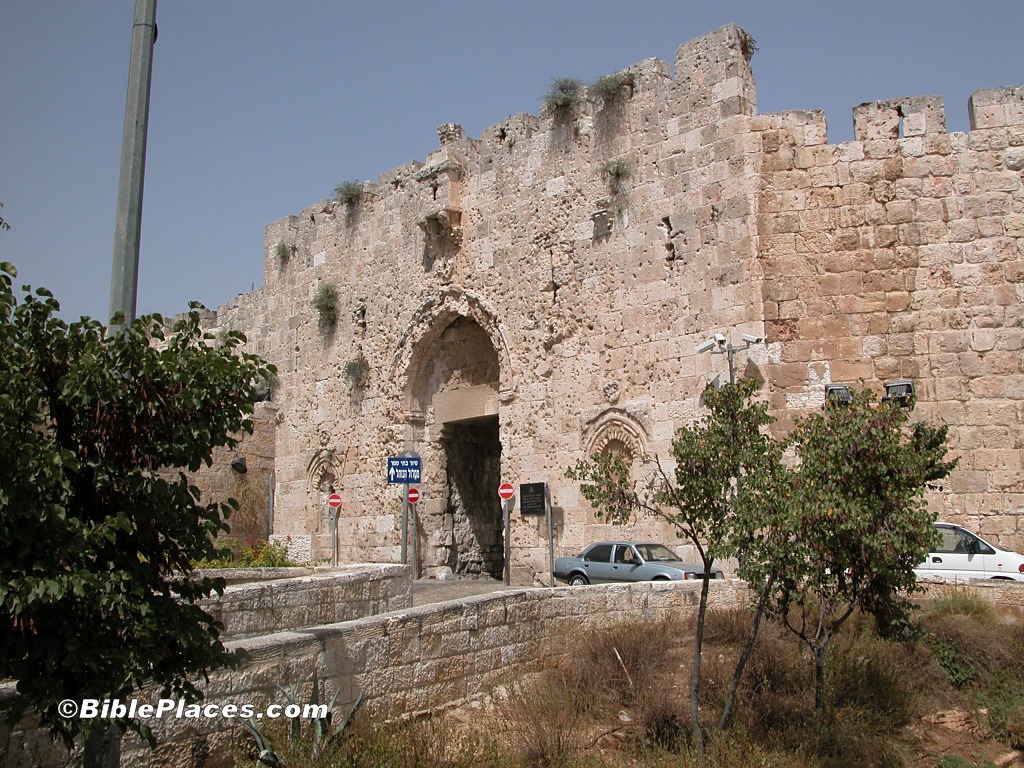
Six months and $200,000 later, Zion Gate is now back in view.  The hundreds of bullet holes and shell marks are still visible, but the stones are now stabilized and less likely to collapse on a vehicle executing a beautiful 11-point turn as they exit the city.

Zion Gate, tb091702701
Zion Gate, before renovation

And perhaps tourism to Iraq is not so far off.

Leen Ritmeyer has a posted (with a follow-up) on his identification of several stones in the eastern wall of the Temple Mount that are clearly pre-Herodian.  Ritmeyer dates them to the time of King Hezekiah, suggesting that he was the one to build the 500-cubit square Temple Mount that Ritmeyer has previously identified.  He includes some helpful illustrations and photos.

A review of current excavations in Turkey is given at Today’s Zaman.  New Testament sites being excavated include Alexandria Troas, Miletus, Hierapolis, Sardis, Smyrna, and Laodicea.  There are many other sites as well.  Many of these cities have very impressive remains, unlike many sites in Israel.  Today’s Zaman also has an article on recent discoveries at Sardis.

NASA has a photo of a street of Ephesus at night, with (the planet) Jupiter illuminating the way.
Across the way in Greece, the ancient hippodrome of Olympia has been discovered.  This is a good story that counters the myth that everything to be found has already been found.

A couple fragments of the Dead Sea Scrolls have now been published by James H. Charlesworth. 

One of the fragments may be from the Samaritan Pentateuch, and the other appears to be from Nehemiah, making it the first portion of that book to be found among the DSS.  Paleojudaica gives more info and links.

If you’re a tourist in Israel and have a question, you can now call the 24-hour tourist hotline.  It’s easy (dial *3888), but it’s not a toll-free number.

One thing (an important thing) to consider when choosing an excavation to join is the extra-curricular activities. By that I mean the evening lectures and the afternoon or weekend tours. Digging in the dirt is nice, but your experience will be greatly enhanced if you can learn about your site and travel around the area. Having said that, and having looked at the schedule at Gath this season, I would certainly recommend choosing Gath for your excavation next year. Check the schedule out at the Gath blog. A tip to other excavations interested in boosting their number of volunteers for future seasons: put your extra-curricular schedule online. And start a dig blog.

Yigael Yadin lecturing at Megiddo, db6703260103
Yigael Yadin lecturing at Megiddo excavation, 1967from forthcoming photo collection of David Bivin