Excavations began in the parking lot below Dung Gate in 2003 and were resumed in 2007.  The Israel Antiquities Authority has just released a brief report on the discoveries from the 2007 season.  It should be noted that this report does not include results from 2008.

Excavations in Central Valley, tb051908109
Excavations of area in May 2008

The longest portion of the report concerns the Second Temple period, which is primarily the 1st century A.D.  It reports one of the discoveries:

A large impressive edifice, whose northeastern corner has only been revealed to date, was in the southern unit. The eastern wall of the building (exposed length over 14 m, thickness c. 2 m, height more than 5 m) was built of large roughly dressed fieldstones, some of which were hundreds of kilograms in weight. The northern wall (width c. 1 m) was also preserved to a substantial height. The interior portion of the building, within the limits of the excavated area, indicated that the structure was divided into elongated halls, oriented northwest-southeast.

This is what was hailed in the media as the “palace of Queen Helene of Adiabene,” though as the 1st century ruler’s name is not mentioned in this report, some may have missed the connection.

The period of greater interest given the current discussion of the nature of Jerusalem in the Old Testament period is the section on the Iron Age, quoted here in full.

The remains of the period, exposed in five strata that represented most of the Iron Age, were founded directly on bedrock, marking the earliest settlement in this part of the City of David. This period was mainly characterized in this area by relatively densely built houses of careless and poor construction. The houses, built of one-stone-wide walls, contained a variety of domestic installations. These indicate a residential quarter that existed in the area during this period.
The early phase of the Iron Age was noted for the use of bedrock the builders had employed for setting the buildings’ walls and incorporating it within their built complex of structures. Thus, ‘habitation pockets’, confined between the buildings’ walls and bedrock outcrops, were discovered. This phase was dated earlier than the eighth century BCE, based on the abundance of ceramic finds. The later phase of this period dated to the seventh–sixth centuries BCE. No building remains from Iron I were discovered.

There are several significant points to note here:

  • The discovery of houses from the Iron Age in Jerusalem is unusual.  In most places, later destruction removed traces of building except for monumental structure (walls, water systems).  The best examples of houses were found on the other (that is, east) side of the City of David in Shiloh’s excavation.
  • Caution should be taken before concluding that because some houses in Jerusalem at this time were of “poor construction,” all were.
  • Some of the material is “earlier than the eighth century,” which means 9th century (or possibly 10th, but distinguishing pottery between the two centuries is problematic at the moment).  This indicates that there was habitation in this area before the expansion in Hezekiah’s day (late 8th century) when the Western Hill was fortified.  This should not be surprising, given indications in the biblical text.
  • That no remains were found from Iron I (or Bronze Age; see end of report) also fits the biblical narrative.  The city of Jebus was small and more closely located to the Gihon Spring when it was captured by David.  The city expanded to the north as David prepared for the construction of the temple.

In other words, the biblical account would lead us to expect to find remains earlier than the 10th century in the City of David, remains from the 10th century and later at the Temple Mount, with a likely “filling in” of habitation between the two sometime after the temple’s construction. 

Admittedly, there are other possibilities, but this one seems quite reasonable, and it appears to fit with the results of this report.

Readers unfamiliar with the geography of the area and the location of these excavations will better understand the last two points with the graphic below, which shows that the excavation area was outside the boundaries of the “City of David.”

Aerial view of City of David, tb010703 givati parking diagram 
Jerusalem from the southwestClick on graphic for high-resolution
Share:

The Shephelah, or western foothills of Judah, is an ideal site for excavations because of

1) its rich history;

2) its close proximity to universities in both Tel Aviv and Jerusalem; and

3) its moderate climate.  There’s enough work to be done in the Shephelah alone to occupy every archaeologist working in Israel for the next 100 years.

Tel  Aviv University has been approved to renew excavations at Azekah.  Though it is one of the most important sites in the Shephelah, it has only been excavated by Robert Alexander Stuart Macalister in a brief dig more than 100 years ago.  Among other things, Azekah is mentioned in the Bible as near the place of the Philistine encampment when David defeated Goliath.  It was one of the last two cities holding out against Nebuchadnezzar in 586 B.C. (see Jeremiah 34:6-7 and Lachish Letter #4).  There are undoubtedly a lot of goodies buried under that pile of dirt.

Azekah from northeast, tb030407700
Azekah from the northeast

Bar Ilan University has been excavating Tel ‘Eton/Tell Aitun under the direction of Avi Faust.  This year was their third season of excavation and they are finding a destruction level as well as a fortress in the style of a four-room house, only larger. The destruction level seems to pre-date Sennacherib’s 701 campaign because pottery is transition form between Lachish III and IV; but also not likely to be Sargon II’s 712/711 campaign since it appears he only visited cities on the coastal plain. Scholars have suggested that the site is biblical Eglon (for more on that, see The Sacred Bridge, 128). The website is viewable in MS Internet Explorer, but not Firefox.

 Tell Aitun, possibly Eglon, from south, tb102900331
Tel ‘Eton, possibly biblical Eglon, from south

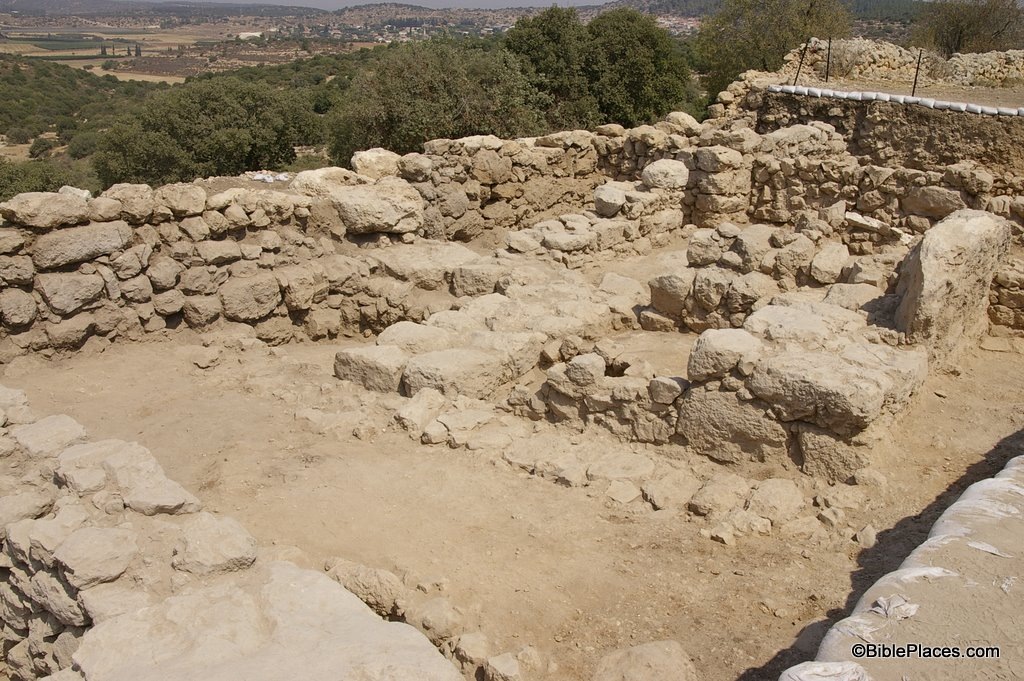
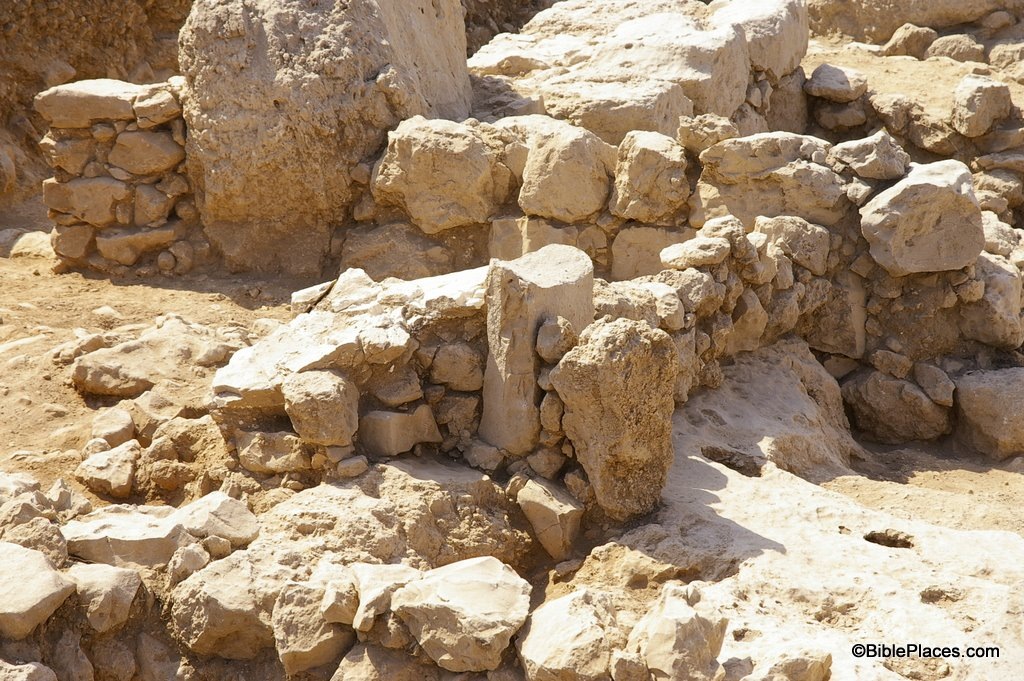
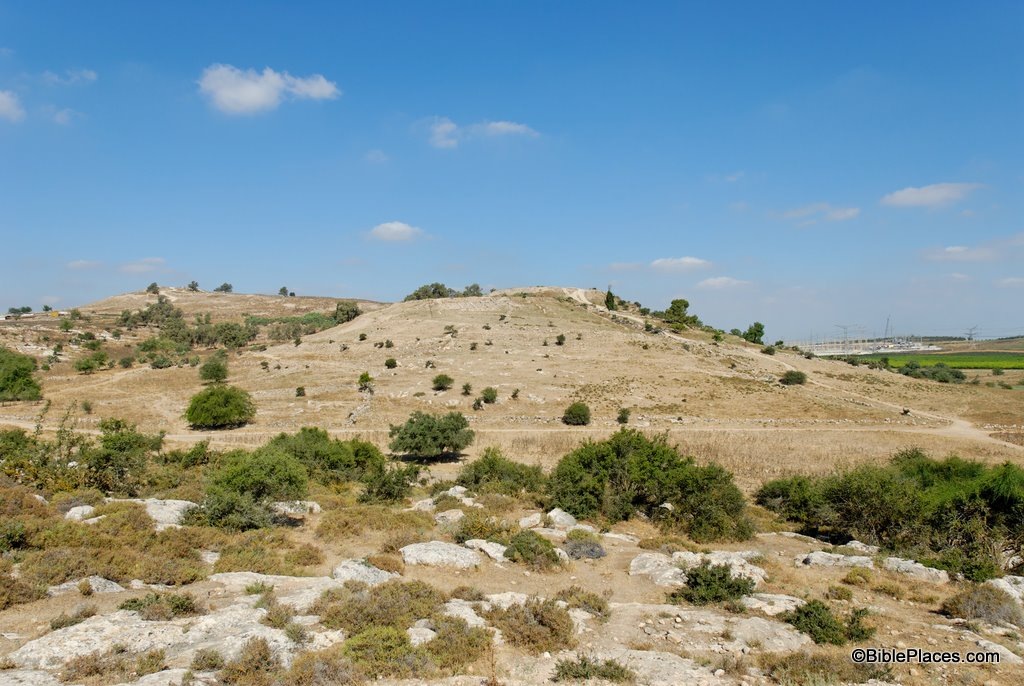
Khirbet Qeiyafa, located directly east of Azekah, is being excavated by Yosi Garfinkel of Hebrew University.  They found a four-chambered gate dating to the 10th century B.C. with a casemate wall and two attached buildings. There was no previous occupation and the nearest subsequent occupation is Hellenistic, so it is virtually a single-period site for Iron IIA. They also found an ostracon (inscribed potsherd) with about 4-5 lines of writing, the contents of which are apparently more sensitive than Israel’s plans to bomb Iran.  (This is a good reminder to thank those archaeologists who are quick to share their discoveries with all of their supporters.)  The ostracon will be published by Misgav.

Share:

Joe Lauer sends along a couple of articles worthy of notice. The excavations at Ramat Rahel are featured in a 3-minute video by infolive.tv.  It begins:

Deep inside of the hills of Jerusalem rests the Kibbutz of Ramat Rachel. Over the past 50 years many archaeologists have realized that hidden beneath this kibbutz are archaeological treasures beyond one’s imagination – the ruins of the palace of one of the king of Judah, along with relics from the Persian, Hellenistic and Roman era. At this site where space and time are mixed within the earth, another hidden treasure long buried underground has recently resurfaced. Just a few days ago, 15 silver coins dating from the Second Temple period were discovered inside of an ancient pot hidden in a columbarium.

The Jerusalem Post has an article on the increase of tourism to sites in east Jerusalem. 

The Company for the Development of East Jerusalem reported 28 percent growth in the number of visitors to the historical sites in and around the Old City’s walls during the first six months of 2008. “More Israelis have rediscovered Jerusalem this year and they visit it more frequently then they used to do in the past,” Gideon Shamir, the company’s director-general, told The Jerusalem Post on Tuesday. During the first half of the year, 143,967 people visited the Ophel Archeological Park, situated at the foot of the southern wall of the Temple Mount, a 24% rise over the same period in 2007, the company said. The Old City Ramparts saw 74,728 people walk on them from January to June, a up 29% from the same months in 2007. Both sections of the Promenade begin at the Jaffa Gate; one route passes through the New Gate, Herod’s Gate and the Lions’ Gate (aka St. Stephen’s Gate), and the other stretches from Jaffa Gate to Zion Gate. Since January 1, 5,549 people visited Zedekiah’s Cave, which was opened to the public in April 2007. During nine months of activity in 2007 the cave was toured by 9,356 people; visits during April to June 2008 are up 86% from the same period last year.

The article continues here.  I’m certainly happy to see these sites open again, but there has been a price.  Getting into the City of David with a group now requires an advance reservation, a fast pace to stay ahead of countless tour groups, and a wad of cash.  Zedekiah’s Cave cost $1 before it closed in 2000; now they charge $5 a person to keep the lights on and a guard at the door.

Share:

From the archaeologists:

The co-directors of the Kabri Archaeological Project (KAP), Assaf Yasur-Landau and Eric H. Cline, would like to announce that a pdf of the preliminary results from the 2008 excavation season at Tel Kabri is now available at: http://digkabri.files.wordpress.com/2008/08/report-on-the-results-of-the-2008-excavation-season-at-tel-kabri1.pdf If the direct link does not work for some reason, go to http://digkabri.wordpress.com/ and click on the link there to download the pdf.   Links to the results of previous seasons (2005, 2006, and 2007) are also listed at http://digkabri.wordpress.com/ KAP Publications which have already appeared are:   E.H. Cline and A. Yasur-Landau, “Poetry in Motion: Canaanite Rulership and Aegean Narrative at Kabri,” in EPOS: Reconsidering Greek Epic and Aegean Bronze Age Archaeology: 157-165, S.P. Morris and R. Laffineur, eds.  Aegaeum 28.  Liège: Université de Liège.  2007.   A. Yasur-Landau, E.H. Cline, and G.A. Pierce, “Middle Bronze Age Settlement Patterns in the Western Galilee, Israel,” Journal of Field Archaeology

HT: Joe Lauer

Share:

Excavations continue at the western end of the Western Wall prayer plaza, and as the work proceeds further into the ground, the more interesting it gets (at least to those of us interested in pre-Byzantine periods).  Peter Wong from Hong Kong was at the site this week and sent me a couple of photos. 

They show a remarkable level of preservation.

IMG_5262

IMG_5268

For context, here’s a photo I took a few months ago that shows the excavation (at bottom) in relation to the prayer plaza.

Western Wall plaza excavations, tb051908178

I have not seen anything reported on this excavation recently, but when I do, I’ll make note of it.

Share:

Haaretz is reporting on the discovery of a hoard of coins at a site three miles south of ancient Jerusalem.

A few days ago, archaeologists made a most surprising find at the bottom of such a columbarium, at a site at Kibbutz Ramat Rachel near Jerusalem – a hoard of coins from the time of the destruction of the Second Temple (70 C.E.).
Late in July, archaeologists from Tel Aviv University identified, beneath the floor of the columbarium, a ceramic cooking pot from the 1st century C.E. that held 15 large gold coins. “It’s very special to find a hoard like this, and it’s very exciting,” related the director of the excavations at the site, Dr. Oded Lipschits, of TAU. “We discovered the hoard with a metal detector, and then we went down into the niche and found this small cooking pot inside it.”
What was a pot holding coins doing at the bottom of a cave used for raising pigeons? According to Lipschits, the pot was covered up in a way that indicates that it had been concealed in a hurry. “We know that coins like these were brought to the Temple,” he says. “Possibly after the Temple was destroyed there was no place to bring the coins, and since the columbarium was no longer in use, they buried the coins here. This arouses sad thoughts as we approach Tisha B’Av,” he added, referring to the Hebrew date (the ninth of Av) that traditionally marks the destruction of both the First and Second Temples.

For photos, see the Hebrew version of the article. (HT: Joe Lauer).

Unrelated to the coin discovery is discussion of the function of the building that has previously been identified as a palace of the Judean kings (something akin to Camp David in the U.S.). 

Lipschits says that one of the aims of the current dig is to clarify the purpose of this structure. “The accepted claim is that it is a palace of the kings of Judea, but I’m dubious of that. The palace lacks any Judean characteristics, and there is no reason that a royal palace would have been built here, when the City of David is not far away.”
Lipschits believes that the palace was built during the period of the Assyrian subjugation. “This entire complex is, in my opinion, an administrative center for the occupying regime, a place where agricultural produce was collected, for delivery as a tax to the Assyrians.”
During the period of the return to Zion (beginning 539 B.C.E.), the Assyrian regime was replaced by a Persian one, but the administrative center continued to operate. Many seal impressions from this period have been found, bearing the name “Pahwat Yahud,” the name of the country under this regime. The Ramat Rachel excavation is is the main accumulation in the country of impressions of this sort, and Lipschits sees this as further proof that the site was an administrative center.

There’s some confusion about this elsewhere, but I think the journalist has it correct.  What Lipschits is suggesting, contrary to his predecessors (Aharoni, Yadin, and Barkay) is that the palace was an Assyrian center, following the time of the Assyrian subjugation of Judah under Hezekiah.  While most would agree that Assyria maintained some sort of control over Judah for about 50 years after Sennacherib’s failed attempt to conquer Jerusalem, Lipschits goes farther in claiming that Ramat Rahel was an on-site command post for Assyria.  Here’s a brief summary of archaeologists’ conclusions about this important and beautiful building:

  • Yohanan Aharoni: Palace of Judean king Jehoiakim (cf. Jeremiah 22); ca. 600 B.C.
  • Yigael Yadin (never missing an opportunity to disagree with YA):  Palace of Judean queen Athaliah; ca. 840 B.C.
  • Gabriel Barkay: Palace of Judean king Hezekiah; ca. 700 B.C. (possibly built, destroyed, and rebuilt during his reign)
  • Nadav Na’aman and Oded Lipschits: Assyrian headquarters in Judah; ca. 700 B.C.

If you’re interested in more, you can start with the article by Barkay in Biblical Archaeology Review, Sept/Oct 2006, pp. 34-44.

Share: