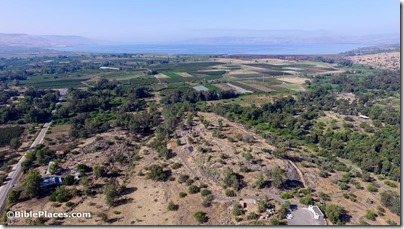
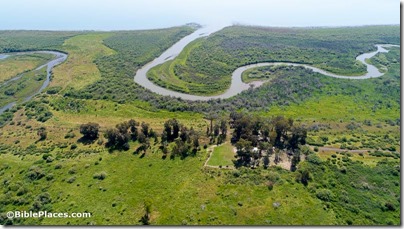
Archaeologists working near biblical Aphek have discovered a large water reservoir dating to about the time of King Hezekiah. The press release includes a one-minute video.

They found Roman remains at el-Araj, a candidate for New Testament Bethsaida. Here’s a photo of some of the Roman mosaic floor.

The third week of the excavations of Gath has ended, and they found an inscription.

Chris McKinny summarizes the results of the third week at Tel Burna. And if you missed the second week review, you can find it here.

The Temple Mount Sifting Project has discovered a Doric capital dating to the 2nd century BC.


The Times of Israel profiles ABR’s new excavation project at Shiloh.

The Greek Orthodox Church has sold the amphitheater and hippodrome of Caesarea in a secretive manner that raises lots of questions.

Archaeologists have found 8 more ancient shipwrecks off the coast of Greece, bringing the total number now discovered there to 53.

“Egyptologists have discovered what they believe is the burial chamber of Ankhesenamun, Tutankhamun’s wife.”

Here are five surprising inventions of ancient Rome, including luxury cruise ships.

Ferrell Jenkins shares his experience and photos with camel caravans in the Sinai.

John MacDermot will lecture on “Olga Tufnell – The Life of a Petrie Pup” at the British Academy in
London on September 20.

Recent Shroud of Turin Research is the top of this week’s edition of The Book and the Spade.

I thought the Kindle sale for Eric Cline’s Three Stones Make a Wall: The Story of Archaeology was for one day only, but the $1.99 deal was still good the last time I checked.

HT: Carl Rasmussen, Charles Savelle, Joseph Lauer, Agade, Mike Harney

Share:

Jodi Magness keeps digging up cool mosaics in the Late Roman synagogue at Huqoq. (Unfortunately, they seem to have released only two photos.)

A manuscript with a medical recipe from Hippocrates has been discovered in restoration works of the library of St. Catherine’s Monastery in Sinai.

The first week of excavations has concluded at Gath, and Aren Maeir has posted a daily summaries and photos from the week.

Chris McKinny has posted a summary of Week 1 at Tel Burna.

The first aquarium in Jerusalem will open later this month next to the Biblical Zoo.

A study of ancient sea walls has found that the Romans used a volcanic ash in construction because it was strengthened by its contact with sea water.

“Iraq’s Ministry of Tourism and Antiquities has accelerated its efforts to finish by the end of 2018 the Virtual Museum of Iraq, which will create a comprehensive database of Iraqi archaeological heritage online.”

Hobby Lobby will pay a fine and return artifacts to settle a lawsuit brought by the US government.


The Federalist argues that the US government should allow Hobby Lobby to retain the artifacts because doing so will ensure their preservation and study.

John DeLancey has posted an 11-minute video showing a hike up Mount Arbel. He has several dozen teaching videos on his website here.

The Bible and Interpretation has posted a review article by Aren M. Wilson-Wright, “Hebrew or
Not?: Reviewing the Linguistic Claims of Douglas Petrovich’s The World’s Oldest Alphabet.”

Lawrence Schiffman writes about a recent conference of Jewish, Christian, and Muslim scholars on the history and archaeology of the Temple Mount.

Wayne Stiles: “Have you noticed how often hymn writers use the Jordan River as a metaphor for transitions in the spiritual life? That may be because the Bible does the same.”

Ferrell Jenkins asks, “Did Philip baptize the Ethiopian at ’Ain ed-Dirweh?”

Scott Stripling is the guest this week on The Book and the Spade, discussing the first season of ABR excavations at Shiloh.

Tom Powers investigates celebrations of the 4th of July held by the American Colony in Jerusalem.

HT: Ted Weis, Charles Savelle, Agade, Joseph Lauer

Share:

A lot happened while we were traveling in June, and I think it is going to take us four roundups to catch up. Today we begin with stories related to Israel.

Archaeologists have discovered a Crusader-era tunnel in Tiberias that apparently led from the fortress to the harbor.

Students excavating in Modiin discovered a collection of women’s jewelry from the Crusader period.

Excavations at the site of Huqoq in Galilee have discovered agricultural installations in use in either the Middle Bronze Age or the Roman-Byzantine period.

Weekly reports are available for ABR’s first season at Shiloh: Week 2 by Mark Hassler, Week 3 by

Andrew Kvasnica, and Week 4 by Gary Byers.

Scholars at Tel Aviv University have used multispectral imaging to reveal text on ancient “blank” potsherds from the First Temple period.

Emek Shaveh has petitioned Israel’s high court to halt excavations in the Western Wall tunnels.

An alert hiker reported suspicious activity which led to the capture of two antiquities thieves near the site of Sepphoris.

The new National Campus for the Archaeology of Israel remains unopened due to a lack of donations. This article in Apollo magazine reviews the controversy over moving archaeological material from east to west Jerusalem.

Haaretz reports on a new exhibit at the Israel Museum, “Faces of Power: Coins from the Victor Adda Collection.” These 75 gold coins depict Roman emperors and their wives and have never been publicly displayed before.

A nighttime audiovisual show at the City of David begins later this month.

The Israeli government has temporarily restricted civilians from visiting the Golan viewpoints overlooking Qunetra.

Appian Media has released a free (and downloadable), 10-minute video on Magdala.

Wayne Stiles notes the irony that “the Church of the Holy Sepulchre demonstrates the need for the place it hallows.”

There are several coming Israel tours of note. Wayne Stiles is taking a group October 26–November 6 and another March 16-27, 2018. Joel Kramer (SourceFlix) is leading a trip March 11-24.

This weekend, fans are reenacting the Battle of the Horns of Hattin in which the Muslims defeated the Crusaders in 1187.

HT: Joseph Lauer, Charles Savelle, Agade

Share:

A new study suggests that the Philistines brought their pigs with them when they sailed to the coast of Israel.

The second issue of the Tel Aviv University Archaeology Newsletter has reports on projects at
Masada, Kiriath Jearim, Timna Valley, City of David, and more.

David Hendin reports on the most significant numismatic discoveries in Israel in recent years.

Wayne Stiles looks at lessons to be learned from sieges in the Bible.

Charlie Trimm explains how soldiers relieved themselves while in battle.

Lexham Geographic Commentary: The Gospels is now available as a standalone purchase in Logos.

The Acts through Revelation volume is in pre-order status.

A new database identifies 20,000 archaeological sites at severe risk of destruction.

Access the Collections is a new feature of the Oriental Institute website to encourage visitors to explore their photographic and document archives.

Recently released:

Hazor VII: The 1990–2012 Excavations: The Bronze Age, edited by Amnon Ben-Tor et al.

Socoh of the Judean Shephelah: The 2010 Survey, by Michael G. Hasel, Yosef Garfinkel, and Shifra
Weiss (Eisenbrauns)

Khirbet Qeiyafa in the Shephelah, edited by Silvia Schroer and Stefan Münger (Academic Press Fribourg)

The Twice-Told Tale: Parallels in the Bible, collated by Abba Bendavid (Carta)

  • A collation of parallel Bible texts showing the duplications, differences, and silences

We’ll have more stories in part 3 of the roundup tomorrow.

HT: Joseph Lauer, Ted Weis, Charles Savelle, Agade

Share:

Archaeologists have revealed new evidence for the Roman destruction of Jerusalem in AD 70 from the excavations of the road from the Siloam Pool to the Temple Mount.

The tomb of an unknown saint has been unearthed at Hippos.

A stone slab with two indentions was used to start fires in the Neolithic period.

The Associates for Biblical Research have completed Week 1 of Season 1 in their excavations of Shiloh.

A network of caves and tunnels at Khirbet Burgin in Judah’s Shephelah has been opened to the public.

An archaeological garden has been opened in the Davidson Center south of the Temple Mount of Jerusalem.

A study to be published in Palestine Exploration Quarterly observes that the large number of reservoirs made Jerusalem unique in the Second Temple period.

International Museum Day has passed, but this is a handy list of museums in Israel.

The Temple Mount Sifting Project met their first goal of 250,000 NIS and is now working to a second, much larger goal.

Aren Maeir shares some photos from the opening of an exhibition of discoveries from Gath (Tell es-Safi) in the Bar Ilan University Library.

Ferrell Jenkins recently was able to visit inside the Dome of the Rock and take photos. He shares some.

A $14 million elevator will be built at the Western Wall Plaza to allow elderly and disabled to go to the Jewish Quarter.

A Russian lawmaker vacationing in Israel drowned in the Dead Sea.

Accordance is having a big sale on many excellent archaeological and geographical resources through Monday.

HT: Joseph Lauer, Ted Weis, Charles Savelle, Agade, Explorator, Chris McKinny, Paleojudaica

Share:

Archaeologists working along Highway 1 near Abu Ghosh discovered a cache of bronze coins from the time of the Persian invasion in AD 614.

A study of a core sample from 1,500 feet below the floor of the Dead Sea points to lengthy droughts in the past.

With Easter approaching, the IAA gave reporters a tour of its storage facility. Haaretz goes with the sensational headline.

For two more articles on this week’s story about the edicule in the Church of the Holy Sepulcher, see The New York Times and National Geographic. The latter includes some terrific photos.

Carl Rasmussen highlights a video that allegedly shows the original stone wall of Jesus’s tomb inside the edicule.

A World of Emotions: The Making of an Exhibition” describes the new exhibit at the Onassis Center in New York. Many photos are included.

Bible History Today has a preview of “Where Are the Royal Archives at Tel Hazor?” from the latest issue of BAR.

Philip F. Esler writes about the ancient Jewish woman that we know the most about: Babatha.

Timothy Lim explains what we know about the Dead Sea Scrolls 70 years after the initial discovery.

Wayne Stiles reveals how the events at Shechem teach us how to live more faithful lives.

HT: Gordon Franz, Ted Weis, Charles Savelle, Jared Clark, Agade, Joseph Lauer

Share: