I updated last week’s post about the mikveh discovery near the Western Wall with a link to Leen Ritmeyer’s explanation of the location of the mikveh in relation to the Xystos and Chamber of Hewn Stone.

Bob Cargill reports that Raphael Golb’s path to prison is still clear.

If you use Logos’ Libronix, but don’t subscribe to the Tyndale Tech newsletter, you’ll find David Instone-Brewer’s “Guides, Tips, and Treasures” helpful.

Ferrell Jenkins is currently traveling through Malta and Italy, visiting such biblical sites as Rhegium, Syracuse, and Rome.  You can read his observations and view his photos on his blog.  I’m presently working on a new CD for the Pictorial Library that will include these places and more.

Gordon Franz gives his reflections on six weeks of excavation at Hazor this summer.

The Wall Street Journal considers the claims of Palestinians who assert that

Jews have no history in the city of Jerusalem: They have never lived there, the Temple never existed, and Israeli archaeologists have admitted as much. Those who deny this are simply liars.

The WSJ mentions “A Brief Guide to al-Haram al-Sharif” as evidence in the discussion, and, as far as I know, this discovery was first mentioned and made available by a reader on this blog.
Share:

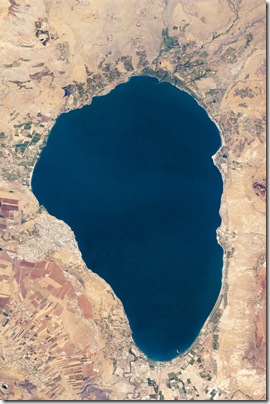
NASA’s “Earth Image of the Day” last week was a beautiful photo of the Sea of Galilee.  I believe that copyright restrictions on NASA images are little to nil for U.S citizens, so you can use it to your heart’s content. 

Sea of Galilee, NASA image

You might take a little more care, however, in the photo’s description.  I don’t think anyone who has seen the area between January and June would call the region an “arid landscape.”  Nor would anyone consider a 4th-5th century synagogue one of the oldest in the world. 

Sea of Galilee southern end from west, tb041003225 Sea of Galilee from the west (source)

The description mentions Edward Robinson, and so interested in what he said about the place he identified as Capernaum, I opened the “Sea of Galilee, Capernaum” PowerPoint file on the new Northern Palestine CD, and read this:

Here are the remains of a place of considerable extent; covering a tract of at least half a mile in length along the shore, and about half that breadth inland. They consist chiefly of the foundations and fallen walls of dwellings and other buildings, all of unhewn stones, except two ruins. One of these is a small structure near the shore, the only one now standing; on a nearer approach, it is seen to have been laid up in later times, with the hewn stones, columns, and pilasters of former buildings. Not far off are the prostrate ruins of an edifice, which, for expense of labour and ornament, surpasses any thing we had yet seen in Palestine (1841: 3: 298; emphasis added).

If you’ve visited Capernaum and seen the beautiful ornamentation, you know what Robinson was talking about.

HT: David Coppedge

Share:

King Herod built four temples throughout his empire, but the location of one is still being discussed. 

Recent archaeological work at Omrit near Caesarea Philippi (Banias) has led the excavators to suggest that they have found Herod’s temple to Augustus.  Stephen G. Rosenberg reports on the discoveries in the Jerusalem Post.

This white stone building at Omrit stands in the middle of nowhere today, but this was not so in antiquity. Recent excavations have shown that it stood alongside the Roman road from Tyre to Damascus, where it was joined by the route from Scythopolis (Beit-She’an) to Damascus. The temple stood high above the road and was joined to it by an avenue of columns that led to a bridge across the wadi Al-Hazin, which the road followed.
[…]
Herod built three temples in honor of his patron Augustus. One stood at Sebastia (Samaria) and a second one at Caesarea. Where was the third? Some archeologists think it was at Banias itself, but that city was dedicated to the god Pan.
Andrew Overman of Macalester College in the US thinks the temple was at Omrit. Overman has been digging at the site for nearly 10 years and sees in the remains all the unique characteristics and high quality of Herod’s methods of building. Like the other two temples, Omrit was approached by a grand flight of stairs that led to a portico of six columns and onto the cella, or enclosed shrine, which would have housed a statue of Augustus, as the Romans considered him a god. It is perhaps significant that the temple faced west, toward Rome and the emperor, and in front of the temple there was a paved area with an altar that would have been used for libations in his honor.
The high quality of the stonework, laid in headers and stretchers without mortar, and the finely carved capitals all point to the work of Herod the Great. So does the concept itself, of an isolated temple standing impressively on a high podium on a prominent ridge to make it visible and even overpowering from afar.

The whole article is worth reading. 

As mentioned here last week, Dan Schowalter will be giving a lecture entitled “Architecture and Power: Excavations of a Roman Temple Site at Omrit in Northern Israel” at the Bible and Archaeology Fest.

HT: Joe Lauer

Omrit temple from east, tb032905156

Omrit temple from the east
Omrit temple from east, tb032905151 Omrit temple from the east

Omrit temple interior, tb032905141

Ashlar masonry construction of Omrit temple
Share:

Two years ago I noted the anticipated excavation of the Roman theater of Tiberias (with photo).  The Israel Antiquities Authority has publicized some of its work and today Haaretz carries a report on it, albeit with a misleading headline. 

A 2000-year-old Roman amphitheatre was finally revealed after 19 years of excavation work since its first discovery.
15 meters bellow [sic] ground remnants of a Roman amphitheatre peak through the sand in a place which was “a central meeting point” according to Archeologist, Doctor Valid Atrash, from the Israel Antiquities Authority….
Only at the beginning of 2009, 19-years after the primary discovery, did the uncovering of the theatre in its entirety begin.
The late Professor Izhar Hirshfeld and Yossi Stefanski, the archeologists heading the excavation, initially assessed the remains to belong to the 2nd or 3rd century CE, but quickly realized that they go all the way back to the beginning of the 1st century CE, closer to the founding of Tiberias.
“The most interesting thing about the amphitheatre,” said Hirshfeld upon the discovery, “is its Jewish context. Unlike Tzipori, which was a multi-cultural city, Tiberias was a Jewish city under Roman rule. The findings demonstrate the city’s pluralistic nature and cultural openness, a fact uncommon in those days.”

A theater is a semi-circular structure used for performance of the dramatic arts.  An amphitheater (amphi means “both” or “around”) is a circular building used for athletic and gladiatorial contests. 
(For more explanation, see this page at the U of Chicago.)

The Hebrew version of the Haaretz article has a small photo.  The IAA report has two medium-sized photos, but I’m having trouble figuring out how they relate to each other.

In any case, this excavation is a welcome development in revealing the city of Tiberias from its earliest periods.  Founded in A.D. 20 by Herod Antipas, Tiberias was the young capital of Galilee during Jesus’ ministry.  Though there is no report that Jesus visited the city, its location on the western shore would have made it difficult to completely avoid.

HT: Joe Lauer

Share:

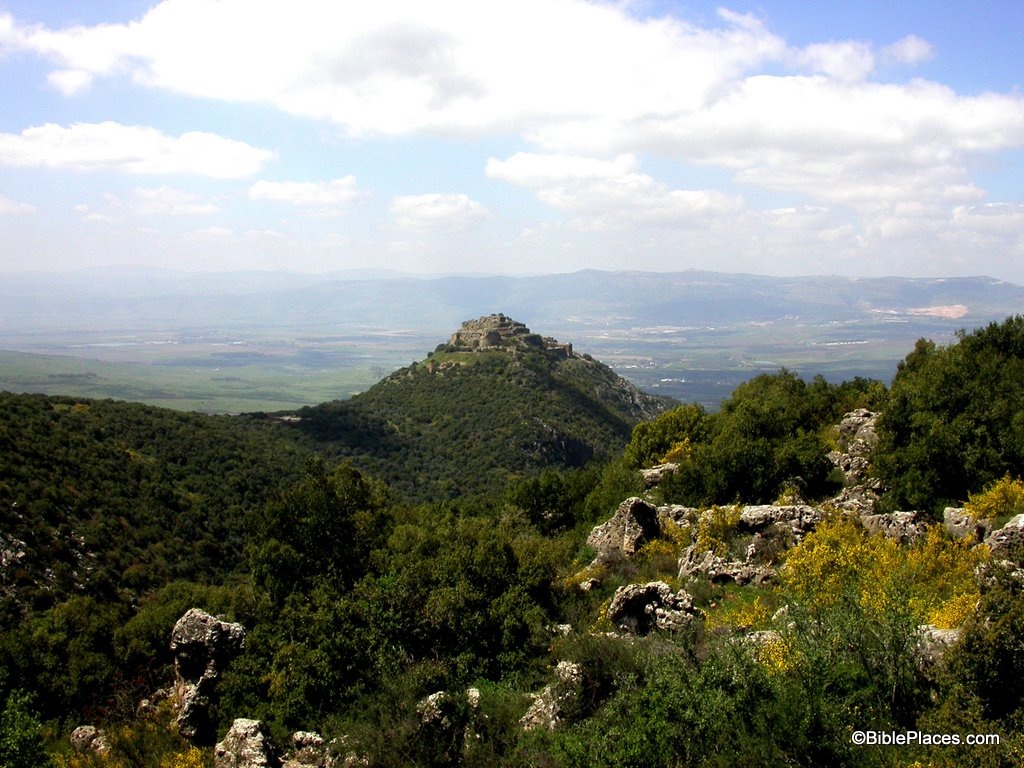
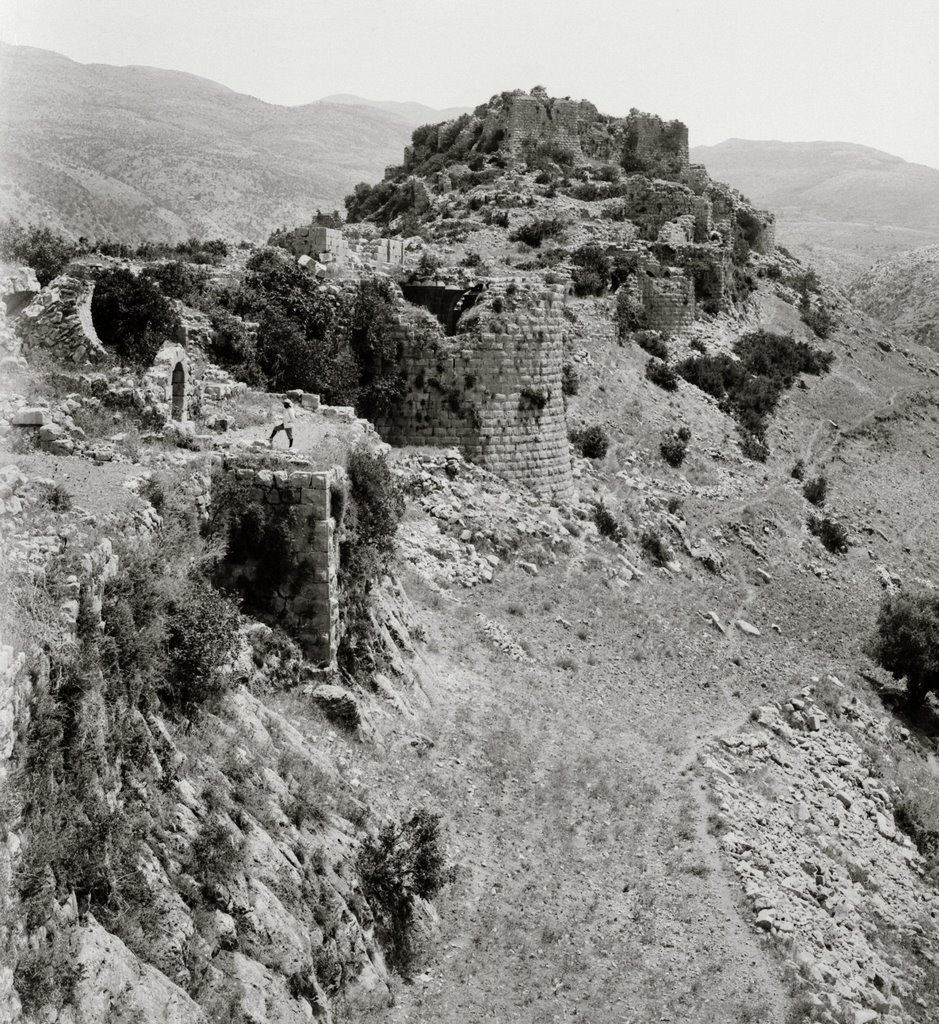
If I ever made a list of best places to visit in Israel, the site that would probably take the award for “best place to explore” would be Nimrod’s Castle.  Also known as Subeibeh and Banias Fortress, the castle on the slopes of Mount Hermon was long believed to be one of a string of Crusader castles found throughout the Levant.  More recent archaeological investigation has determined that the fortress was built by the Ismali’is (c. 1130) and then expanded by Malik el-Aziz Uthman (c. 1230). 

The Crusaders held the castle for a brief time, but they were not responsible for its initial construction or its later expansion.

Nimrod's Fortress from east, tb040903258

Nimrod’s Fortress from the east

Stephen Gabriel Rosenberg has written a good summary of the castle’s history and beauty in the Jerusalem Post this week. 

The best way to tour the extensive castle is to follow a path along the walls, which passes all sixteen towers, each one bearing a different, elaborate, stonework design. At first glance, the architecture looks to be styled by the Crusaders, but further examination reveals that the arches do not bear the vintage pointed, gothic trademark, and the lintels over the doorways have double corbels and decorated relieving arches, which is typical Arab style. However, obvious similarities inevitably exist given that Muslim work is contemporary with that of the Crusaders, and the locals clearly absorbed some of the fine French designs of their enemies.
Of the sixteen towers, the large, semi-circular structure on the southern wall – appropriately dubbed, the “Beautiful Tower” – is of particular note. The massive central pier is asymmetrical and octagonal, and reconciles the outer semicircle, composed of five sides, to the inner rectangular plan of three sides. The vaults from the pier to the outside walls, although now partly destroyed, reflect the complicated curved surfaces that had to be cut in stone to achieve the precise reconciliation between the curved and rectangular layout of the tower.
Visiting the site with children can be enormously enjoyable, given the many strange and interesting staircases, as well as the stepped, “secret passage” which serves as an exit on the west end. The passage was either an elaborate postern or hidden pedestrian entrance, and was uncovered by the Israel Antiquities Authority in 1994. Some of the towers, as well as the keep, have retained their original stone roofing, and from there one can appreciate the extensive view over the deep, adjoining valleys of the Sa’ar and Guvta wadis. Those who launched attacks against the fortress from these low points must have either been intensely brave or profoundly insane.

The full article is here

HT: Joe Lauer

Subeibeh, Nimrod's Fortress, mat01121

Nimrod’s Fortress, 1900-1920
Nimrod's Fortress view from keep, tb040903264View of Nimrod’s Fortress from the keep with Huleh Basin and mountains of Upper Galilee
Black and white photo from Northern Palestine CD, volume 1 of The American Colony and Eric Matson Collection. Photo: Library of Congress, LC-matpc-01121.  Color photographs from Galilee and the North CD of the Pictorial Library of Bible Lands.
Share:

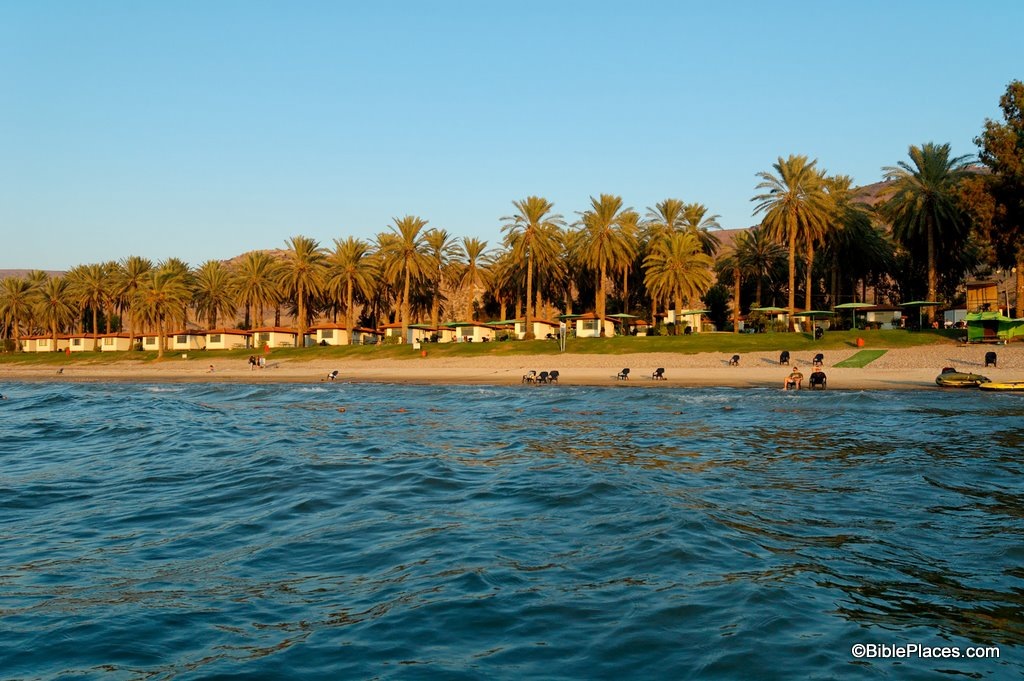
One of my favorite places in Israel is not visited by most tourists.  (Come to think of it, that’s true of most of my favorite places.)  I like tells and I love panoramic vistas.  But I also love to sit back, put my feet in the Sea of Galilee, and relax.  Give me a book or give my kids a raft and it’s all the better.  I’ve probably watched the sun set over the Sea of Galilee from here more than 200 times.

En Gev holiday village from Sea of Galilee, tb101105949ddd En Gev Holiday Village

The place is En Gev, and it hasn’t always been a beautiful holiday resort.  In biblical times, people were settled on the tell in the middle of today’s kibbutz.  Some have identified it as “Lower Aphek.” 

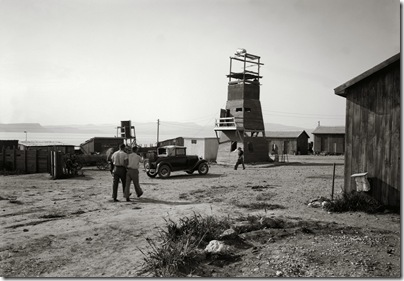
In the 1930s, courageous Jewish pioneers settled this uninhabited area with a “tower and stockade.” 

The compound became a kibbutz, and from 1948 to 1967 residents lived below the Syrian-controlled mountains of the Golan Heights.  Shelling was frequent and bomb shelters became bedrooms.  Since 1967, Israel has controlled the Golan Heights and Kibbutz En Gev has developed a flourishing tourist industry, including the holiday village, tourist boats, and fish restaurant. 

Ein Gev lookout tower with sea beyond, mat03684

En Gev settlement with watchtower. Date of photograph: 1934-39

As you drive along the eastern shore of the Sea of Galilee today, there is relatively little development.  One reason for that is the hostile conditions until 1967 and the uncertainty since then of the Golan Heights’ future. 

The second photograph is one of 600 high-resolution images in the newly released Northern Palestine CD, volume 1 of The American Colony and Eric Matson Collection. Photo: Library of Congress, LC-matpc-03684.

Share: