Noah Wiener has a follow-up article on the spring tunnel discovered in the Rephaim Valley. He includes a great photo of the tunnel.

Zachi Zweig disagrees with Leen Ritmeyer’s dating of the newly revealed course of ashlar stones on the Temple Mount. He dates it to the Early Islamic period.

A woman has turned over to the IAA a large collection of pottery discovered by a relative in the Mediterranean Sea.

The winter dig at Khirbet el-Maqatir began in the snow. They spent several weeks excavating three caves.

The ancient Myceneans once used portable grills at their picnics.

Archaeologists have discovered grain from the Neolithic period at Çatalhöyük.

The report for the 2013 excavation season at Tall el-Hammam is now online.

The first two volumes of NGSBA Archaeology are available for download. (NGSBA = Nelson Glueck School of Biblical Archaeology.)

Just published: The Oxford Handbook of the Archaeology of the Levant: c. 8000-332 BCE, edited by
Margreet L. Steiner and Ann E. Killebrew. Oxford University Press. 912 pages. $165.

Wayne Stiles explains how to make the maps in your Bible atlas fully searchable.

HT: Joseph Lauer, Tim Graham, Jack Sasson

Share:

(Post by Seth M. Rodriquez)

You can have Athens . . . I’ll take Corinth.

As I prepared to write another post on a site in Greece, I was drawn once again to Corinth. It is such a fascinating site in so many different ways: archaeologically, geographically, and biblically. After searching around for another site to write about (for the sake of variety) I’m throwing in the towel . . . Our picture of the week comes from Volume 11 of the Pictorial Library of Bible Lands and focuses once again on Corinth.

The picture below is entitled “Corinth bema and Acrocorinth.” The Acrocorinth is the tall mountain that rises in the distance. The bema (also called the “tribunal” or “judicial bench”) is the structure in the left half of the picture. It was a platform on which a judge would sit as the people brought their cases before him while standing in the plaza below. This is one of those rare places where we can say that a certain biblical event took place. This place of judgment is mentioned in Acts 18, when Paul was brought before Gallio.
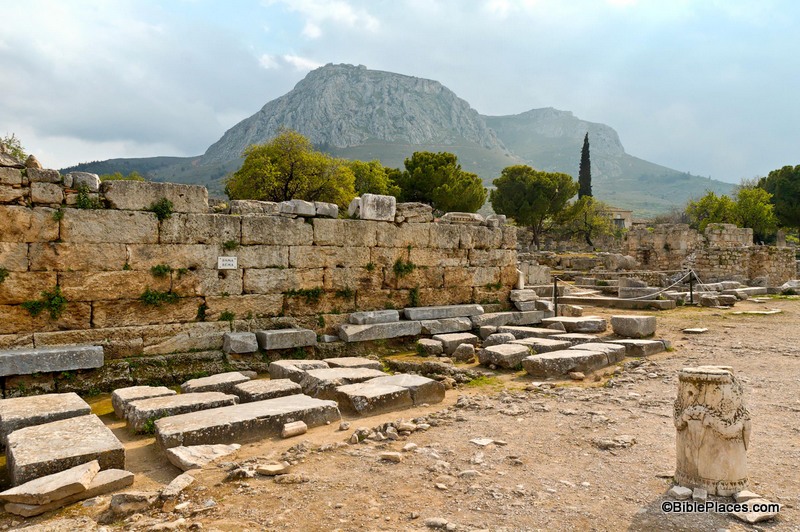
But when Gallio was proconsul of Achaia, the Jews made a united attack on Paul and brought him before the tribunal, saying, “This man is persuading people to worship God contrary to the law.” But when Paul was about to open his mouth, Gallio said to the Jews, “If it were a matter of wrongdoing or vicious crime, O Jews, I would have reason to accept your complaint. But since it is a matter of questions about words and names and your own law, see to it yourselves. I refuse to be a judge of these things.” And he drove them from the tribunal. And they all seized Sosthenes, the ruler of the synagogue, and beat him in front of the tribunal. But Gallio paid no attention to any of this. (Acts 18:12-17, ESV)

The PowerPoint® notes in the PLBL provides the following background information:

The Roman tribunal where Paul was dragged before Gallio has been uncovered in the center of the agora. This was the bema, where Roman officials would appear before the public…. Had Paul’s trial been more formal, it likely would have been held at the North Basilica instead of the Bema. In Christian times, a church was built atop the bema.

So we know where this trial (or would-be trial) took place, but the story doesn’t stop there. F. F. Bruce in his book, New Testament History, points out that this trial had particular significance in Paul’s ministry:

Sir William Ramsay regarded Gallio’s ruling as ‘the crowning fact in determining Paul’s line of conduct’, because it provided a precedent for other magistrates, and thus guaranteed Paul’s freedom to prosecute his apostolic mission with the assurance of the benevolent neutrality of the imperial authorities for several years to come. One thing at least is certain: if Gallio had given an adverse verdict against Paul, it would have been pleaded as a precedent by Paul’s opponents for the rest of his life; and a precedent established by so exalted and influential a magistrate as Gallio—a much more important personage than the politarchs of Thessalonica—would have carried great weight.  The mere fact that Gallio refused to take up the case against Paul may reasonably be held to have facilitated the spread of Christianity during the last years of Claudius and the earlier years of his successor.

Thus, this site can not only be tied to a biblical event, but it can be tied to a biblical event that is more significant than can be observed at first glance. The event that happened in this humble location helped determine how the rest of New Testament history played out.

This photo and over 800 others are available in Volume 11 of the Pictorial Library of Bible Lands and is available here for $34 (with free shipping). Other photos of Corinth and its surrounding territory can be found on the BiblePlaces website here and here. The excerpt was taken from F. F. Bruce, New Testament History (Garden City, NY: Anchor Books, Doubleday & Company, 1969), p. 317, and is available for purchase here.

Share:

If you want to see more of the Herod exhibit than the Israel Museum put online, you can watch a 13-minute video tour. The audio is in German, but everyone can get a feel for the displays.

A blogger on Forbes gives some of the tax history of the first four Dead Sea Scrolls.

If you have missed Chris McKinny’s recent series Secret Places, he will be back. He has been teaching an intensive course in Israel and is now supervising excavations at Tel Burna. You can follow the results there as he and others post on the day’s finds, beginning with Day 1 and Day 2.

It’s never occurred to me that the Hinnom Valley has been redeemed, but Wayne Stiles makes a case.

Luke Chandler’s blog hosts the world premiere of a new short film titled “Khirbet Qeiyafa: A Fortified City in the Kingdom of Judah.”

Some tourists are starting to return to Greece as the rioting subsides and the prices go down.

In fact, you can now book a tour of Greece with the Associates for Biblical Research. The 12-day trip in March 2014 will be led by Gordon Franz. The cost is $3199.

A Chinese tourist who left his mark on an Egyptian temple got in trouble.

Israel Today has a 2-minute video tour of Jaffa (biblical Joppa).

HT: BibleX, Alexander Schick

Corinth plain and excavations from Acrocorinth, tb050803135
Plain of Corinth from Acrocorinth
Photo from Pictorial Library of Bible Lands
Share:

Tom Powers has created a map identifying visible remnants of the ancient aqueducts in Bethlehem.

“Thessaloniki’s Pompeii” will be preserved.

Israel Knohl speculates that a second Gabriel Stone may exist. The display of the first Gabriel Stone at the Israel Museum has produced a number of articles.

The Lowell Thomas Travelogues are now featured in an exhibit at Marist College in Poughkeepsie, New York.

A new exhibit open until July: Mapping the Holy Land: Cartographic Treasures from the Trevor and Susan Chinn Collection in the Israel Museum.

A video of Aren Maeir’s recent lecture on Gath at William Jessup University is now available along with his PowerPoint presentation.

“Issa is the Name, Basketball is the Game” – If you’ve seen the signs in the Old City and wondered what the story was, this article explains it all.

HT: Charles Savelle, Joseph Lauer, Jack Sasson

Issa is the Name, Basketball is the Game, sign in Old City, tb010310723
“Issa is the Name” sign in the Old City
Photo from “Signs of the Holy Land
Share:

The Israel Prize for the Land of Israel, Geography, and Archaeology “will not be given because the prize committee attempted to award it to two candidates, in violation of ministry rules which state that each prize may be given to only one winner.”

The Garden Tomb is now suggesting a $5 donation.

The Bible Lands Museum Jerusalem is recommended for children, according to this article in Haaretz.

A couple of Russian tourists climbed to the top of the Great Pyramid and took some photos.

Ted Weis (Living the Biblios) has written a Garden of Gethsemane Devotional and illustrated it with a number of helpful photos.

New excavations at Ur in southern Iraq have revealed a palace or temple.

David Amit, deputy director of the Excavations and Surveys Department of the Israel Antiquities
Authority, died last week.

The Vatican has asked Israel’s Chief of Police to protect Christians in Israel after criminals halted restoration work of the chapel in Nain.

Jerome Murphy-O’Connor’s new book, Keys to Jerusalem: Collected Essays, is reviewed by Joshua Schwartz in the Review of Biblical Literature.

The commercial heart of the ancient city of Thessalonica is in the way of a new subway station and
that’s a big problem.

Give SourceFlix two minutes and they’ll give you “Passion Week Archaeology.”

HT: Jack Sasson, Explorator

Garden Tomb at night, tb123005430
The Garden Tomb in Jerusalem
Photo from the Pictorial Library of Bible Lands
Share:

This is a series I should have done on this blog. But BibleX has done it first and quite well: Picture Taking Tips for the Holy Land, Part 1, Part 2, and Part 3. Thank you, Dr. Savelle.

The Shephelah is a great place to live. The ancients knew it and now modern people are catching on.

That’s bad for those who care about the preservations of ancient sites, as Luke Chandler explains in his well-illustrated post, Khirbet Qeiyafa to be Enveloped by City Expansion.

Beth Shean—A Place for Happy Explorers: Check out the photos, the video, and the city’s lingering lesson.

“Huge flocks of synchronized starlings that appear like a black cloud returned to Israel last year for the first time in 20 years.” This free Haaretz article includes impressive photos.

Jerusalem Online has a 4-minute video on The Search for Herod’s Grave. You can read the transcript at the same link.

The ancient Corinthians liked to feast, a fact confirmed by the recent excavation of more than 100,000 bones excavated in the abandoned theater.

The Guardian reports on Turkey’s on-going efforts to blackmail museums around the world.

For more, check out the Archaeology Weekly Roundup at the ASOR Blog.

HT: Joseph Lauer, Jack Sasson

Beth Shean aerial from northeast, tbs118210011
Beth Shean aerial from northeast.
Photo from Samaria and the Center.
Share: