Plans to reconstruct Herod’s tomb at the Herodium have been scrapped.

The same article reports that the Herod exhibition at the Israel Museum has been extended to January 2014.

Tuesday’s Samaritan Passover ceremony is described in a Haaretz article. (I believe the first photo caption is wrong, for the animal is not slain until sunset.)

105 million euros is not enough to save Pompeii from deterioration, according to a New York Times video.

Ferrell Jenkins is back in Israel and he recently spent a morning with Shmuel Browns.

The Spring 2013 season at Tel Burna is over and they have found evidence of a destruction in the 9th century. There are still a few days left to sign up for the summer season.


Haaretz’s “Tourist Tip #218” describes the significance of the Broad Wall of Jerusalem.

The temporary bridge to the Mughrabi Gate next to the Western Wall still stands, but next month a committee is going to meet in Paris to discuss its replacement.

FoxNews reports on apps for archaeology.

Berlin’s Pergamon Museum has a new exhibition on the Mesopotamian city of Uruk. Better photos are available here.

Christianbook.com is now selling The New Interpreter’s Dictionary of the Bible (5 vols.) for only $99.99. (That’s 75% the $400 list.)

A rare, original set of the 13 volumes of the Survey of Western Palestine has just been listed by a UK bookseller for $6,400. For $35 more, you can pick up a digital copy of the oversized maps.

HT: Jack Sasson
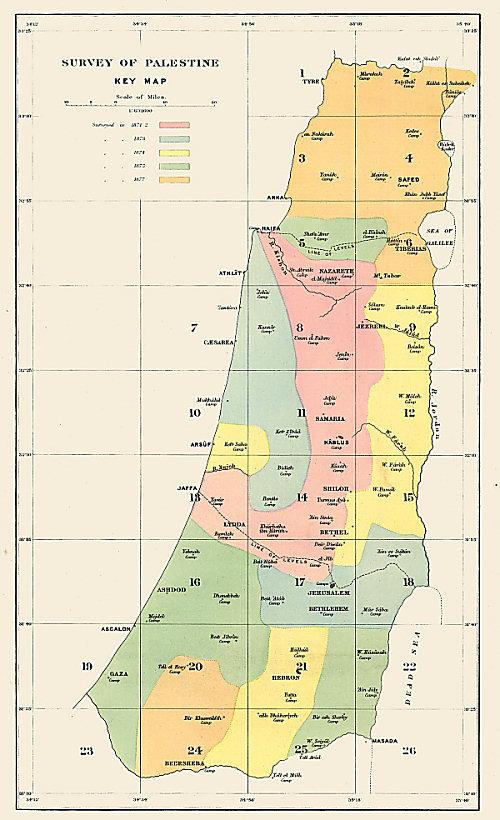
Key Map for the Survey of Western Palestine. All 26 maps (plus one from Transjordan) are for sale here.
Share:

From Arutz-7:

Jewish groups held a mock Passover sacrifice on Thursday opposite the Temple Mount in Jerusalem. The ritual slaughter was not merely a historic reenactment, but, they say, practice in advance of the reconstruction of the Temple. The practice sacrifice has been held annually for the past several years. This year organizers were unpleasantly surprised by a veto from Israel’s Veterinary Services, which refused to authorize the event. Organizers took the matter to court, and were able to quickly get a ruling permitting the ritual. The various groups involved in the event were represented by Rabbi Yehuda Glick, who told Arutz Sheva that the ritual was carried out with as much Biblical accuracy as possible. “We took the goat, as the Torah commands, we had an altar built like the real one, and a cooking pit built according to halacha [Jewish law],” he said. “We slaughtered the goat with Leviim singing and priestly clothing, just like in the real Passover sacrifice.”

The full story includes a one-minute amateur video. Another video from a similar service several years ago was produced by SourceFlix.

Share:

Religion News Service has begun a few feature called “Ask the Experts” and the first edition is focused on Christmas. They ask half a dozen scholars to weigh in on the following questions. I provide responses to three questions.

  • Why do some Christians celebrate Christmas on January 7th?
  • Why do we repeatedly hear about the “three wise men,” when biblical scholars tell us there were in fact many magi who attended Jesus after his birth?
  • Why did Mary and Joseph have to go to Bethlehem? How did civil authorities determine which town people had to report to at census-taking time?
  • Is it true that the word translated “inn” – kataluma – could also mean guest room? In other words, could Mary and Joseph been seeking shelter in relative’s guest rooms, rather than at the inn?
  • How was the birth of Christ celebrated before Constantine?
  • Is it true that most Christian churches did not celebrate Christmas in significant way until about a hundred years ago?
  • Is it true that department stores were the ones that started many of the traditions that we celebrate today?

The statement that Bethlehem was not on a major road is wrong. Bethlehem is located along the central ridge of the hill country and virtually everyone traveling to Jerusalem from the south would have passed by it. For more about the kataluma issue, see my previous post here.

Read all of the questions and answers here.

Shepherd with flock near Bethlehem, mat06290
Shepherd with flock near Bethlehem.
Photo from
The American Colony Collection.
Share:

If you’ve ever wondered which way Joseph and Mary traveled to Bethlehem or how the Magi were able to flee without Herod chasing, you should listen in tomorrow to the broadcast of The Land and the Book. Hosts Charlie Dyer and Jon Gauger interview me on the background of the familiar Christmas story.

It’s beginning to look a lot like Christmas…or so goes the song! From the music on the radio to the decorations in store windows, it’s hard to miss the fact that Christmas is almost here. But what would it have been like for Mary and Joseph that very first Christmas? If we could somehow go back in time, what would the sights, sounds and smells of that first Christmas season have been like? We don’t have a time machine here on The Land and the Book, but we have the next best thing…someone who has lived in the land of Israel and who knows it like the back of his own hand. We’ll be talking with Todd Bolen about what it would have been like for Mary and Joseph that first Christmas season.

You can find more details and a link for listening live on the Moody Radio website.

TheLandTheBook_Banner_Final
Share:

Vandals spray-painted anti-Christian graffiti on the Dormition Abbey church. UPDATE: The graffiti was near the Dormition Abbey, just outside Zion Gate on the door of the Franciscan Convent.

Haaretz has a photo. (Thanks, Dina.)

Israel and Jordan are planning to work together to rehabilitate the Jordan River.

The case for the authenticity of the Gospel of Jesus’ Wife is getting weaker.

Aren Maeir posts an archaeological note relating to Sukkot.

If you’re interested in historical fiction set in the life of the early church, The Scribes is currently free for Kindle.

The problem with blackmail is that it never stops, even between governments and world-class museums.

How is the Messiah related to the feast of Sukkot? Wayne Stiles explains and illustrates.

HT: Jack Sasson

Man with four species during Sukkot at Western Wall, cd091006002

Sukkot prayers (photo source)
Share:

Today is Yom Kippur and I suggest you read Wayne Stiles’ lavishly illustrated article on the tabernacle and its significance for the Day of Atonement.

A full-scale replica of the Tabernacle stands in the very wilderness where Moses and the children of Israel wandered for forty years.
It is like entering a doorway to history—and viewing a picture of your salvation.
Reading the Tabernacle’s dimensions in Exodus 35-40 is so different from seeing them with your own eyes—and in the same wilderness where the Tabernacle stood (Exodus 40:34-38).
The realistic replica echoes of Yom Kippur—the Day of Atonement—when God forgave the sins of His people.

Read the full article here.

Tabernacle model from outside courtyard, tb030807084
Tabernacle replica at Timna Park
Share:
