The largest treasure of gold coins ever found in Israel was recently discovered in the harbor of Caesarea. Most of the coins date to the Fatimid period (ca. AD 1000). There’s a close-up of a well-preserved coin here. Seven high-res images are available here.

The Jerusalem Post has photos and a video of the recent snowfall in Israel. Record snowfall was recorded in Istanbul, and the snow was heavy in Lebanon and Jordan. Yahoo has more photos of Jerusalem here. And Shmuel Browns has some photos from his neighborhood in the German Colony.
Leen Ritmeyer suggests that some paving stones on the Temple Mount pre-date the Roman destruction.

The next stop for the Passages exhibit is the happy town of Santa Clarita, California.

Some of the Dead Sea Scrolls are coming to the California Science Center next month, along with the Jerusalem IMAX movie.

Ever wanted to volunteer in Israel? Wayne Stiles suggests 15 volunteering opportunities.

James Pritchard’s HarperCollins Atlas of Bible History is not the best atlas out there, but it’s currently only $3.99 for Kindle. As one reviewer notes, the text may be more useful on the screen than the maps.

This week on the Book and the Spade: Herod’s palaces and ancient olive oil, with Clyde Billington.

Ferrell Jenkins explains how Pilate used coins to promote the emperor cult.

Codex Vaticanus is now online.

Aren Maeir’s recent lecture at GVSU is now posted on Youtube.

Eric Cline will be lecturing at the Oriental Institute in Chicago next week.

Gabriel Barkay, Zachi Dvira, and others involved in the Temple Mount Sifting Operation are coming on a fundraising tour in April and May. Check out their blog to learn how you can arrange talks or dinners with them.

The Islamic State is reportedly looting ancient sites “on an industrial scale.” Some people are trying to stop it.

HT: Ted Weis, Joseph Lauer, Charles Savelle, Jock Stender

Gold coins discovered in Caesarea harbor
Photo copyright: Clara Amit, courtesy of the Israel Antiquities Authority
Share:

A new “Rosetta Stone” has been discovered near Alexandria, with the text written in hieroglyphics and demotic script.

One hundred prehistoric cultic sites have been studied in the Eilat Mountains. The academic article on which the news story is based is available on academia.edu. And there are more photos here.

Roman-period mosaics have been discovered in an illicit excavation near Kerkenes, Turkey.

An unlooted Mycenean tomb has been excavated in central Greece from about 1200 BC.

The air pollution (aka “dust”) in Israel and the Middle East was extremely high this past week. Daily
Mail has some amazing photos and Exploring Bible Lands cites a relevant verse. Carl Rasmussen explains the positive effect.

The dust storm was followed by a snow/rain storm (with video). This storm exposed a large Byzantine storage jar on the beach of Yavne-Yam (with photo).

Since you’re reading this, you’re already familiar with one of the 5 Holy Land Blogs You Should Follow, by Wayne Stiles, but you may not be aware of all of the other ones.

Ferrell Jenkins is taking a closer look at Herod’s temples, beginning with the one at Caesarea Philippi (or better, Omrit?) and continuing with Caesarea on the Sea. Both posts are well illustrated.


The New York Times reports on questions about the origins of tablets from the Jewish exiles in Babylon now on display in Jerusalem.

An article in The Jewish Week describes some of what George Blumenthal has done to bring the world of biblical archaeology closer to all of us.

Which popular movies were filmed in Israel? Which ones were not? Those in the former category include “Exodus” and “Schindler’s List.” A longer list is available in this premium article at Haaretz.

Flames of Rome, by Paul L. Maier, is on sale for Kindle now for $1.99. This covers the period after Pontius Pilate and is also recommended if you like historical fiction from biblical times.

Just published: Robert Alter’s Strong As Death Is Love: The Song of Songs, Ruth, Esther, Jonah, and Daniel.

#5 on our list of Jerusalem favorites is Hezekiah’s Tunnel. The top four are coming on Monday on Twitter and Facebook.

HT: Jay Baggett, Charles Savelle, Agade, Joseph Lauer

Share:

From the Israel Antiquities Authority:

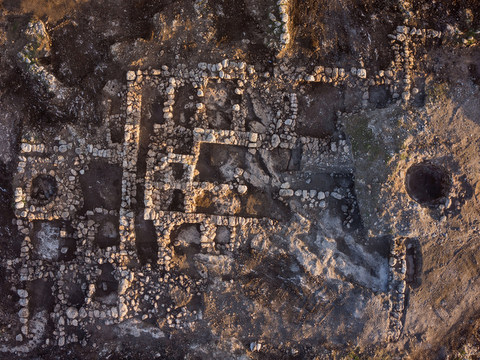
An impressive farm house, 2,800 years old, which comprised twenty-three rooms, was exposed in recent weeks during archaeological excavations the Israel Antiquities Authority is carrying out in Rosh Ha-‘Ayin before the city is enlarged in an initiative by the Ministry of Construction. According to Amit Shadman, excavation director on behalf of the Israel Antiquities Authority, “The farm, which is extraordinarily well-preserved, extends across an area of 30 × 40 m and was built in the eighth century BCE, the time of the Assyrian conquest. Farm houses during this period served as small settlements of sorts whose inhabitants participated in processing agricultural produce. The numerous wine presses discovered in the vicinity of the settlement indicate the wine industry was the most important branch of agriculture in the region. A large silo, which was used to store grain, shows that the ancient residents were also engaged in growing cereal.”
According to Shadman the building continued to be used during the Persian period (also known as the Time of the Return to Zion) in the sixth century BCE, and in the Hellenistic period as well which began in the country with the arrival of Alexander the Great, one of the greatest military leaders of antiquity. With Alexander’s victory over the Persian army in 333 BCE he embarked upon numerous successful military campaigns. His campaign in Israel did not encounter any special difficulties and the country opened its gates to the great warrior.
[…]
In light of this impressive building’s excellent state of preservation, the Israel Antiquities Authority and Ministry of Construction decided to conserve the structure in situ for the benefit of the city’s residents and the visiting public.

The full press release is here. The story is also reported by the Jerusalem Post. Rosh HaAyin is near the biblical city of Aphek mentioned in 1 Samuel 4:1.

An aerial photograph of the farm house. Photographic credit: Skyview Company, courtesy of the Israel Antiquities Authority
Share:

A reporter visited the Kishle in Jerusalem on its recent opening. The article includes a nice photo and an audio version.

Portions of Jerusalem’s Decumanus have been uncovered near Jaffa Gate.

Leen Ritmeyer notes new building violations on the Temple Mount.

The Temple Mount Sifting Project is seeking volunteers who can assist them in raising money through crowd-funding.

Why should Jews and Christians be denied from praying on the Temple Mount while Muslims are
allowed?

“There is a little corner of Jerusalem that is forever India. At least, it has been for more than 800 years…”

The latest SourceFlix video short: Biblical Cities – From the Air.

A Palestinian archaeologist is claiming to have discovered the church where the martyr Stephen’s bones were buried. The site is near Ramallah (10 miles north of Jerusalem), and the claim is based on an inscription not shown in the article. Perhaps some Byzantines were trying to capitalize on the tourist trade, just as they plan to do to the site in the future.

A fortified site from the time of Persia’s conquest by Alexander the Great has been excavated near
Israel’s border with Gaza.

The laborers at the copper mines in the Timna Valley ate well, according to an analysis of bones from Slaves’ Hill.

Luke Chandler has a report on Yosi Garfinkel’s recent lecture on Khirbet Qeiyafa, including word on two more inscriptions.

Tourism in Israel was down 33% in October from the previous year.

If you can use financial help to excavate next summer at Tel Burna, check out this scholarship opportunity.

Ferrell Jenkins shares a beautiful photo of Mount Arbel and the Sea of Galilee.

HT: Ted Weis, Charles Savelle, Joseph Lauer, Keith Keyser

Share:

A replica of Solomon’s Temple has now opened in Sao Paulo. But since it has the capacity to seat 10,000 people (and Solomon’s could seat exactly zero), one has to wonder in what sense it is a “replica.” This Forbes article has more info and a computer image. Google has more images.

Results of excavations at Tell Jemmeh in southern Israel from 1970 to 1990 have now been published.

G. M. Grena shares a list of lectures and abstracts of interest from the ASOR 2014 meeting in San Diego in November.

Wayne Stiles highlights some ancient tombs in Israel that you can visit.

Bible History Daily has a roundup of articles related to summer excavations.


The Times of Israel has a good collection of photos of mosaics from the Huqoq synagogue.

The NY Times has more on the destruction of the tomb of Jonah in Iraq.

ArtDaily: “Scientists at the Penn Museum in Philadelphia have re-discovered an important find in their own storage rooms, a complete human skeleton about 6,500 years old.”


Haaretz runs a profile on 5,000 years of strife in Gaza: “Gaza’s history reads like an encyclopedia of misery – war, destruction, earthquakes, plagues and floods. It has been destroyed and rebuilt, conquered again and again. But it also enjoyed periods of prosperity, when pagan, Jew and others lived together in harmony.”

Last call for the lowest price on Logos’ Archaeological and Theological Studies of Jerusalem (10 vols.) Some of the works I’m not familiar with, but the two Warren volumes are classics. The  more
who order, the lower the price goes for all of us.

I recommended ScrollTag several years ago, but if you missed it then, you should check it out now.

The program now includes the Trainer, a unique tool that will help you learn (and remember!) Greek
and Hebrew word forms. The package price is a great deal.

HT: Jack Sasson, Charles Savelle

Tell Jemmeh and Nahal Besor view northwest, tb050701349
Tell Jemmeh and Nahal Basor
Photo from the Pictorial Library of Bible Lands,
volume 5
Share:

SourceFlix has a new video with fly-overs of nine important biblical sites.

A Nebuchadnezzar Cylinder recently sold for $605,000. (That’s an interesting number given that Nebuchadnezzar came to the throne in 605 BC.)

BibleX shares a report from the 1880s of a visit inside the traditional house of Simon the Tanner.

Robert Mullins is on The Book and the Spade this week discussing the recent season of excavations at Abel Beth Maacah.

That recently discovered Iron Age gate at Lachish is neither a gate nor is it from the Iron Age. Luke Chandler explains.

Ferrell Jenkins explains the importance of the Tenth Roman Legion in Jerusalem, and he follows it up with a number of photographs.

Five haredim were arrested this week for attempting to block entrance to an excavation site near the Old City.

IAA Director General Yehoshua (Shuka) Dorfman died on July 31 after a long illness.

HT: Ted Weis

Jaffa, house of Simon the Tanner, mat06522
Interior of House of Simon the Tanner
Photo from Northern Palestine
Share: