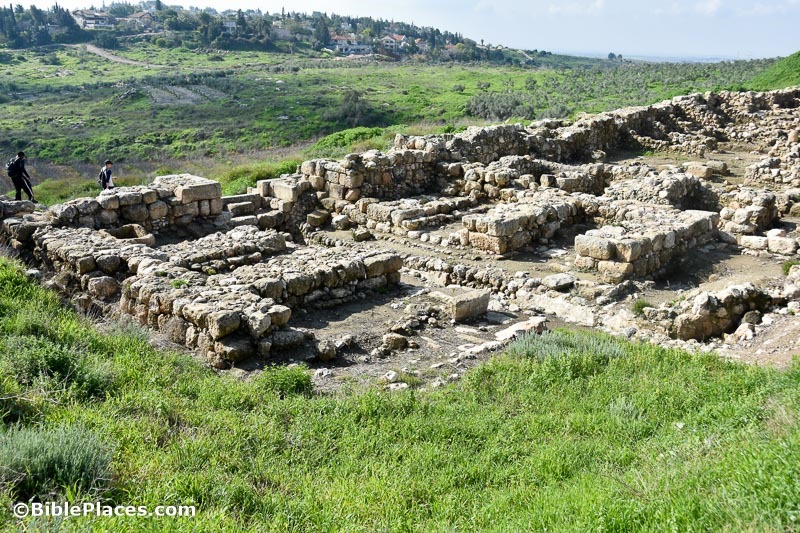
Archaeologists have uncovered the largest Early Bronze city in Israel. The site of En Esur is 160 acres in size and is located 7 miles (11 km) east of Caesarea.

A lengthy inscription discovered at Pompeii in 2017 has been translated. It describes a “massive coming-of-age party for a wealthy young man.”

In the ruins of the ancient Hittite capital, there is a large, beautiful green rock that is a mystery to archaeologists and visitors.

Christopher Rollston is using multispectral imagery to study ostraca discovered at Macherus in 1968.

“The British Library, the largest national library in the world by number of items cataloged, has for the first time ever put some of its rarest and most ancient religious texts online for the general public to be able to access them from around the world.”

In a 2015 article for a special edition of the BBC History Magazine now published online, Aren Maeir identifies 10 key discoveries from the Holy Land. (It seems to me to be cheating for one of those to be “the discoveries of Jerusalem.”)

A portion of the Istanbul Archaeology Museums has reopened after years of renovations.

250,000 objects from the Louvre will be moved over the next four years to a non-public storage facility in northern France.

A student volunteer describes her experiences at Hazor in the last three years.

Wayne Stiles recently led a tour to Rome, and he shares some of his observations and reflections here.

JJ Routley argues that there is such a thing as Christian archaeology.

Bryan Windle has begun a new series of archaeological biographies, and the first subject is King Hezekiah.

The Getty Trust is devoting $100 million over the next 10 years to protect endangered historical sites around the world through dialogue and conservation.

If you would like to volunteer for a winter excavation in Israel, registration is now open for the February season at Timna.

A new survey is aiming to shed light on the Nabateans who lived in what is now Saudi Arabia.

The Wadi Shuʿaib Archaeological Survey Project (WSAS) is a new project in the area northwest of Amman, Jordan.

Bryan Windle has posted a resource review of the Photo Companion to the Gospels, with a focus on how he has used the Luke volume in his preaching.

HT: Agade, Joseph Lauer, Ted Weis, Keith Keyser, Explorator

Share:

Excavations in Alexandria have revealed a well-preserved mosaic floor from the Roman period.

An artificial reef and underwater museum is being created in the Red Sea waters of Aqaba from old military vehicles.

The Tetrapylon avenue at Aphrodisias will open soon, following the completion of excavations.

Egypt’s Ministry of Antiquities June 2019 Newsletter provides the latest updates.

Four ancient Babylonian tablets at the British Museum were apparently used to calculate the motion of Jupiter.

An exhibition of looted archaeological artifacts is now on display at the Capitoline Museums.

A man who made more than half a million dollars by selling to a museum an “ancient Egyptian figurine” he made in his garden shed is sorry.

Mastic, from the island of Chios (cf. Acts 20:15), is getting a fresh look as a possible super-drug.

In an excerpt from her new book, Sarah Parcak asks, “Will the future of archaeology not require moving dirt?”

Jimmy Hardin discusses the latest discoveries at Macherus on The Book and the Spade.

In the final post in his series on Paul’s shipwreck on Malta, Carl Rasmussen shares photos of a more likely place than the traditional bay.

HT: Joseph Lauer, Agade, Charles Savelle, Mark Hoffman, Steven Anderson, Explorator

Share:

Archaeologists working at el-Araj (Bethsaida?) are claiming that a Byzantine church they are excavating is the “Church of the Apostles.” The story is reported in Haaretz (premium); the excavation website has lots of photos.

The excavation season at Gath is over. Among this week’s posts is this one with their end-of-season photo shoot.

“A rare, very early rural mosque was unearthed during recent archaeological excavations in the southern Israel Bedouin city of Rahat.”

Excavations on Mount Zion have revealed a moat from the Crusader siege of Jerusalem in 1099.

“An unprecedentedly vast Neolithic settlement — the largest ever discovered in Israel and the Levant, say archaeologists — is currently being excavated ahead of highway construction five kilometers from Jerusalem

The University of Basel announced its possession of the oldest autograph of a Christian letter.

Researchers are studying the harbor technologies of Portus, the maritime harbor of Rome in the first centuries AD.

For the first time in decades, Egypt has opened the Bent and Red Pyramids of Dahshur to tourists.

Wayne Stiles draws spiritual lessons about closed doors from Paul’s second missionary journey.

New from Eerdmans: Scribes and Scrolls at Qumran, by Sidnie White Crawford

Now at the top of my wish list (but more difficult to acquire outside of Israel): Ancient Jerusalem Revealed: Archaeological Discoveries, 1998–2018, edited by Hillel Geva.

HT: Joseph Lauer, Ted Weis, Charles Savelle, Agade

Share:

Museums:

“Assyrians in the Shadow of Vesuvius” is a new exhibit at the National Archaeological Museum in Naples.

“Buried by Vesuvius: Treasures from the Villa dei Papiri” is now on display at the Getty Villa in southern California. The post discusses how the Getty Villa was designed after the Villa of Papyri.

“Last Supper in Pompeii” is a new exhibit opening later this month at the Ashmolean Museum.

A replica of the destroyed Lion of Mosul is going on display at London’s Imperial War Museum.

A major exhibition on Troy will open at the British Museum on November 21.

The Egyptian Museum, though losing much of its collection to the Grand Egyptian Museum, will undergo a three-year renovation with the hope of securing status as a UNESCO World Heritage Site.

A new exhibition on Tall Zira’a opened this week at The Jordan Museum.


Lectures:

Shahrokh Razmjou will be lecturing on “The Rise and Fall of Persepolis: A Wonder of the Ancient World” in London on July 23.

Twenty scholars will be speaking at the 22nd Annual Bible and Archaeology Fest in San Diego, November 22-24.


Tourism:

Jerusalem’s “Tomb of the Kings” will reopen to visitors for the first time since 2010, but the tombs themselves will be off-limits.

With restorations complete, Bethlehem’s Church of the Nativity has been removed from UNESCO’s list of endangered world heritage sites.

The Lahun Pyramid opened to the public for the first time last week.

Every year there’s a story that Carchemish will soon be opened to the public.

Babylon has been named a 2019 UNESCO World Heritage Site.

Adam Stewart Brown articulates well why you should visit the Holy Land.

HT: Joseph Lauer, Ted Weis, Charles Savelle, Agade, Explorator, Bill Krewson

Share:

A Seleucid fortress has been discovered off the shore of Dor (Haaretz premium).

Scott Stripling reports the progress in the Shiloh excavations in a series of recent videos (May 21, May 22, May 24, May 27, May 30).

A new visitor’s center has been opened at Caesarea in four reconstructed vaults underneath Herod’s temple. They are hoping to double tourism to the site in the next six years.

Sara Toth Stub writes about the oasis of En Gedi in a feature piece from the Archaeology magazine.

Archaeologists working in Cairo have discovered a temple from the time of Nectanebo I.

Archaeological researchers believe that they have discovered the baptistery in the Hagia Sophia that was used to baptize Byzantine emperors.

A large marble head of Dionysus has been discovered in excavations of the ancient forum in Rome.

Brent Seales is about to conduct his first scans of Herculaneum scrolls in nearly a decade.

Appian Media has announced their upcoming projects, along with a way to support them by becoming a member.

The Biblical Archaeology Society has a sale on The Sacred Bridge, marking the second edition down to $90.

The Book and the Spade pulls out of their archive a 1983 interview with Gabriel Barkay, shortly after he discovered the silver amulets at Ketef Hinnom.

Wayne Stiles has launched a new podcast, “Live the Bible.”

Omer Frenkel is a professional narrator who has made recordings of the Hebrew Bible over the last 14 years. Steven Anderson has created convenient playlists (in English).

HT: Agade, Joseph Lauer, Keith Keyser

Share:

Scientists have produced alcohol from ancient yeast excavated at four archaeological sites in Israel.

Aren Maeir is compiling a list of press reports and shares some of the video clips. One reporter offers a review.

After a Second Temple period burial cave in Jericho’s impressive necropolis was damaged by tractor work, hundreds of the bones were re-buried elsewhere.

Israel’s Supreme Court ruled that the identities of archaeologists working in the West Bank must not be released by the government.

A new entrance to the Tel Zafit National Park (the Philistine city of Gath) was dedicated this week. Aren Maeir shares lots of photos.

With temperatures in Israel soaring above 100 degrees F (37 C), wildfires are causing the evacuation of many communities in central Israel, including the Neot Kedumim Biblical Landscape Reserve.

Gordon Govier talks about Psalm 122 and the archaeology of Jerusalem on this week’s The Book and the Spade.

Peter Hessler tells the story of a how an Egyptian guard improvised in the early days of the Arab Spring to protect a site from looting.

Archaeologists working at Kirikkale in central Turkey have uncovered nine layers of Hittite ruins.

Ferrell Jenkins shares a favorite photo of the ancient Diolkos near Corinth.

Carl Rasmussen explains why early Christians very likely frequented places like the local thermopolium.

In a 20-minute video, David Moster shows what there is to see at the Museum of the Bible in Washington, DC.

Ferrell Jenkins explains why he thinks that “the two current volumes on Daniel and Esther may be the best.”

HT: Agade

Share: