Riccardo Lufrani counters the proposal of Amos Kloner that the tombs of St. Etienne were originally the resting places of the last kings of Judah. He essentially addresses the translation of Josephus’s “royal caverns.” He does not mention the fact of that these tombs are located in the midst of an Iron Age cemetery.
Zahi Hawass gives his side of the story and explains why he will not be going to jail. Hershel Shanks has a lengthy interview with Hawass to be published in the May/June issue of Biblical Archaeology Review and now online here. Shanks writes of his time with Hawass, “I found him confident, overbearing, domineering, brash and loud. But he was also sometimes reasonable and often even charming.”
A four-minute video gives some insight into the revived chariot races in Jerash (Gerasa), Jordan.
Italy has announced a major restoration of Pompeii, following the recent collapse of an ancient house.
Christians celebrated Palm Sunday in Jerusalem yesterday.
Bible Gateway has a complex graphic that illustrates the chronology and geography of events during the week leading to Jesus’ crucifixion. “Follow the lines in the chart to see at a glance what people were doing, where they were, and whom they were with at any point during the week.”
We wish a happy Passover to all of those celebrating this evening.
HT: Explorator, Jack Sasson, Carl Rasmussen
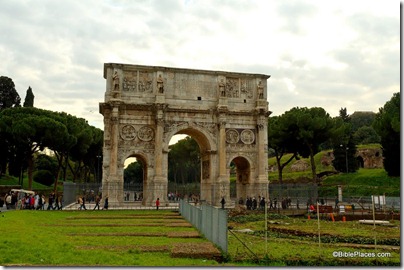 Arch of Constantine, Rome