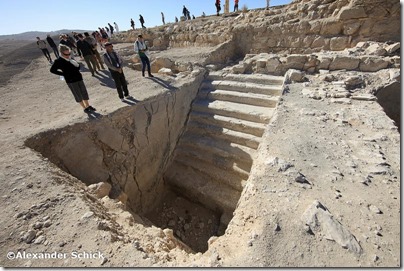
For photographs, sometimes timing is everything. A recent example of this comes from Alexander Schick’s visit to Macherus after the discovery of a large mikveh (ritual bath). He took this photo in November 2016.

Macherus mikveh Alexander Schick P 4971

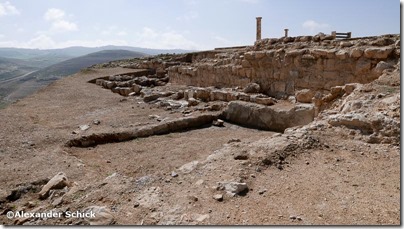
But he returned to the site a few weeks ago, and this is how it looks now.
Macherus mikveh filled in, Alexander Schick, P1030239
For reasons we can only speculate about (safety?, preservation?, anti-Jewish sentiment?), the mikveh has been filled in. Macherus is still a fantastic site to visit, but you won’t be able to see the ritual bath that its Jewish inhabitants used in the 1st century.
Share:

The first-ever issue of Biblical Archaeology Review without Hershel Shanks at the helm has been published. This annual excavation issue also includes articles on an ancient Jerusalem trash dump, Canaanite art at Hazor, and the Ketef Hinnom silver amulets.

Carl Rasmussen explains Paul’s walk from Troas to Assos with photos and a map.

A writer for The New York Times describes his visit to Alexandria.

A study shows that black ink from Egyptian papyri contains copper.

The Egyptian government is working on a bill to increase the penalty for smuggling antiquities to life imprisonment.

Police in Turkey have recovered over 26,000 artifacts from a smuggling ring in Istanbul.

The German Protestant Institute of Archaeology in the Holy Land (GPIA) has launched a new website for its project DOJAM – Documentation of Objects in Jordanian Archaeological Museums.   

The winter issue of the Oriental Institute’s News & Notes is online.

The ancients used meteoritic material in the forging of daggers, axes, and jewelry.

Rome will begin charging tourists to visit the Pantheon.

The New York Metropolitan Museum purchased a 14th-century illuminated Hebrew Bible before it was to be auctioned by Sotheby’s.

How did the 1917 Jerusalem surrender flag end up in Ohio?

William Dever, Carol Meyers, and Israel Finkelstein were among those receiving awards at the 2017 ASOR Annual Meeting.

LiveScience suggests some major finds in biblical archaeology in 2017.

Merry Christmas!


HT: Ted Weis, Joseph Lauer, Agade

Share:

Yehiel Zelinger discusses the excavations of Bliss and Dickie on Mount Zion and shares a great photo of his own excavations there. (I’d love to see a labeled version, if anyone knows of such or can create one…)

Archaeologists working in Turkey have uncovered evidence related to the collapse of the Assyrian empire.

The first phase of the renovation of St. Catherine’s Library is complete.

The BBC tells the story of the relocation of the modern inhabitants of ancient Gadara through its former security guard.

The third issue of the newsletter of Tel Aviv U’s Institute of Archaeology includes field reports from this year’s work at Ashdod-Yam, Kiriath Jearim, Beth Shemesh, and the City of David.

And now Hollywood gives us . . . Samson. (Whether you are interested in the trailer or not, click the link to see how archaeologist Aren Maeir keeps his volunteers in line.)

Ferrell Jenkins shares a beautiful aerial photo of Jerusalem from the west.

A writer for Haaretz (premium) asks, Why doesn’t Israel have a museum for Jesus?

LiveScience looks into the backstory of a bone that Oxford scientists believe comes from the real St. Nicholas.

The city of Nazareth has cancelled Christmas celebrations in protest of Trump’s decision to recognize Jerusalem as Israel’s capital.

Was the census that brought Jesus to Bethlehem a coincidence?

Among the specials for Accordance’s 12 Days of Christmas is the Biblical Archaeology Review (1975-2012).

We’ll have part three of the roundup tomorrow with another dozen stories.

HT: Ted Weis, Joseph Lauer, Agade, Mark Hoffman, Charles Savelle, Explorator, Chris McKinny,
Mike Harney

Share:

Egypt announced the discovery of two private 18th-dynasty tombs in Luxor yesterday.

Heath D. Dewrell provides an introduction to child sacrifice in Israel that is based on his recent monograph on the subject.

The Jewish Week interviews Lawrence Schiffman about his involvement with the Dead Sea Scrolls.

The Anglo-Israel Archaeological Society has posted its schedule of spring lectures.

Writing on Forbes, Sarah Bond suggests five ways to listen to the music of the ancient world.

With Germany’s refusal to recognize Israeli ownership of the Dead Sea Scrolls, the Israel Antiquities Authority is not allowing any scrolls to be part of a special exhibit at the Bible Museum in Frankfurt.

This week on The Land and the Book with Charlie Dyer: a discussion on Biblical Customs and Curiosities with George Knight.

Tel Lachish and Tel ‘Eton are the latest stops on the tour schedule of Israel’s Good Name.

Ferrell Jenkins shares a photo of a new scene he saw on his last visit to Bethlehem’s Church of the Nativity.

If you’ve ever wondered how an expert restores dozens of pottery sherds into an intact vessel, watch this short video.

Check out this site if you’re interested in touring southern Jordan on a bike. Or ride your bike 850 miles (1,400 km) in the Holyland Challenge from Mount Hermon to Eilat.

HT: Joseph Lauer, Agade, A.D. Riddle

Share:

Volume 8 of The Israel Museum Studies in Archaeology is available online. Several articles address a monumental Herodian Ionic capital from Jerusalem.

Detailed site plans and other materials from the Tell en-Nasbeh (Mizpah) excavations are now available online.

The exhibition “Nineveh – Heart of an Ancient Empire” has opened at the National Museum of Antiquities in the Netherlands.

The full lecture schedule for the Bible and Archaeology Fest XX has been posted.

Mount Nemrut in southeastern Turkey has attracted more than 50,000 tourists so far this year.

David Kennedy has identified nearly 400 mysterious ancient stone structures in Saudi Arabia using Google Earth.

“Is the Bible a True Story?” Nir Hasson wants you to think that there is “no evidence” for anything (Haaretz premium). Brent Nagtegaal responds here.

The September 2017 Newsletter of the Egyptian Ministry of Antiquities is online.

William Dever’s latest book, Beyond the Texts: An Archaeological Portrait of Ancient Israel and Judah, will be released on Friday.

Apparently there is a “Land of the Bible Park” in the Ramot forest near Jerusalem.

JewishPress.com reports on the excavations at Magdala. And Richard Bauckham is editing a book on Magdala (forthcoming fall 2018).

“Is there no balm in Gilead?” Wayne Stiles tackles this one.

HT: Charles Savelle, Agade

Share:

I’ve recommended Ginger Caessens’s study tour of Jordan in the past, and I’ve always received enthusiastic reviews from those who participated. Of course, I’m not surprised because I participated on this outstanding trip more than a dozen years ago.

The UHL website has all the details, including a full itinerary, but here’s the short version:

A ton of biblical history occurred in Jordan and if you don’t see it, you will miss it. There is no better program on the planet than that offered by UHL and taught by Dr. Caessens. If you want to see all the major biblical sites in Gilead, Ammon, Moab, and Edom, and you want to understand what you’re seeing, this is your trip. There are all kinds of people who go back to Israel their third, fourth, or tenth time and they’re not going on this trip, and I just don’t understand that. Maybe they just don’t realize that it was in the (modern-day) country of Jordan where:

  • Jacob wrestled at the Jabbok
  • The Israelites looked on the bronze serpent
  • The Israelites defeated the army of Sihon
  • Moses spoke the book of Deuteronomy
  • Moses viewed the land from Mount Nebo
  • Gideon pursued the Midianites
  • Jephthah fought the Ammonites (and then his daughter)
  • Ruth married Naomi’s son
  • Saul delivered the city of Jabesh Gilead
  • Uriah the Hittite died because of David’s treachery
  • David fled from his son Absalom
  • Ahab was killed by the Arameans
  • Jehoshaphat fought the Moabites
  • Jehu launched his coup
  • Elijah was born and later ascended into heaven
  • The prophets spoke against Ammon, Moab, and Edom
  • John the Baptist ministered and baptized
  • Herod Antipas beheaded John the Baptist
  • Jesus traveled through Perea

And I didn’t even mention the Medeba Map, Wadi Rum, or Petra.

You’re missing half of the story by not studying the east side of the Jordan River.

It’s worth your time, and it’s worth your money. Download an application here.

Amman citadel fortification eastern wall, tb031115005
The ancient citadel of Rabbath-Ammon where Uriah was killed
Share: