The Macherus article in the newest issue of Biblical Archaeology Review is quite good, especially with its reconstruction diagrams. A particularly impressive photo is the panoramic shot from Macherus showing Masada, Herodium, and Jerusalem. I was surprised to see the entire article available online this morning. If you don’t subscribe to the print edition, you have a brief chance to read it before it goes behind the subscription wall. An annual digital subscription to BAR is now available for $20. A 21-m-long sediment sample near the Dead Sea is providing scientists with information about the area’s climate in history. According to Thomas Litt, the results “clearly show how surprisingly fast lush Mediterranean sclerophyll vegetation can morph into steppe or even desert vegetation within a few decades if it becomes drier.” The level of the Sea of Galilee dropped more than two feet this summer. Carl Rasmussen has just added photos to his site of a place in Galilee I have not seen: Domus Galilaeae is a Roman Catholic retreat center overlooking the northern side of the Sea of Galilee. And his latest travel tip suggests an alternative viewpoint now that Arbel is controlled by Park Rangers and closes way too early. Wednesday marked the 200th anniversary of John Lewis Burckhardt’s visit to Petra. He was 27 when he re-discovered the Nabatean city for the western world on August 22, 1812. Gus W. Van Beek died this week. He was Curator of Old World Archaeology in the National Museum of Natural History, Smithsonian Institution and recent author of Glorious Mud! How in the world did the ancients ever move massive stones such as the trilithons in the Jupiter Temple of Baalbek that weigh more than 1,000 tons? Paleobabble answers that question with diagrams and translation from an older French article.
Trilithon in Jupiter Temple, Baalbek (photo from the Lebanon volume of the Pictorial Library of Bible Lands)
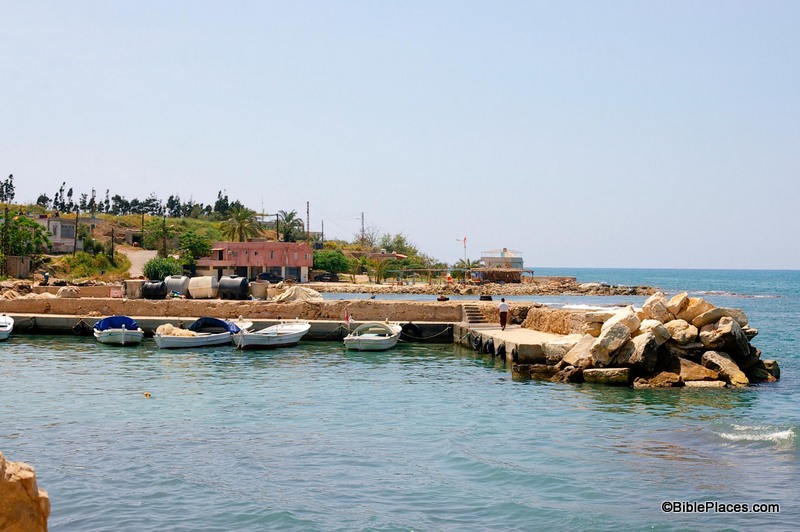
The Daily Star (Lebanon) reports on the continued excavations in the port city of Sidon.
Excavations led by a delegation from the British Museum at the Frères’ archaeological site in the old city of Sidon unearthed more important antiquities during their 14th year, it was revealed Tuesday.
Preparations also got under way for the construction of a museum to display the findings at the site. The construction is due to begin in September.
Discoveries at the site since excavations began in 1998 have revealed artifacts from the Early Bronze Age, which began around 3,000 B.C., through to the Iron Age, which covered around 1,200-539 B.C.
Among the latest discoveries was a particular type of Phoenician architecture, which the archaeologists said was not commonly found in Lebanon, consisting of stones cut for the construction of walls or floors.
Over 50 amphorae were also found, as well as a stunning Attic vase, depicting two riders going to war wearing white tunics and holding spears.
More details of the discoveries are given in the full story.
Sidon is mentioned many times in the Old and New Testaments. Some passages indicate that Sidon was intended to be the northern border of Israel (Gen 10:19; 49:13; Judg 1:31; 2 Sam 24:6), and in the days of Zerubbabel cedars were imported for the Second Temple (Ezra 3:7). Both Jesus and Paul visited the city or area of Sidon (Matt 15:21; Acts 27:3). Though prophets condemned the city (Isa 23:2-12; Jer 47:4; Ezek 28:21-22; Joel 3:4), Jesus declared that Sidon would fare better on the day of judgment than Chorazin and Bethsaida (Matt 11:21-22).
HT: Jack Sasson
- Tagged Discoveries, Excavations, Lebanon, Museums
In the 1920s, archaeologists had the chance to study remains underneath Al Aqsa Mosque. The findings of a Jewish mikveh, Byzantine mosaic, and other pre-Islamic items were not made public until recently. Nadav Shragai describes their importance and connects them with the discoveries made in the Temple Mount Sifting Project.
Shragai mentions in that same article that rebar and other construction material is now laying on the Foundation Stone, the holy rock inside the Dome of the Rock. Leen Ritmeyer has photos.
“The Palestine Archaeological Databank and Information System is now accessible openly without registration.”
The Tel Burna team has aerial photos showing the great progress they have made.
“The Church of the Nativity in Bethlehem on Friday became the first World Heritage Site to be listed under the name of Palestine.” (JPost)
Four caves in Mount Carmel with early evidence of human occupation were also designated as a World Heritage site.
The ESV Concise Bible Atlas is now available. The 64-page paperback sells for $10, and both size and price may be attractive to the weak and the poor. (See here for my comments on its big brother.)
John Monson is interviewed this week on the Book and the Spade, with attention given to his upcoming participation in the Khirbet Qeiyafa excavation and the shrines discovered there.
The widening of Highway 1 will slow down traffic from Tel Aviv to Jerusalem for many years.
Matti Friedman retells the story of the discovery of the Cave of the Treasure, a cache of more than 400 copper objects more than 5,000 years old.
“An ancient Phoenician port in Beirut dating back to at least
500 B.C. was destroyed Tuesday,” said archaeologists. There’s no port there, according to the
Archaeological Assessment Report.
The Day of Archaeology 2012 was yesterday, but posts will continue to be added for another week.
HT: Charles E. Jones, Jack Sasson
- Tagged Jerusalem, Judah, Lebanon, Resources, Shephelah, Temple Mount, Weekend Roundup
A miniature prayer box from the 6th-7th centuries was discovered recently in the excavations in the Central Valley south of the Dung Gate of Jerusalem.
Haaretz: “The High Court of Justice yesterday criticized the agreement by which a private association, Elad, operates the City of David national park in Jerusalem, but said the agreement was legal.” One potential change to the agreement would open the site to tourists on Shabbat. The Jerusalem Post covers the story here.
A local watchman of the lower Herodium sued archaeologist Ehud Netzer days before his death.
Recent court proceedings rejected all of the plaintiff’s claims and observed that the watchman had been extorting the archaeologist for years. The article is in Hebrew, with a Google translation here.
China will help build a railway to Eilat. Israeli officials hope that this boosts tourism to the Red Sea resort city.
Time Magazine gives five reasons to visit Beirut.
“The largest collection of biblical artifacts ever displayed outside Israel” opened yesterday in New York City.
Shmuel Browns gives readers a tour of the four sites run by the East Jerusalem Development Company: Ramparts Walk, Roman Plaza, Zedekiah’s Cave, and the Davidson Archaeological Park.
Joe Yudin recommends hiking to Ein Akev in the Negev Highlands. (Am I the only one offended that the Jerusalem Post publishes material with very basic mistakes in English grammar?)
Peter Williams’ lecture on “New Evidences the Gospels Were Based on Eyewitness Accounts” primarily discusses data from recent studies of names, but he also includes a geographical section in minutes 36-42 of this Lanier Library Lecture now posted at Youtube. (He shares a photo from BiblePlaces.com, but by using a low-res web version his viewers have a hard time making out what he’s trying to show.)
HT: Joseph Lauer, Yitzhak Sapir, A.D. Riddle
- Tagged Discoveries, Jerusalem, Lebanon, Lectures, Museums, Tourism, Weekend Roundup
Hershel Shanks asks whether it is legitimate for Eilat Mazar to speculate that her excavation has uncovered the palace of David. He invites readers to respond and I suspect there will be some good discussion. The editorial includes a drawing of the main wall of Mazar’s Large Stone Structure, a reconstruction which seems to me to be wishful thinking.
An article in Popular Archaeology explains why Nineveh must be preserved.
CNN reports on the challenges of protecting the cedars of Lebanon. The four-minute video report is accompanied by a story that gives the main points.
Fake Fake Metal Codices vs. Real Fake Metal Codices – Paleojudaica has the latest twists in the saga.
Wayne Stiles’ column on Hazor includes a video fly-over of the largest of ancient sites in Israel.
The price on the 16-volume collection of William M. Ramsay has come down from $30 to $20 in the last week. A few more orders will push the price down to $15 before the deal closes on Friday.
I was visiting a friend a few weeks ago and he observed that his out-of-print book now sells in the used market for over $200. I never thought I’d see my Jerusalem CD selling for $219 on Amazon.
(Note: it’s still only $25 at BiblePlaces.com.)
Crossway has posted a beautiful image of an open Bible with Jerusalem in the background. The publisher is using this image to promote the new ESV Study Bible, Personal Size, but teachers might find this image useful (click through for high resolution). I note that the Bible is open to the beginning of Psalm 48, but you must flip over one page in order to read some of my favorite words about Jerusalem:
Psalm 48:12–14 (ESV) — Walk about Zion, go around her, number her towers, consider well her ramparts, go through her citadels, that you may tell the next generation that this is God, our God forever and ever. He will guide us forever.
In Lebanon, just northeast of the city of Zahle, there is a small village named Karak Nouh. Karak Nouh is located in the Beqaa at the eastern foot of the Mt. Lebanon range. In a building adjoining the village mosque, there is a long sarcophagus draped in a green cloth. It is claimed this is the tomb of Noah.
Mark Twain wrote about his visit to Karak Nouh in The Innocents Abroad.
Noah’s tomb is built of stone, and is covered with a long stone building. Bucksheesh let us in. The building had to be long, because the grave of the honored old navigator is two hundred and ten feet long itself! It is only about four feet high, though. He must have cast a shadow like a lightning-rod. The proof that this is the genuine spot where Noah was buried can only be doubted by uncommonly incredulous people. The evidence is pretty straight. Shem the son of Noah, was present at the burial, and showed the place to his descendants, who transmitted the knowledge to their descendants, and the lineal descendants of these introduced themselves to us to-day. It was pleasant to make the acquaintance of members of so respectable a family. It was a thing to be proud of. It was the next thing to being acquainted with Noah himself.
There is another tomb of Noah in the city of Cizre, Turkey (pronounced Jizre). Cizre is on the Tigris River, north of the location where Iraq, Turkey, and Syria all meet. To the east is Cudi Dağ, identified as Mt. Ararat in some traditions.
Tomb of Noah, Cizre, Turkey.
Evidently, there is also a shrine to Noah name Hazrat Nuh in Kerak, Jordan. I have not visited this one, nor do I know if there is a tomb associated with the shrine. I believe the shrine is the small, turquoise building at the far left in this photograph. It is located in a cemetery on the northwestern edge of the modern town.
The BiblePlaces Blog provides updates and analysis of the latest in biblical archaeology, history, and geography. Unless otherwise noted, the posts are written by Todd Bolen, PhD, Professor of Biblical Studies at The Master’s University.
As an Amazon Associate we earn from qualifying purchases. In any case, we will provide honest advice.