A miniature prayer box from the 6th-7th centuries was discovered recently in the excavations in the Central Valley south of the Dung Gate of Jerusalem.

Haaretz: “The High Court of Justice yesterday criticized the agreement by which a private association, Elad, operates the City of David national park in Jerusalem, but said the agreement was legal.” One potential change to the agreement would open the site to tourists on Shabbat. The Jerusalem Post covers the story here.

A local watchman of the lower Herodium sued archaeologist Ehud Netzer days before his death.

Recent court proceedings rejected all of the plaintiff’s claims and observed that the watchman had been extorting the archaeologist for years. The article is in Hebrew, with a Google translation here.

China will help build a railway to Eilat. Israeli officials hope that this boosts tourism to the Red Sea resort city.

Time Magazine gives five reasons to visit Beirut.

“The largest collection of biblical artifacts ever displayed outside Israel” opened yesterday in New York City.

Shmuel Browns gives readers a tour of the four sites run by the East Jerusalem Development Company: Ramparts Walk, Roman Plaza, Zedekiah’s Cave, and the Davidson Archaeological Park.

Joe Yudin recommends hiking to Ein Akev in the Negev Highlands. (Am I the only one offended that the Jerusalem Post publishes material with very basic mistakes in English grammar?)

Peter Williams’ lecture on “New Evidences the Gospels Were Based on Eyewitness Accounts” primarily discusses data from recent studies of names, but he also includes a geographical section in minutes 36-42 of this Lanier Library Lecture now posted at Youtube. (He shares a photo from BiblePlaces.com, but by using a low-res web version his viewers have a hard time making out what he’s trying to show.)

HT: Joseph Lauer, Yitzhak Sapir, A.D. Riddle

Share:

Hershel Shanks asks whether it is legitimate for Eilat Mazar to speculate that her excavation has uncovered the palace of David. He invites readers to respond and I suspect there will be some good discussion. The editorial includes a drawing of the main wall of Mazar’s Large Stone Structure, a reconstruction which seems to me to be wishful thinking.

An article in Popular Archaeology explains why Nineveh must be preserved.
CNN reports on the challenges of protecting the cedars of Lebanon. The four-minute video report is accompanied by a story that gives the main points.

Fake Fake Metal Codices vs. Real Fake Metal Codices – Paleojudaica has the latest twists in the saga.

Wayne Stiles’ column on Hazor includes a video fly-over of the largest of ancient sites in Israel.

The price on the 16-volume collection of William M. Ramsay has come down from $30 to $20 in the last week. A few more orders will push the price down to $15 before the deal closes on Friday.

I was visiting a friend a few weeks ago and he observed that his out-of-print book now sells in the used market for over $200. I never thought I’d see my Jerusalem CD selling for $219 on Amazon.

(Note: it’s still only $25 at BiblePlaces.com.)

Crossway has posted a beautiful image of an open Bible with Jerusalem in the background. The publisher is using this image to promote the new ESV Study Bible, Personal Size, but teachers might find this image useful (click through for high resolution). I note that the Bible is open to the beginning of Psalm 48, but you must flip over one page in order to read some of my favorite words about Jerusalem:

Psalm 48:12–14 (ESV) — Walk about Zion, go around her, number her towers, consider well her ramparts, go through her citadels, that you may tell the next generation that this is God, our God forever and ever. He will guide us forever.

Share:

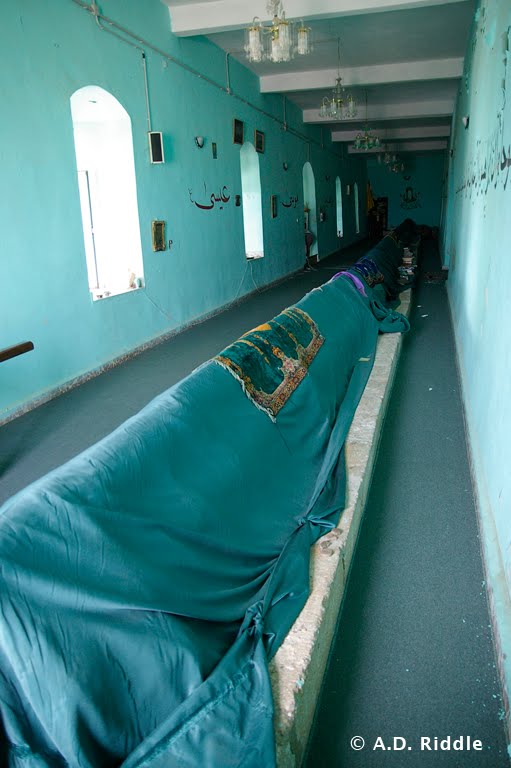
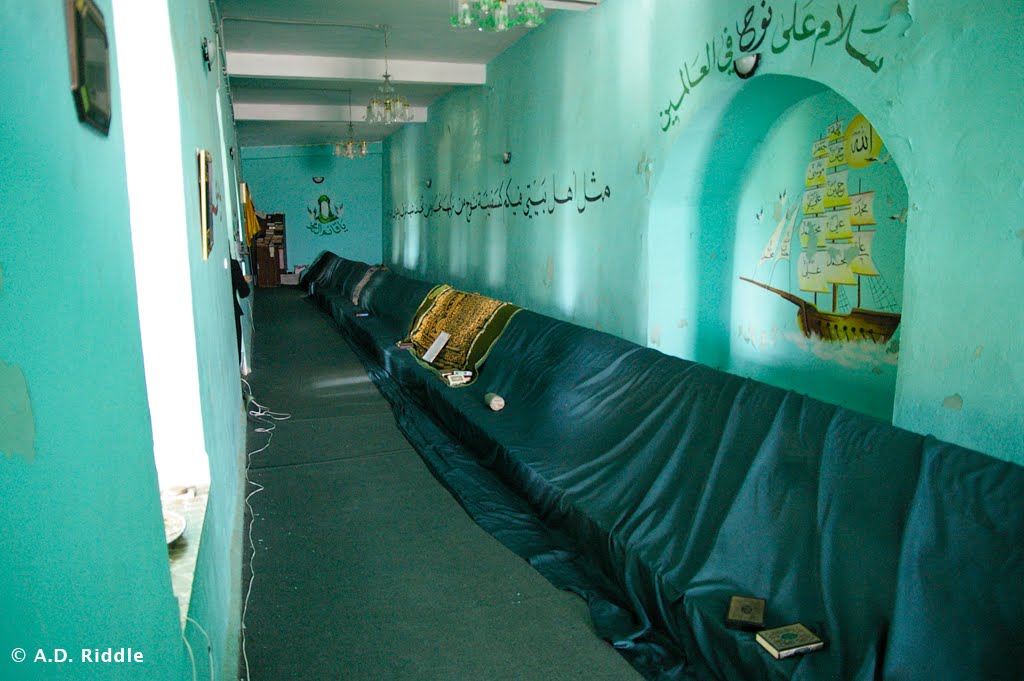
In Lebanon, just northeast of the city of Zahle, there is a small village named Karak Nouh. Karak Nouh is located in the Beqaa at the eastern foot of the Mt. Lebanon range. In a building adjoining the village mosque, there is a long sarcophagus draped in a green cloth. It is claimed this is the tomb of Noah.


Karak Nouh, Lebanon.

Mark Twain wrote about his visit to Karak Nouh in The Innocents Abroad.

Noah’s tomb is built of stone, and is covered with a long stone building. Bucksheesh let us in. The building had to be long, because the grave of the honored old navigator is two hundred and ten feet long itself! It is only about four feet high, though. He must have cast a shadow like a lightning-rod. The proof that this is the genuine spot where Noah was buried can only be doubted by uncommonly incredulous people. The evidence is pretty straight. Shem the son of Noah, was present at the burial, and showed the place to his descendants, who transmitted the knowledge to their descendants, and the lineal descendants of these introduced themselves to us to-day. It was pleasant to make the acquaintance of members of so respectable a family. It was a thing to be proud of. It was the next thing to being acquainted with Noah himself.

There is another tomb of Noah in the city of Cizre, Turkey (pronounced Jizre). Cizre is on the Tigris River, north of the location where Iraq, Turkey, and Syria all meet. To the east is Cudi Dağ, identified as Mt. Ararat in some traditions.

Tomb of Noah, Cizre, Turkey.


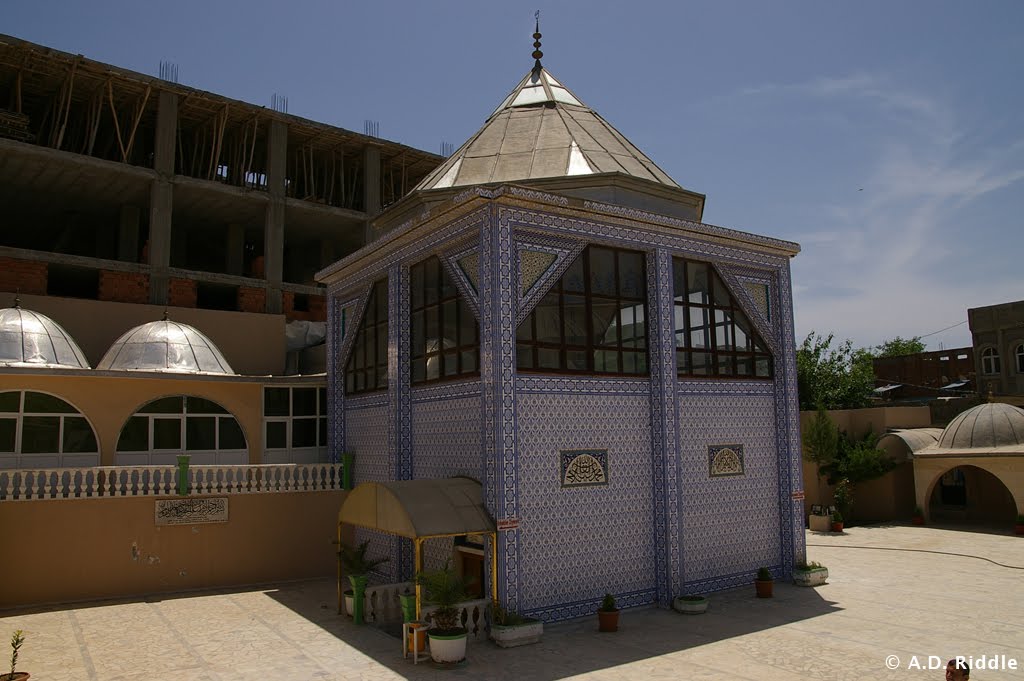
Evidently, there is also a shrine to Noah name Hazrat Nuh in Kerak, Jordan. I have not visited this one, nor do I know if there is a tomb associated with the shrine. I believe the shrine is the small, turquoise building at the far left in this photograph. It is located in a cemetery on the northwestern edge of the modern town.

Kerak, Jordan.

Share:

There are reports of bulldozer work being carried out on the Temple Mount.

Current excavations at Shiloh are noted in this Arutz-7 article.  The article itself says very little, but the photos indicate that the work is being carried out in Area C, where archaeologists previously uncovered a series of Iron I buildings (from the time of Samuel).

Israeli officials are denying claims that the Jordan River is so polluted it is unsafe for baptism.

A student recounts her experience in the final season of excavations at Tel Kedesh in the Upper Galilee.

The Daily Star (Lebanon) has an update on recent finds in the 12th season of excavations at Sidon.  A one-minute telecast in Arabic shows the work in progress and some of the finds.

Haaretz carries a longer story on how recent excavations of the Jaffa Gate have apparently changed everything.  There are some problems with the article, however, and you might wait to revise your book (or your class notes) until the excavators publish their report.  Take note, as well, of Leen Ritmeyer’s analysis of the article.

HT: Joe Lauer

Share:

The Abu Gosh hummus record stood for less than four months after Lebanon makes a ten-ton dish.  From the Jerusalem Post:

Lebanon launched a decisive retaliation on Saturday, in the campaign that Army Radio described as the Third Lebanon War. No Katyushas or Scuds crossed the northern border, but Lebanon served Israel a 10-ton blow in the competition for regional supremacy. Lebanon struck down Israel’s world record for the largest plate of humous on Saturday, in the village of Fanar, east of Beirut. About 300 Lebanese cooks prepared a batch of humous that weighed 10,452 kilograms, The Associated Press reported. A Guinness World Records adjudicator confirmed that Lebanon reclaimed the record. Lebanon accuses Israel of stealing traditional Arab dishes such as humous, and marketing them worldwide as Israeli. Saturday’s plate more than doubled the record set on January 8 by Jawdat Ibrahim, of Abu Ghosh. However, the competition’s not over. “No matter what happens I’m going to double it. I’m going to show who humous belongs to,” Ibrahim told The Jerusalem Post on Sunday. Ibrahim’s humous is made in the Abu Ghosh Restaurant that he opened in late 1992, single-handedly starting a dining trend that put his town on the national tourism map. He uses all Israeli chickpeas, grown on kibbutzim.

The rest of the story includes Ibrahim’s promise to reclaim the record before the year is out, along with his goal of using the contest to promote peace between Lebanon and Israel.

Share:

One of these days I’m going to get to Beirut, Lebanon.  Until then, I’m going to imagine that it looks just like this.

Beirut and St George's Bay, mat10591

Beirut and St. George’s Bay, probably in 1920s

J. L. Porter visited the city in the 1870s and wrote about it in The Giant Cities of Bashan and Syria’s Holy Places:  “The site of Beyrout is among the finest in the world. From the base of Lebanon a triangular plain juts into the sea, and round a little bay on its northern shore nestles the nucleus of the city, engirt by old walls and towers. Behind the city the ground rises with a gentle slope, and is thickly studded with villas of every graceful form which Eastern fancy, grafted on Western taste, can devise; and all embosomed in the foliage of the orange, mulberry, and palm. In spring time and summer Beyrout is beautiful. The glory of Lebanon behind, a mantle of verdure wrapped closely round it, fringed by a pearly strand; in front the boundless sea, bright and blue as the heavens that over-arch it. Such is Beyrout” (282).

The photo and quotation are both taken from the Lebanon, Syria, and Jordan volume of The American Colony and Eric Matson Collection (Library of Congress, LC-matpc-10591).

Share: