New excavations at Hyrcania have already turned up an inscription in Greek adapted from Psalm 86.

“A cave containing the remains of a young woman who was likely a courtesan during the Hellenistic period has been discovered near Hebron Road in Jerusalem, along with a well-preserved, rare bronze mirror.”

Gershon Galil claims that he has deciphered a fragmentary inscription from the time of Hezekiah that was discovered in Jerusalem forty years ago (Hebrew version here). (I wouldn’t recommend trusting Galil’s judgment on anything these days. So far the story is only covered by Ynet; if other outlets cover this, they will surely include responses from other scholars.)

Archaeologists have made new and interesting finds at the ancient submerged Egyptian city of Heracleion.

This one-minute video shows how cuneiform tablets were formed from clay and inscribed.

In the newest episode in the Flora & Faith series, Brad Gray explains the symbolism of the almond tree in Scripture.

The latest episode in “Faith Journeys with God in the Land” with John DeLancey was filmed at the Pool of Siloam earlier this year.

Erez Ben-Yosef was on the What Matters Now podcast to discuss his theory about the beginnings of the United Monarchy. The Times of Israel article includes a transcript.

Zoom lecture on Oct 5: “Maritime Viewscapes and the Material Religion of Levantine Seafarers,” by Aaron Brody ($13). Brody has written an article on the ASOR Blog on the same topic.

Zoom lecture on Oct 19: “Archaeology of Jesus’ Nazareth,” by Ken Dark. Registration required.

Biblical Archaeology Report has a rundown on the top three discoveries of the month.

Ferrell Jenkins shares some experiences and photos from his visits to Mount Nebo.

Sukkot, the Feast of Tabernacles, the seventh and final commemoration in the biblical calendar, begins today. TheTorah.com has an article on the etrog as the fruit of the tree of the knowledge of good and evil.

HT: Agade, Ted Weis, Joseph Lauer, Arne Halbakken

Archaeologists discovered a Second Temple period stonemason’s workshop near Jerusalem.

“A United Nations conference voted Sunday to list ruins of the ancient West Bank city of Jericho as a World Heritage Site in Palestine.”

The Temple Mount Sifting Project blog provides a glimpse into the difficulties of protecting the debris that is the focus on their study.

“The ongoing excavation of Horvat Midras/Khirbet Durusiya (Israel) provides an opportunity to study changes in the ethnic and religious makeup of a rural settlement in the ancient southern Levant.”

David Moster explains how tall the Jerusalem temple was by comparing it with other large monuments including the Dome of the Rock. He even found a classical-style building with very similar dimensions to Solomon’s temple.

Jerusalem Post: “Is the biblical ark of the covenant hidden in an Ethiopian church?”

Zoom lecture on October 24: “The Austrian Expedition to Tel Lachish 2017–2023,” by Katharina Streit and Felix Höflmayer.

Registration is open for next year’s excavation season at Shiloh.

HT: Agade, Joseph Lauer, Arne Halbakken

Middle Bronze gate at Gezer during reconstruction. Photo taken by John Black on Tuesday.

The Biblical Museum of Natural History in Beit Shemesh has a large collection of animal horns, but not all qualify to be used for the Feast of Trumpets.

A fire broke out at Tel Gezer yesterday, forcing the evacuation of some hikers.

Archaeologists are making significant discoveries in eastern Turkey underneath the Zerzevan Castle.

Turkish Archaeological News has a roundup of major stories in the month of August.

Archaeologists have uncovered new evidence related to the battle of Salamis.

Some people are not happy with a new wooden ceiling installed at the Karnak Temple.

Mohy-Eldin E. Abo-Eleaz writes about the harsh life of diplomatic messengers in Egypt in the Late Bronze Age.

The US returned to Lebanon a dozen looted artifacts valued at $9 million, including three from the New York Metropolitan Museum of Art.

The “Origins of Olive Oil” is the subject of the latest podcast on The Ancients.

The price for the 2023 Friends of ASOR Seminar, with many well-known speakers, has been greatly reduced.

Writing for Bible and Spade, David Spoede reviews the overwhelming archaeological evidence for the domestication of camels in the time of Abraham.

Michael Holmes explains why a newly published Greek fragment related to the Gospels is a big deal.

In the latest episode of Walking The Text, Brad Nelson explains how “understanding how a fig tree produces fruit clarifies exactly what’s happening when Jesus curses the fig tree.” The website includes discussion questions as well as resources for further study.

HT: Agade, Ted Weis, Arne Halbakken, Keith Keyser, Gordon Franz

The Times of Israel gives an update on Israel’s decade-long systematic attempt to survey and excavate the caves of the Judean wilderness ahead of looters.

Ruth Schuster writes about a new theory that the Buqeia Valley east of Jerusalem was occupied around the time of King Josiah by quasi-military herders. The article includes some beautiful photos of the area.

Haaretz summarizes a new article that “examines the archaeological and historical evidence for the existence of Jewish gladiators in the first to fourth centuries.”

The latest issue of Biblical Archaeology Review includes articles on Jerusalem’s Millo, Baal, and Constantinople.

Leen Ritmeyer writes about archaeological evidence for Jews in exile in Babylon.

“An ancient Roman statue believed to depict the daughter of the emperor Marcus Aurelius, and valued at $5 million, has been seized by New York officials.”

“A British auctioneer has pleaded guilty to numerous charges relating to the sale of rare ancient coins, including a hoard discovered by Palestinian fishermen.”

The synagogue that housed the Cairo Geniza has been completely renovated.

Chandler Collins has posted part 2 of his historical study of the excavations of the Stepped Stone Structure in Jerusalem.

The Anglo-Israel Archaeological Society has posted some lectures on their new YouTube channel, including:

New release: Excavating the Land of Jesus, by James Riley Strange (Eerdmans, $30). Phillip J. Long has a review here.

HT: Agade, Joseph Lauer, Arne Halbakken, Keith Keyser, Alexander Schick, Alexander Schick

Four Roman swords were discovered in a cave near En Gedi. Three are spatha swords, and all were likely stolen from Roman soldiers by Jewish rebels during the Bar Kochba revolt.

The swords were discovered incidentally while doing multispectral imaging on a 7th-century BC inscription in the cave. The new reading of the inscription may include the word “salt.”

An Israeli teenager discovered an bronze Roman ring at Sussita/Hippos.

i24News visits the “dig for a day” program in the caves of Bet Guvrin.

The German Protestant Institute for Archaeology will celebrate its 125th anniversary with a conference in Jerusalem on October 16-17.

Jordan Ryan is a guest on The Book and the Spade discussing the 2023 excavation season at Tel Shimron.

Abigail Leavitt shares a number of photos from her walk around the Old City of Jerusalem.

The IBEX program in Israel where I taught for some years is featured in the new issue of The Master’s University Magazine.

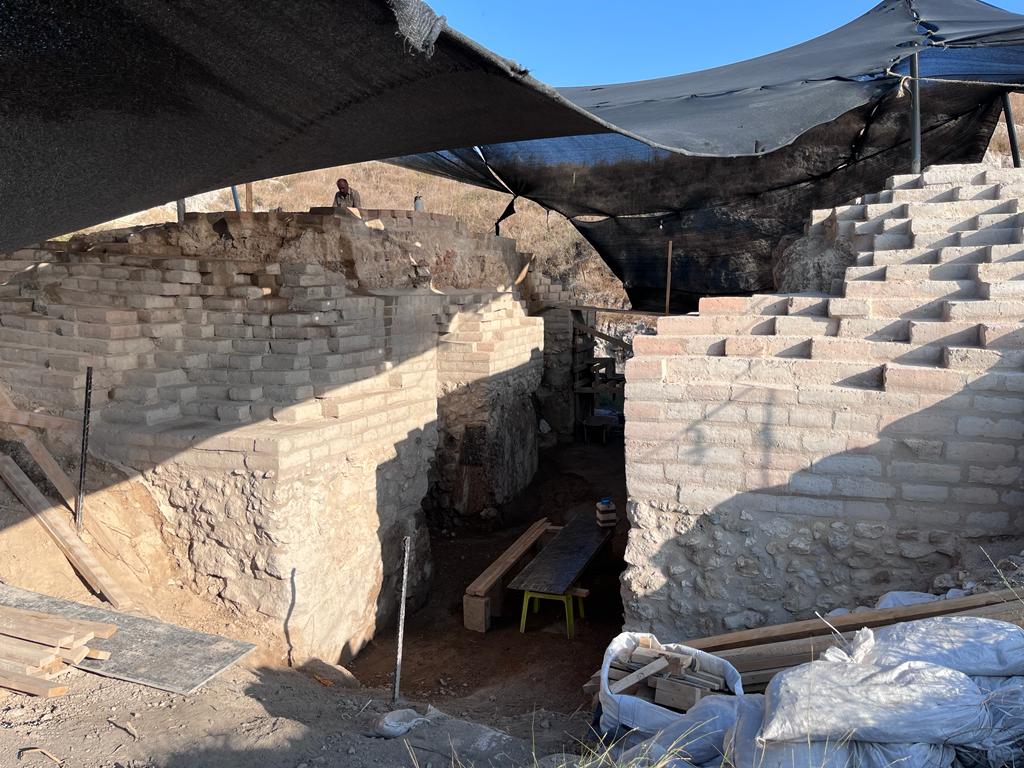
Was a major discovery related to the Pool of Siloam made this week? Some unreliable websites suggest something new was revealed. The regular sources seem to be ignoring it, though The Jerusalem Post has recycled this reporting, with a completely irrelevant photo. When you read beyond the headline, the claim is that eight steps were discovered. A comparison of the published photo with earlier photos suggests that a portion of the lowest flight of steps, previously partially revealed, has now been fully exposed along with a portion of the reservoir and walls within.

Pool of Siloam steps. The wooden boards are located on the second (of three) flight of steps, filling in gaps in preserved stones. Photo published with the news reports this week, courtesy of the City of David Foundation. Comparison with the photos below indicates that this was taken earlier this summer.

Pool of Siloam in 2006, with three flights of stairs. The lowest flight is not fully exposed.

Pool of Siloam last month, showing third flight of steps and on-going excavations in pool below the steps. Some walls appear to be visible within the pool. Photo by John Black.

Pool of Siloam on Wednesday, September 6, showing wall inside the area of the pool. Photo by John Black.

HT: Agade, Joseph Lauer, Arne Halbakken, Alexander Schick, Ted Weis, Gordon Dickson

Archaeologists working on Mount Zion have discovered, for the first time ever, destruction levels from the Romans and the Babylonians in the same space. Shimon Gibson believes that the evidence from the Persian period suggests that Nehemiah’s wall included not only the City of David but also the Western Hill.

“Ground-penetrating radar is revealing the secrets of a Roman legion camp near Tel Megiddo, including the ancient camp’s amphitheater for combat training.”

Chris McKinny and Joe Uziel write about “The Millo: Jerusalem’s Lost Monument” in the forthcoming issue of Biblical Archaeology Review. They discuss the subject in a video interview with Nathan Steinmeyer.

Bible Archaeology Report has created a list of the top ten discoveries related to the book of Isaiah.

Jerusalem Seminary has been given a grant to provide discounts on tuition for their fall courses. The grant also enables increased scholarships.

Jordan has a severe water crisis.

A rockslide at the waterfall in Nahal David at En Gedi led to the death of an 8-year-old boy and injuries to eight others. The Yonatan Bar David mentioned in the article is from Yad HaShmonah.

Amnon Ben-Tor, the director of excavations at Hazor since 1990, died on Tuesday at the age of 88.

An expanded edition has just been released of Amnon Ben-Tor’s Hazor: Canaanite Metropolis, Israelite City (Israel Exploration Society, 180₪)

Conference on Sept 11-12 at Ariel University: “Boundaries and Influences in the Archeology of Israel and the Eastern Mediterranean”

Ferrell Jenkins shares photos of carob pods like those that were eaten by the prodigal son.

The Bible Mapper Blog is now the Bible Mapper Atlas, with more than 150 maps freely available. You can find lists organized by historical event and by region here.

HT: Agade, Arne Halbakken, John Black, Alexander Schick, Explorator

The recently collapsed section of the Roman aqueduct at Caesarea. Photo by Michael Schneider