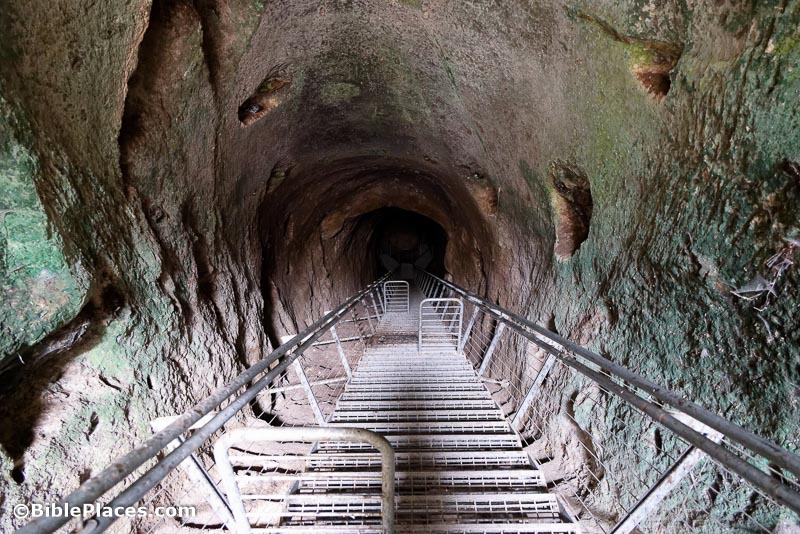
The Times of Israel gives an update on Israel’s decade-long systematic attempt to survey and excavate the caves of the Judean wilderness ahead of looters.

Ruth Schuster writes about a new theory that the Buqeia Valley east of Jerusalem was occupied around the time of King Josiah by quasi-military herders. The article includes some beautiful photos of the area.

Haaretz summarizes a new article that “examines the archaeological and historical evidence for the existence of Jewish gladiators in the first to fourth centuries.”

The latest issue of Biblical Archaeology Review includes articles on Jerusalem’s Millo, Baal, and Constantinople.

Leen Ritmeyer writes about archaeological evidence for Jews in exile in Babylon.

“An ancient Roman statue believed to depict the daughter of the emperor Marcus Aurelius, and valued at $5 million, has been seized by New York officials.”

“A British auctioneer has pleaded guilty to numerous charges relating to the sale of rare ancient coins, including a hoard discovered by Palestinian fishermen.”

The synagogue that housed the Cairo Geniza has been completely renovated.

Chandler Collins has posted part 2 of his historical study of the excavations of the Stepped Stone Structure in Jerusalem.

The Anglo-Israel Archaeological Society has posted some lectures on their new YouTube channel, including:

New release: Excavating the Land of Jesus, by James Riley Strange (Eerdmans, $30). Phillip J. Long has a review here.

HT: Agade, Joseph Lauer, Arne Halbakken, Keith Keyser, Alexander Schick, Alexander Schick
Share:

Four Roman swords were discovered in a cave near En Gedi. Three are spatha swords, and all were likely stolen from Roman soldiers by Jewish rebels during the Bar Kochba revolt.

The swords were discovered incidentally while doing multispectral imaging on a 7th-century BC inscription in the cave. The new reading of the inscription may include the word “salt.”

An Israeli teenager discovered an bronze Roman ring at Sussita/Hippos.

i24News visits the “dig for a day” program in the caves of Bet Guvrin.

The German Protestant Institute for Archaeology will celebrate its 125th anniversary with a conference in Jerusalem on October 16-17.

Jordan Ryan is a guest on The Book and the Spade discussing the 2023 excavation season at Tel Shimron.

Abigail Leavitt shares a number of photos from her walk around the Old City of Jerusalem.

The IBEX program in Israel where I taught for some years is featured in the new issue of The Master’s University Magazine.

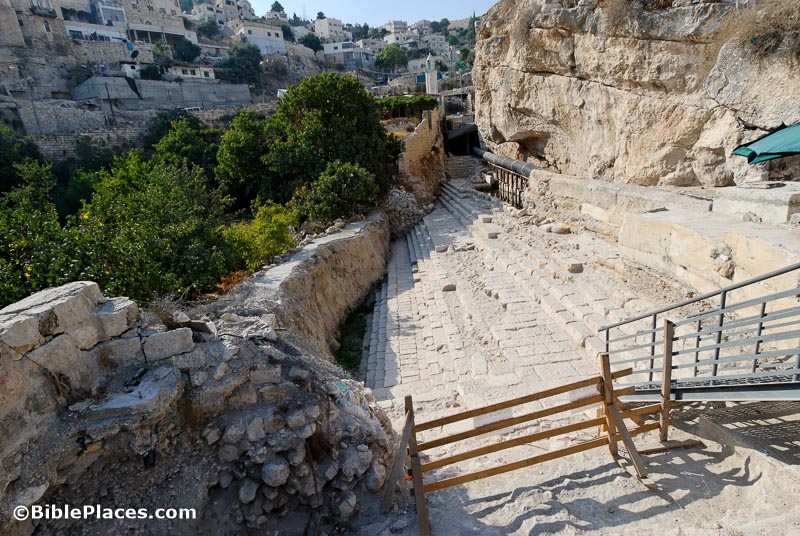
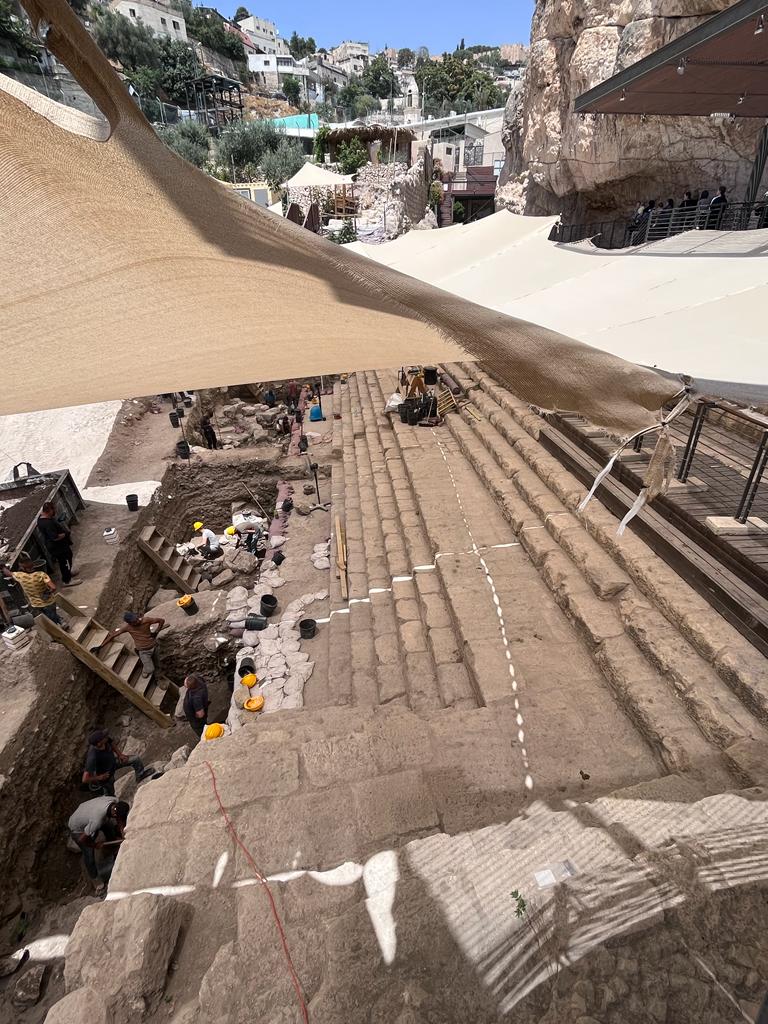
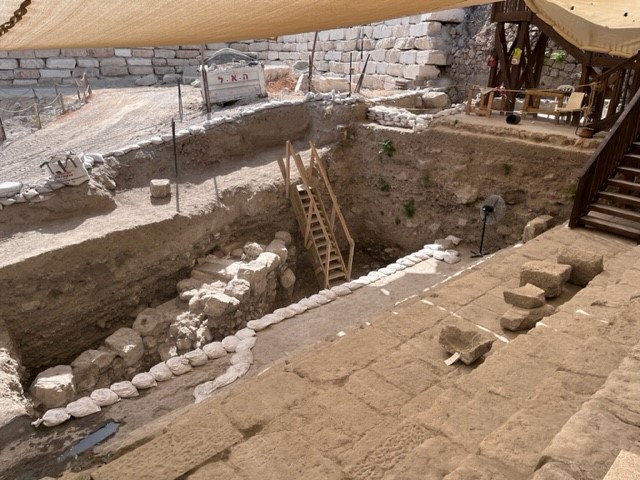
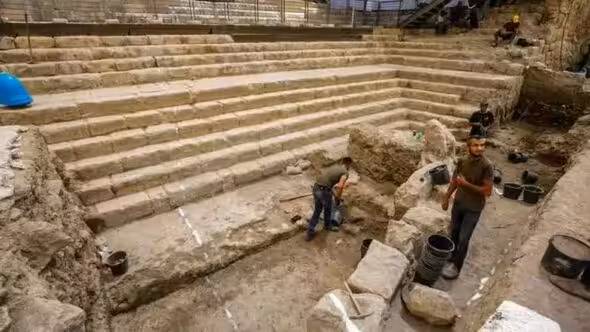
Was a major discovery related to the Pool of Siloam made this week? Some unreliable websites suggest something new was revealed. The regular sources seem to be ignoring it, though The Jerusalem Post has recycled this reporting, with a completely irrelevant photo. When you read beyond the headline, the claim is that eight steps were discovered. A comparison of the published photo with earlier photos suggests that a portion of the lowest flight of steps, previously partially revealed, has now been fully exposed along with a portion of the reservoir and walls within.

Pool of Siloam steps. The wooden boards are located on the second (of three) flight of steps, filling in gaps in preserved stones. Photo published with the news reports this week, courtesy of the City of David Foundation. Comparison with the photos below indicates that this was taken earlier this summer.

Pool of Siloam in 2006, with three flights of stairs. The lowest flight is not fully exposed.

Pool of Siloam last month, showing third flight of steps and on-going excavations in pool below the steps. Some walls appear to be visible within the pool. Photo by John Black.

Pool of Siloam on Wednesday, September 6, showing wall inside the area of the pool. Photo by John Black.

HT: Agade, Joseph Lauer, Arne Halbakken, Alexander Schick, Ted Weis, Gordon Dickson

Share:

Archaeologists working on Mount Zion have discovered, for the first time ever, destruction levels from the Romans and the Babylonians in the same space. Shimon Gibson believes that the evidence from the Persian period suggests that Nehemiah’s wall included not only the City of David but also the Western Hill.

“Ground-penetrating radar is revealing the secrets of a Roman legion camp near Tel Megiddo, including the ancient camp’s amphitheater for combat training.”

Chris McKinny and Joe Uziel write about “The Millo: Jerusalem’s Lost Monument” in the forthcoming issue of Biblical Archaeology Review. They discuss the subject in a video interview with Nathan Steinmeyer.

Bible Archaeology Report has created a list of the top ten discoveries related to the book of Isaiah.

Jerusalem Seminary has been given a grant to provide discounts on tuition for their fall courses. The grant also enables increased scholarships.

Jordan has a severe water crisis.

A rockslide at the waterfall in Nahal David at En Gedi led to the death of an 8-year-old boy and injuries to eight others. The Yonatan Bar David mentioned in the article is from Yad HaShmonah.

Amnon Ben-Tor, the director of excavations at Hazor since 1990, died on Tuesday at the age of 88.

An expanded edition has just been released of Amnon Ben-Tor’s Hazor: Canaanite Metropolis, Israelite City (Israel Exploration Society, 180₪)

Conference on Sept 11-12 at Ariel University: “Boundaries and Influences in the Archeology of Israel and the Eastern Mediterranean”

Ferrell Jenkins shares photos of carob pods like those that were eaten by the prodigal son.

The Bible Mapper Blog is now the Bible Mapper Atlas, with more than 150 maps freely available. You can find lists organized by historical event and by region here.

HT: Agade, Arne Halbakken, John Black, Alexander Schick, Explorator

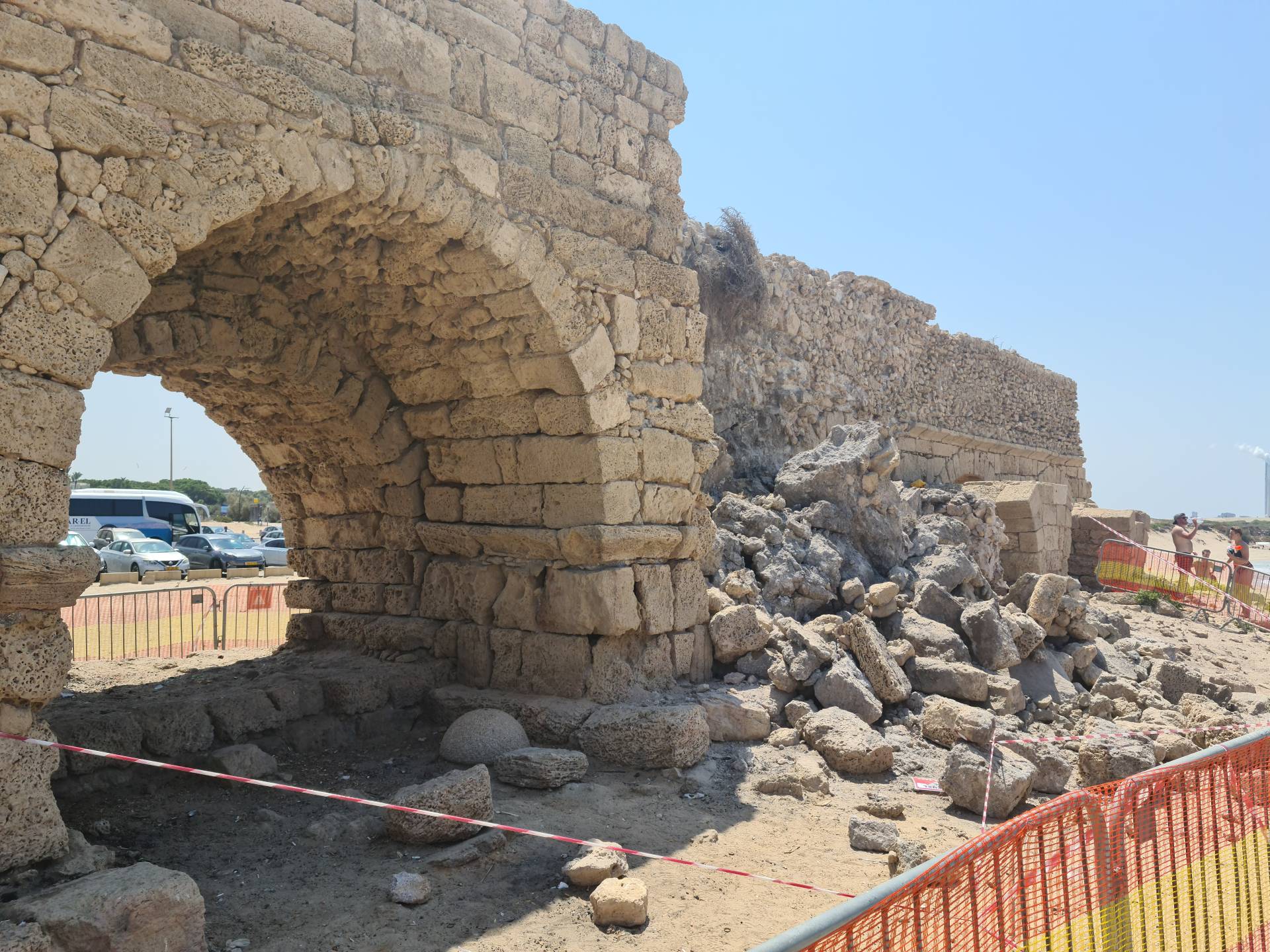
The recently collapsed section of the Roman aqueduct at Caesarea. Photo by Michael Schneider

Share:

Archaeologists discovered an Akkadian tablet from 1800 BC during excavations of a palace in ancient Alalakh in southern Turkey.

Excavations of the tophet in Carthage uncovered “five gold coins from 2,300 years ago, tombstones and several urns with the remains of animals, infants and premature babies.”

Two new fragments of the Fasti Ostienses have been discovered in the Ostia Antica Archaeological Park.”

A 1st-century BC synagogue has been discovered in southwestern Russia. It stood for more than 500 years before it was likely destroyed.

“Coal miners in Serbia have discovered the remains of a large wooden boat likely used by the Romans to supply a nearby city and military headquarters on the empire’s frontier.”

“Once quiet backwater departments of Assyriology (sometimes called Sumerology or Mesopotamian studies) are suddenly hotbeds of innovation” with the help of AI.

“The ‘miracle’ plant Silphium consumed by Ancient Greeks, Romans, and Egyptians, which was thought to have become extinct two thousand years ago, has recently been rediscovered in Turkey by a professor, who thinks he’s found a botanical survivor.”

“The distinctive transdisciplinary approach of the recently established Yale Ancient Pharmacology Program (YAPP) may provide keys to [the] rediscovery” of the use of ancient plants.

Zoom tour on Aug 23: “The First Half of History: A Virtual Tour of the Yale Babylonian Collection,” by Ekhart Frahm and Agnete Lassen ($7)

Zoom lecture on Aug 31: “Who Really Invented the Alphabet?,” by Seth Sanders ($6/12). Season passes for the Friends of ASOR Webinar Series are now available. You can also purchase recordings from previous seasons’ webinars.

“The Corning Museum of Glass is pleased to announce its 61st Annual Seminar on Glass, a two-day program of online sessions that complements the special exhibition Dig Deeper: Discovering an Ancient Glass Workshop.” All are welcome, and there is no charge for the Oct 19-20 event.

New release: Scientific Traditions in the Ancient Mediterranean and Near East, edited by Sofie Schiødt, Amber Jacob and Kim Ryholt (NYU Press, $85)

New release: The Routledge Handbook of Museums, Heritage, and Death, edited by Trish Biers, Katie Stringer Clary (Routledge, $216/$46)

ACOR has signed agreements with the Jordanian Department of Antiquities to restore the Kerak Castle, the Byzantine church in Aqaba, and the Beit Ras Amphitheater.

Geoffrey Lenox-Smith describes what he saw on a tour in a “soft opening” of the Grand Egyptian Museum.

HT: Agade, Gordon Dickson, Al Sandalow, Will Varner, Arne Halbakken, Roger Schmidgall, Keith Keyser, Wayne Stiles, Explorator

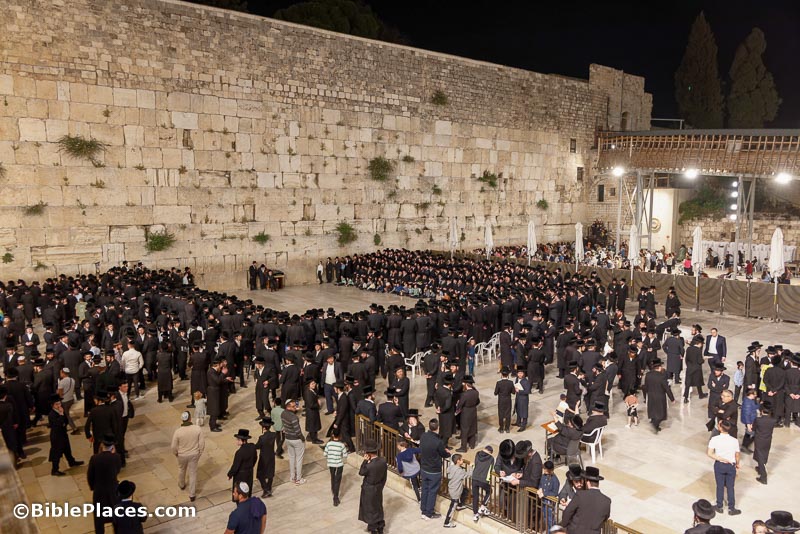
The visit of a rabbi to Jerusalem was met with great excitement by his followers.

Share:

Jerusalem Seminary is going strong, with more classes than ever being offered this fall. This is the first time they’re offering all three levels of Biblical Hebrew as a living language, all taught by believing Israeli teachers. And they have a number of other interesting courses. Here’s a brief rundown, with links for more information.

Biblical Hebrew as a Living Language (Level 1), US time slot taught by two JS Hebrew for the Nations certified Israeli teachers.

Biblical Hebrew as a Living Language (Level 1), Asia/Pacific time slot taught by two JS Hebrew for the Nations certified Israeli teachers.

Biblical Hebrew as a Living Language (Level 2), taught by two JS Hebrew for the Nations certified Israeli teachers.

Biblical Hebrew as a Living Language (Level 3), taught by two JS Hebrew for the Nations certified Israeli teachers.

Life and Land of Yeshua, taught by Gary Alley, MA.

Early Christian Worship in its Jewish Context, taught by Brittany Loewenstein, MM.

Faith, Ministry and Politics in the Middle East, facilitated by Dr. Philip Lanning.

Biblical Hebrew Reading Groups and Tutoring– read Biblical texts together guided by JS Hebrew for the Nations certified Israeli teachers, or sign up for one on one tutoring.

You can find all the details at the Jerusalem Seminary course catalog.

Share:

Recent excavations in front of the edicule in the Church of the Holy Sepulcher revealed the 4th century arrangement of the rotunda.

Chris McKinny gives an overview of the results from Week 2 of excavations at Tel Burna.

Aren Maeir notes that excavations are also currently underway at Tell el-Hesi and Khirbet Summeily.

Archaeologists have invited the local community to help conserve the Middle Bronze gate at Gezer after last year’s fire.

William Hild, a participant in this summer’s excavation at Hyrcania, is guest on The Book and the Spade discussing the project.

Ruth Schuster writes about the treasures that were returned when the Israel Antiquities Authority announced an amnesty campaign. Enjoy the many photos, for you’ll never see these objects again as the IAA protects them in a vast storage center.

Ariel David reports on Garfinkel’s latest claim of Judah’s importance in the 10th century, including criticism from other archaeologists. Melanie Lidman has a similar story.

Tim Chaffey explains how Ernest Martin and Robert Cornuke “avoid key passages of Scripture, distort Josephus’ words, and ignore the findings of archaeologists” in their relocation of Solomon’s temple.

New release: Ancient Synagogues Revealed 1981-2022, edited by Lee I. Levine, Zeev Weiss, and Uzi Leibner (Israel Exploration Society, 300 NIS). You can see all the volumes in the long-running series on the IES website.

Hybrid conference on July 10-13 in Jerusalem: “Jerusalem: From Umbilicus Mundi to the Four Corners of the Earth and Back.” The conference brochure is here. The live broadcast will be here.

Zoom lecture on July 25: “Jesus in Galilee: An Archaeological Perspective,” by Eric Meyers

BBC Reel has released “Armageddon: The ancient city behind the biblical story.”

Chandler Collins considers what may be learned from 19th century travelers’ writings about their first views of Jerusalem.

HT: Agade, Arne Halbakken, Joseph Lauer, Explorator

The latest big hole in the ground opened to visitors is the Gezer water system. The descent gives you a new appreciation for the value of a secure source of water.

Share: