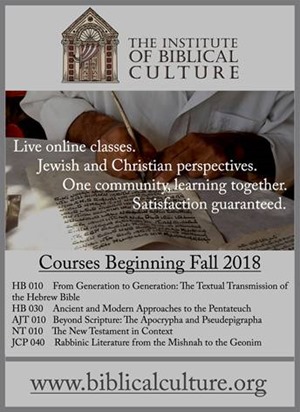
I just noticed that the early-bird discount ends next Wednesday for the Institute of Biblical Context conference in June. If you were thinking about attending, now is the time to secure your spot. I’m looking forward to it, and I hope to meet some of you there, either for the first time or to catch up.

I previously explained why I think this is an outstanding conference, but I’ll note here the theme for each day:

  • Day 1: The Shepherding Context
  • Day 2: Shepherding Stories in the OT
  • Day 3: Shepherding Stories in the Gospels

I predict that many attendees will go away saying, “I’ll never think about sheep and shepherds the same way again!”

Coins from the Jewish Revolt (AD 66-70) were found on March 26 by Dr. Eilat Mazar during renewed excavations at the Ophel.

“Elaborate decorations including stucco from the time of Nero have been found in the remains of a villa and bath complex in the outskirts of Rome.”

The February 2018 edition of the Newsletter of the Egyptian Ministry of Antiquities reports the latest archaeological discoveries, meetings, projects, and more.

A new study suggests that King Tut was not a sickly boy but a warrior king.

The Getty Conservation Institute announced that its restoration of the tomb of King Tut in Egypt is near completion.

The Nicholson Museum in Australia was surprised to discover an Egyptian coffin in their possession for more than a 150 years actually contains a mummy.


The Times of Israel profiles a tattoo parlor in Jerusalem that has been inking Easter pilgrims for centuries.

A schedule for the Haifa Phoenician Series 2018 is now online.

David Laskin attempts to look at ancient Rome through the eyes of Josephus.

The Albright Institute has posted its program for April and May.

Joan Taylor asks what Jesus looked like.

Ferrell Jenkins shares a photo of an unusual sunrise on the Sea of Galilee. Leon Mauldin provides a wrap-up of their trip in Israel and Jordan.

Israel’s Good Name visited Ein Bokek and Ami’az Plateau.

HT: Mike Harney, Ted Weis, Agade, Jared Clark, Joseph Lauer

Seven inscriptions from the Assyrian king Esarhaddon have been found in looter tunnels beneath the tomb of Jonah in Mosul, Iraq.

A rare pair of 2nd AD Roman boxing gloves was unearthed near Hadrian’s Wall in Hexham, England.

Egypt has announced the discovery of a large cemetery near the city of Minya. Photos are here.

“Remains of a 2,600-year-old statue with an inscription written in Egyptian hieroglyphics has been discovered in a temple at Dangeil, an archaeological site along the Nile River in Sudan.”

LiveScience reports on the excavations that have identified a different location for the Plutonium at Hierapolis.

The theater in Perga will be restored with a grant of 3 million Turkish Lira.

The Church of the Holy Sepulcher was closed for several hours today in protest of a new tax plan.

The US Supreme Court has ruled the Oriental Institute at the University of Chicago will be allowed to retain thousands of cuneiform tablets that originate from Iran.

The Minerva Center for the Relations between Israel and Aram is hosting its annual conference on
May 14–17, 2018, in Leipzig, Germany on the theme of “Re-Writing History by Destruction.”

Adriano Orsingher provides a short introduction to tophets on the ASOR Blog.

A conference on “Rethinking Layard 1817-2017” will be held in March in Venice.

BBC and Netflix have created an 8-part series on the Trojan War that is the most expensive drama in
BBC’s history.

HT: Agade, Joseph Lauer, Ted Weis, @go2Carl

A 12-minute video on the discovery of the Isaiah seal impression describes the background and significance of this find. The video includes interviews with Eilat Mazar and Shmuel Ahituv.

Christopher Rollston issues some cautions about identifying that seal impression with the prophet Isaiah. He follows up with more here. Michael Welch goes further and says that the seal belongs to
Isaiah (son of) Nobai or Isaiah the Nobian and not the famous prophet.

Biblical Archaeology Review is honoring its founder Hershel Shanks with a double issue, the table of contents of which is now online.

Mark D. Smith investigates the probability of a body of an criminal executed by Rome being buried.

Wayne Stiles considers the purpose of Jesus’s transfiguration and its significance to us today.

Ferrell Jenkins recalls his own experiences in visiting the Jordan River near Jericho.

How was Jesus heard without a microphone? That’s the topic on this week’s The Land and the Book broadcast with Barry Britnell.

Sharon Herbert will be lecturing at the Albright Institute on March 1  on “New Work on the Sealings and the Archive from Tel Kedesh.”

Now’s a good time to sign up for the summer excavations at Tell es-Safi/Gath.

HT: Agade, Joseph Lauer, Ted Weis

A recent DNA study confirms that the “Screaming Mummy” is the son of Ramses III, and the hanging marks around his neck indicate that he was the conspirator who plotted to murder his father.

Haaretz: “About a dozen life-sized stone sculptures and reliefs of camels have been found in a markedly inhospitable site in northern Saudi Arabia.”

A 2nd-century Roman temple has been discovered in Kom Ombo, Egypt.

Randall Younker will be lecturing on “Ancient Worlds of the Bible” on Feb 23 and 24 in Medford,
Oregon.


The Times of Israel has a short article on a seal depicting Cupid that was discovered in Jerusalem in 2010.

The Albright Institute has a busy schedule of events in February and March.

Luke Chandler notes a new video on the Lachish excavation that includes a number of interviews
with dig volunteers and career archaeologists.

Carl Rasmussen looks more closely at Herod’s Tomb in the Israel Museum.

Israel’s Good Name describes the second day of the Wadi Qilt Tour.

John DeLancey is wrapping up another tour of Israel.

The Book and the Spade is celebrating 35 years of broadcasts, and this week Mark Fairchild is on the program discussing the latest discoveries at Laodicea.

Gordon Govier was on The Eric Metaxas Show yesterday discussing the world of biblical
archaeology.

HT: Agade, Joseph Lauer

Lois Tverberg explains the reading tradition used in the synagogue in ancient times, and she provides a list of the triennial reading schedule used in the 3rd to 7th centuries.

Wayne Stiles’s post on “How to live the impossible Christian life” includes a beautiful photo of the Sea of Galilee.

The Young Archaeologists School in el-Alamein, Egypt, is teaching schoolchildren about the importance of archaeology.

“Why don’t most ancient Near Eastern languages have words for ‘blue,’ ‘yellow,’ or even ‘color’?”

G. M. Grena notes a couple of episodes on the “Excavating the Bible” show that mention LMLK seals.

Chris McKinny is one of the authors of a new article entitled “The Agricultural Landscape of Tel Burna: Ecology and Economy of a Bronze Age/Iron Age Settlement in the Southern Levant.

Aren Maeir has posted the schedule for the annual “Aharoni Day,” this year focused on ancient metallurgy.

In honor of Tu B’Shevat, the Temple Mount Sifting Project shares some of the fascinating story of ancient wooden beams from the Temple Mount.

Israel’s Good Name took a field trip to the IAA Warehouse and to the Rockefeller Museum.