Archaeologists have discovered the Roman theater at the site of Hippos.

Excavations of the Crusader-era Montfort Castle in Galilee have discovered game pieces, belt buckles, pig bones, and much more.

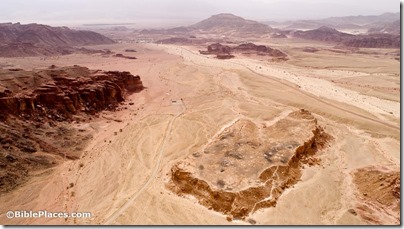
Analysis of organic remains from a 10th B.C. gatehouse complex in the Timna Valley suggests that food and supplies were brought in from a long distance.

Engravings of an ancient menorah and cross were found inside a cave in the Judean Shephelah.

A gang of antiquities thieves was caught illegally digging at a site near the Golani Junction in the Galilee. A 3-minute video (in Hebrew) is online.

What are the origins of tomb raider curses?

Three scientists from Beersheba’s Ben Gurion University have used NASA data to date the “sun standing still” to an eclipse in 1207 BC.

A life-size CAVEkiosk (“cave automated virtual environment”) recently opened at UCSD will allow scholars to study 3-D data from at-risk sites.

The Israel Museum has announced that Eran Neuman will succeed James S. Snyder as director.

Wayne Stiles explains why God made the Israelites rest the land every seven years and what that means today.

Colin Hemer’s The Book of Acts in the Setting of Hellenistic History is available in Logos this month for $1.99.

HT: Agade, Joseph Lauer, Ted Weis

Share:

An ancient Christian “crossword puzzle” has been discovered in the agora of Smyrna.

A sewage system in the Urartian city of Van that dates to 800 BC has been fully excavated.

You missed the first-ever “Swim the Corinth Canal” event, but perhaps you can join next year.

Greece’s National Archaeological Museum is celebrating its 150th anniversary.

At the ASOR Blog, the executive producer of a new documentary about Gertrude Bell provides some background. You can also watch the trailer.

New paper at Academia: “Computer Experiments on the Khirbet Qeiyafa Ostracon,” by Eythan Levy and Frédéric Pluquet.

Nigel Fletcher-Jones considers the ethical problem of the public display of mummies and alternative approaches.

A French-Egyptian citizen turned over a golden mummy mask to the Egyptian government.

The November/December issue of Biblical Archaeology Review is now online.

If you’re a subscriber to the Wall Street Journal, you can read Roger Toll’s “The Real Adventurer’s Guide to the Ancient City of Petra.”

I made it into Wayne Stiles’s post this week about the Dead Sea Scrolls. Check out the great quote by Frederic G. Kenyon.

Shmuel Browns shares a couple of photos he took at Machtesh Qatan.

The extraordinary Bible collection of the late Charles Ryrie is being auctioned off by Sotheby’s.

HT: Charles Savelle, Agade, Joseph Lauer, Ted Weis, Paleojudaica

UPDATE: Next weekend’s roundup will be delayed by several days.

Share:

A couple of Israeli scholars are suggesting that the Hasmonean Hall (aka “Hall of the Freemasons”) in the Western Wall Tunnels may have served as a triclinium for Jerusalem’s city council.

Scientists working in Galilee have discovered caves used by rebels in the Jewish Revolt. For a more academic study, see this journal article.

The eastern temple of Ramses II at Karnak has been opened after restoration.

Excavations at Petra have revealed new information about the water systems that kept the city alive 2,000 years ago.

Municipal workers in Turkey’s Çanakkale province discovered gold jewelry in an 8th century BC sarcophagus.

Russia is sending a team of scientists to investigate World Heritage sites in Syria allegedly destroyed in the civil war.

The Basrah Museum is opening soon in a former palace of Saddam Hussein.

The Archaeological Museum of Kos re-opened up last month after renovation.

A competition is being held for the architectural design of the new Cyprus Museum in Nicosia.

The International Criminal Court in The Hague has ruled that destroying cultural antiquities is a war crime.

Wayne Stiles’s new post on the history and significance of Eilat is filled with lots of photos I really like.

Ferrell Jenkins shares a photo of a beautiful sunrise over the Sea of Galilee.


Haaretz reviews the best of archaeology in Israel this past (Jewish) year.

John S. (Jack) Holladay died last week. He was a long-time professor at the University of Toronto and he was involved in excavations at Gezer and in the Wadi Tumilat Project.

HT: Agade, Charles Savelle, Joseph Lauer

Share:

Digital imaging technology has virtually opened an ancient scroll from En Gedi to reveal the first two chapters of Leviticus. The publication in Science Advances includes a number of photos. Another article published in Textus is also online. The portions deciphered so far exactly match the Masoretic Text, but the radiocarbon date of 3rd-4th centuries AD differs from the paleographer’s date to the 1st or 2nd centuries.

The discovery of a menorah at Abila provides the first evidence of Jewish presence at this city of the Decapolis.

2,000-year-old human skeleton remains have been found buried at sea near a shipwreck at Antikythera, Greece.

A fisherman’s house from the Ottoman period was discovered along the beach in Ashkelon.

Bedouin youths have helped to excavate Byzantine-era farm buildings in the Negev.

A new virtual reality tour in Jerusalem takes “visitors” inside the Temple. There’s a short video clip here.

Archaeologists plan to finish reconstruction work on Laodicea’s Hellenistic theater within three years.

The Malawi Archaeological Museum in Minya was reopened this week after three years of renovation.

Omar Ghul, an epigrapher at Yarmouk University, discusses important inscriptions discovered in Jordan.

Laïla Nehmé is interviewed by Ancient History Etc. about the history of the Nabateans.

Ferrell Jenkins concludes his series on Iznik (Nicea) with a post on the modern city and its vicinity.

Wayne Stiles considers the history and the lessons from Hezekiah’s Tunnel.

Chris McKinny will be lecturing at Texas A&M Corpus Christi on October 3 on the Late Bronze finds from Tel Burna.

On sale for Kindle for $2.99: Do Historical Matters Matter to Faith?, edited by James K. Hoffmeier and Dennis R. Magary. I require several of the chapters for at least one course I teach.

Mordechai Gichon died this week.

Ferrell Jenkins remembers Erle Verdun Leichty on the announcement of his passing.

HT: Joseph Lauer, Agade, Ted Weis, Charles Savelle

Share:

A stone seal discovered this summer at Abel Beth Maacah suggests Israelite presence at the site in the 9th century.

Luke Chandler has collected a number of photos of floor tiles from Herod’s Temple Mount that have been restored by the Temple Mounting Sifting Project. The Jerusalem Post has more details. There are more photos here. A 20-minute video of the press conference is online, with English starting at about 3 minutes.

Archaeologists have uncovered a Byzantine-era stable at Avdat in southern Israel. High school students joined in the sifting of hundreds of buckets of organic material left behind by donkeys, sheep, and goats. Five high-resolution photos are available.

There’s now an island in the Sea of Galilee. It’s near the southern shore and is the result of the low water level. Artillery shells from WWI have also been discovered nearby.

A mosaic from the Huqoq synagogue may depict Alexander the Great meeting the high priest of Jerusalem. Another interpretation is that it shows the battle between Antiochus VII and John Hyrcanus I. The National Geographic article has photos.

Israel’s ancient capital of Samaria has been vandalized. A video in Hebrew shows some of the damage.

Exploring Bible Lands continues its series on “Walking like Jesus” with a photo of a Roman road in Galilee.

Wayne Stiles explores why Kiriath Jearim is ignored, and why it shouldn’t be.

Thursday’s Archaeological Conference in the City of David entitled “Digging for Truth — Jerusalem,
Archaeology & UNESCO” may be watched online. Parts are in Hebrew and other parts in English, with the whole lasting 4.5 hours. The program may be viewed here. The Jerusalem Post reports on the talk by Dore Gold.

Olive pits discovered at Khirbet Qeiyafa receive special attention at a new exhibit at the Bible Lands
Museum Jerusalem.

HT: Joseph Lauer, Charles Savelle, Agade, Ted Weis

Share:

Shmuel Browns reviews the new “Pharaoh in Canaan” exhibit at the Israel Museum and shares many photos.

Carl Rasmussen gives two reasons why he likes to visit Magdala.


Haaretz posts several impressive photos from this year’s celebration of the Samaritan Passover.

Tom Powers visits the Pools of Siloam through photographs of the American Colony. He also suggests (in a comment) that both pools existed from much earlier than the time of Jesus and he proposes distinct purposes for each.

“In an area of Israel that offers fewer attractions to visitors, Tel Arad is like coming upon an oasis of archeology.”

Fifteen years after the excavation of the “Cave of John the Baptist,” Popular Archaeology revisits the site with James Tabor.

Birket Ram is an interesting lake in the Golan Heights. Ferrell Jenkins looks at several historical sources and shares a wide-angle photo.

Leon Mauldin pays tribute to Ferrell Jenkins on his 50th Anniversary Tour.

A slackliner walked from one tower to another in the Tower of David Museum. Video here.

A 23-year-old Israeli hiker fell to his death when climbing in Wadi Rum in Jordan.

An oil deposit has been discovered near the Dead Sea.

The Biblical Museum of Natural History opened in Beit Shemesh in 2014.

It’s time to stop referring to the urban legend about NASA discovering Joshua’s long day.

Emek Shaveh has petitioned Israel’s Supreme Court to halt the transfer of the library and artifacts from the Rockefeller Museum to west Jerusalem. The Israel Antiquities Authority has responded that they’re only moving the library to protect fragile books.

Archaeology of Jordan Online went live this week. They provide a lot of great links (but don’t yet list our photo collection).

The latest edition of The Holy Land Magazine is online and features articles on Magdala, Shiloh, Tiberias, and Neot Kedumim


Revue de Qumrân is finally available on JSTOR.

HT: Joseph Lauer, Agade, Charles Savelle, Paleojudaica

Share: